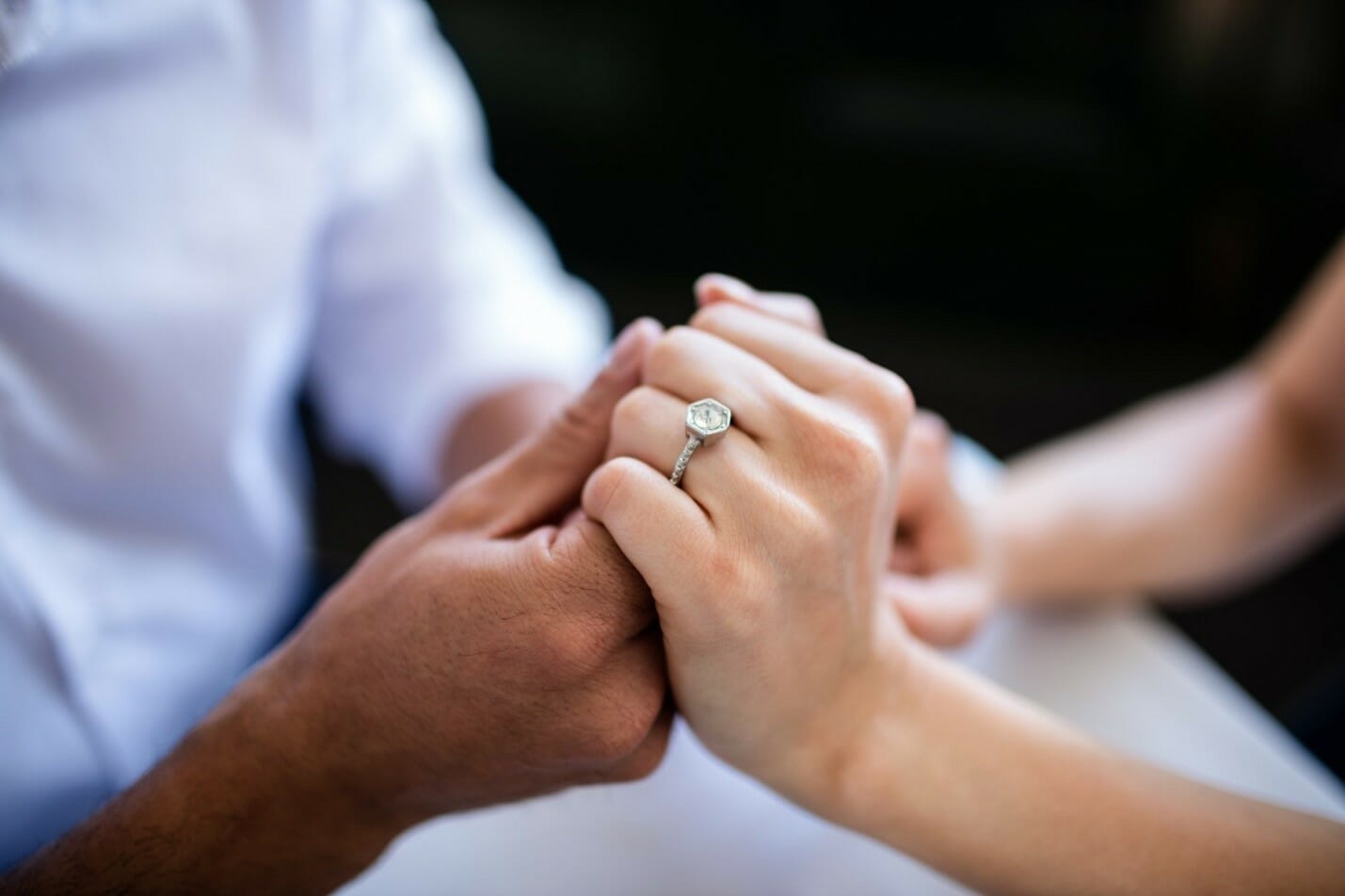
The traditional model goes like this: one person secretly selects a ring, gets down on one knee, and the other person says yes to both the relationship and the jewelry simultaneously. It’s cinematic. It’s also, increasingly, not how people are actually doing it.
The question of when to buy the ring, and who should be involved, has quietly become one of the more contested conversations in modern wedding culture. And the answer matters more than most people realize, for reasons that go beyond romance.
In this article:
- The Case for Buying Before
- The Case for Buying After
- The Proposal Ring Option
- What This Means for Your Budget
- How to Decide What’s Right for You
The Case for Buying Before
The surprise proposal has a certain mythology around it that the jewelry industry has worked very hard to maintain. And there are genuine arguments for it.
Selecting a ring independently forces you to pay close attention. If you’ve been listening, you already know whether your partner leans toward yellow gold or white metal, whether they wear delicate jewelry or substantial pieces, whether they’d be drawn to a round solitaire or something more architectural. The ring becomes evidence of that attention. When it lands right, it means something.
There’s also the practical reality that a surprise proposal has a specific emotional weight that a joint shopping trip doesn’t replicate. For some couples, that moment is worth optimizing for.
The risk is obvious. You might get it wrong. Not just the size, which is fixable, but the style, which is harder to undo gracefully. A ring that sits in a box unworn because it doesn’t suit the person wearing it is a quiet but recurring source of friction. The jewelry industry’s return and exchange policies exist precisely because this happens often enough to require a solution.
The decision-helper question: Do you know, with genuine confidence, what they would choose for themselves? Not what you think looks beautiful. What they would choose.
The Case for Buying After
Joint ring selection has shed most of its stigma. What once felt unromantic now reads as considered. The generation getting engaged in 2026 largely grew up watching their parents navigate marriages that didn’t always account for both people’s preferences, and they’ve drawn conclusions from that.
The practical advantages are real:
- You get exactly what you want
- Sizing is precise from the start
- The metal, setting, and stone reflect the person who will actually wear the ring
- No returns, no awkward conversations, no ring that spends more time in a drawer than on a hand
For couples who have already discussed marriage openly, which is most couples by the time a proposal actually happens, joint selection doesn’t diminish the moment. The proposal is still a proposal. The ring is just chosen by the right person.
The more interesting shift is that some couples are now treating the ring selection as its own event. A dedicated shopping experience, sometimes involving a custom design process, that becomes a memory in its own right rather than a logistics task.
DEEPER DIVE: Arizona races to reskill workforce before wave of 700,000 new jobs hits
INDUSTRY INSIGHTS: Want more news like this? Get our free newsletter here
The Proposal Ring Option
A third path has emerged that sidesteps the binary entirely: propose with a placeholder.
This is more common than most people admit. A simple band, a family heirloom, a deliberate stand-in that marks the moment without locking in a permanent jewelry decision. The couple then selects the engagement ring together after the proposal.
The objection is usually sentimental. The iconic image of the ring in the box is culturally powerful. But the counterargument is that the proposal moment is about the question, not the object. A placeholder handled with genuine intention can carry as much emotional weight as a chosen ring, sometimes more because of the transparency it signals.
If you go this route, be explicit about it. Frame it in the proposal itself. “I want us to choose this together” lands very differently from “I ran out of time to buy a ring.”
What This Means for Your Budget
The timing of your ring purchase has a direct effect on what you can spend, and how.
Buying before the proposal means the purchase is yours alone, made without full visibility into the other person’s expectations. This creates pressure to either overspend defensively or make assumptions about budget alignment that may not hold.
Buying together removes that pressure entirely. You can have the actual conversation about what you want to spend, what you want to get, and what tradeoffs make sense.
Lab-grown diamonds have made this conversation more interesting because the budget dynamics are genuinely different. A stone that would cost significantly more in a traditional retail setting can often be matched in quality at a meaningfully lower price through factory-direct brands that skip the wholesale and retail markup layers.
Brands operating in this space, including those focused on fine diamond jewelry with direct production models, have changed what a given budget can achieve. A couple shopping together who understands this can get substantially more stone for their money than one person shopping alone under deadline pressure.
For buyers new to this space, lab-grown engagement rings from factory-direct brands like Leonids Jewelry are worth comparing directly against traditional retail options before any decision is made. The specification transparency alone, full IGI or GIA grading details published upfront, makes it easier to evaluate whether you’re getting equivalent quality at a different price point.
How to Decide What’s Right for You
There is no universally correct answer. But there are better and worse ways to arrive at your own. Ask yourself:
- Do you know your partner’s aesthetic with enough precision to make a jewelry decision that will hold up over decades of daily wear? If yes, the surprise proposal with a pre-selected ring is a viable path. If you’re uncertain, joint selection protects both of you.
- Have you had an honest conversation about marriage? If the proposal is genuinely a surprise in every sense, buying before makes the moment. If you’ve already discussed it openly, the ring selection can be shared without losing anything.
- Is the visual of the ring-in-the-box important to your partner? Some people have held that image in their minds for a long time. Others have no particular attachment to it. Know which one you’re dealing with.
- What does your budget look like honestly? A rushed, solo purchase under pressure is one of the most common ways couples overpay for rings that don’t fully suit the person wearing them. Removing that pressure, either by shopping together or by using the proposal ring approach, tends to produce better decisions.
The ring is the beginning of a much longer story. How you choose it is the first chapter. Make it one that fits the relationship, not just the moment.