Here’s the short answer to what makes a carry-on work from airport to boardroom. It fits the airline you’re actually flying. You can still lift it once it’s full. It rolls without a fight, lets you reach your laptop and documents when you need them, and gets a jacket to the meeting looking like a jacket. And it doesn’t look out of place in a client’s lobby.
That’s the whole brief. One-bag business travel isn’t a minimalism contest. It’s a workflow: fewer pieces to manage and fewer handoffs where something can go sideways between the curb and the conference room.
What Does One-Bag Business Travel Actually Mean?
It is to make the trip based on cabin luggage rather than checked luggage. This can vary by airline and type of fare purchased.
Some travelers read “one bag” literally. Others mean one suitcase plus a work bag. Both are legitimate setups, and neither one is the purist’s version.
Carry-On vs Personal Item
A carry-on bag is usually kept in the overhead bin. A personal item (briefcase, tote, small backpack or handbag) is intended to fit under the seat in front of you. This is the overall division. Each airline determines the exact sizes and the number of pieces of luggage you receive, and some airlines even have it vary based on the ticket price.
Can a backpack and carry-on be brought? Yes often, if the backpack is your personal item on this ticket. Two backpacks or a handbag on top of two other bags? It’s the carrier’s decision, not a rule. Some basic fares include only the personal item.
One Physical Bag vs One Carry-On System
One physical bag. You have one thing to watch, lift and roll. The catch is access: if the laptop lives inside the suitcase, you’re opening it at security and again at the gate.
Carry-on plus personal items. Clothes stay shut in the overhead bin while the laptop, charger and passport sit at your feet. The catch is two pieces to manage, and the setup only works when your fare allows the second one.
Airline Fit Comes Before Boardroom Style
The operating carrier’s current size, weight and item-count rules decide it, not the label on the box.
The FAA states that most airlines will only allow a maximum of 45 linear inches (height by width by depth), and it advises passengers to verify with their airline as some are more restrictive. Pay attention to the word “most”. When a bag sails through on Monday, it gets tagged to the hold on Wednesday on regional jets, codeshares and international connections.
One thing you should do: Research the actual airline that flies each leg of the trip, not the airline that sold you the ticket.
What Qualifies as a Carry-On?
In practical terms, a bag qualifies when the airline allows it into the cabin on that flight and it fits that airline’s limits. TSA screens what’s inside the bag. It doesn’t set carry-on dimensions; the airline does.
What If the Bag Is 1 Inch Too Big?
It may not fit the sizer, and you may be told to check it, sometimes with a fee. Some agents wave bags through and others don’t, so tolerance isn’t a plan. It’s also worth clearing up one popular search: there is no single set of “new 2026 carry-on rules” that covers every airline. Rules shift carrier by carrier, so recheck before each trip.
Access Strategy: Front Pocket vs Separate Work Bag
You’ll need your laptop, charger, passport and documents in a hurry at least a few times per trip. That access doesn’t have to come from the suitcase itself.
| Setup | What it does well | What it costs you |
| Front-access carry-on | Laptop and papers stay with the suitcase. One fewer piece to track | The front compartment takes packing space and adds another zipper |
| Closed-shell carry-on + personal item | Work tech rides under the seat, within reach. The clothing case stays closed | Only works as a two-piece system when the airline and fare allow the personal item |
| Single closed-shell bag | Simplest piece count and a clean exterior | The least convenient option if you pull out the laptop mid-trip |
Be honest about how often you open the laptop between your front door and the hotel. If the answer is “at security and twice at the gate,” a front pocket or an under-seat bag will save a lot of fumbling. If it stays shut until the meeting, a closed shell with a slim work bag is the tidier setup.
Then plan for the one thing nobody likes to plan for: the gate check. On a full flight, a carry-on can end up in the hold even when it’s within limits. Keep the laptop, medication, chargers and anything you need for a 9 a.m. meeting somewhere you can pull out in ten seconds.
Clothing That Can Go From Cabin to Meeting
One-bag packing works best with a small wardrobe where everything goes with everything, packed so the pieces aren’t crushed.
Build a Meeting-Ready Capsule
Pick a tight color palette. Plan on a couple of tops that work with one pair of trousers or a skirt, one main business shoe, a layer for an overcooled conference room, and very little “just in case.” Wear the bulkiest item on the plane. (Flying into Phoenix in July, that probably isn’t a wool coat.)
Garment Protection vs Maximum Capacity
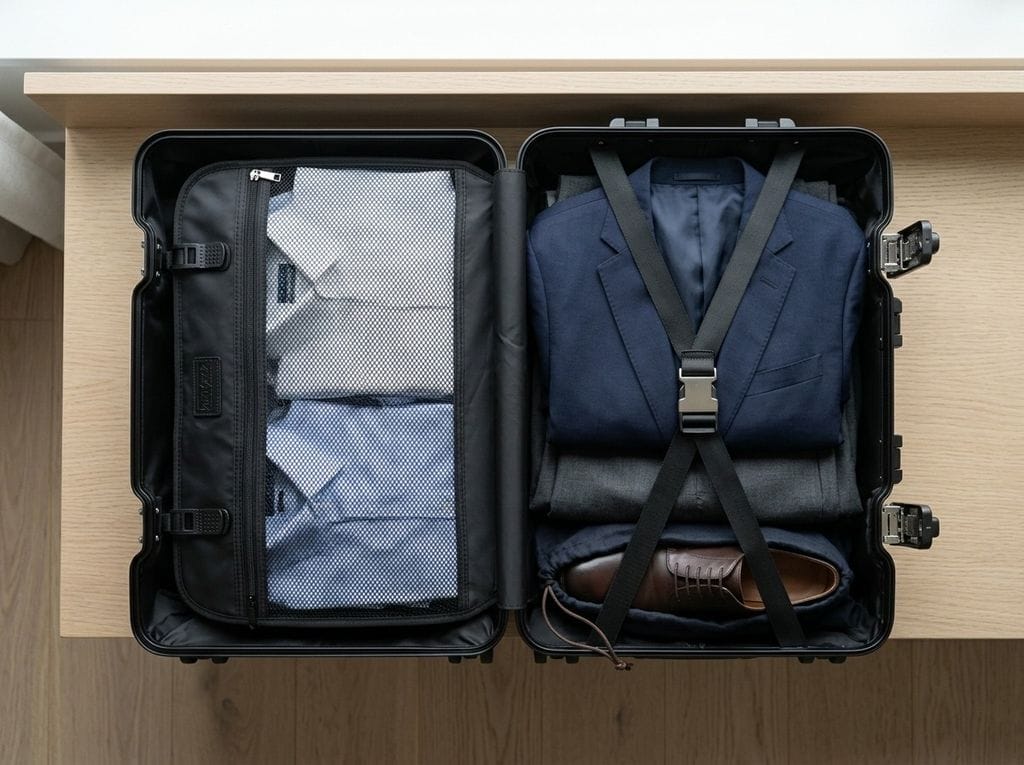
Capacity and clothing care pull in opposite directions. Pack a case to its absolute limit and structured pieces get pressed into shapes they weren’t cut for. Lay jackets and trousers on the flattest panel, use dividers or straps to hold them still rather than squash them, and bag your shoes away from shirts. Hang everything up when you arrive. None of this guarantees zero wrinkles, but it improves the odds.
Empty Weight vs Useful Capacity
Useful capacity is what you can pack while staying inside the airline’s size and weight rules. It isn’t the biggest liter figure on a product page.
The math is simple: the published cabin weight allowance minus the empty suitcase weight gives you roughly what’s left for your things. Where a carrier publishes and enforces a cabin weight limit, that subtraction decides how much you can bring.
Take one example. MVST’s current TREVA carry-on specifications list the TREVA Carry-On at 21.7 × 14.8 × 8.7 inches including wheels, 34 L and 9.37 lb. That 14.8-inch width is worth flagging: on a carrier that enforces a 14-inch maximum width, it’s over on paper, and its 45.2 linear inches sit just above the FAA’s 45-inch guide.
Liters don’t translate neatly into outfits, either. Brands measure capacity in different ways, so 34 L in one case and 36 L in another aren’t a like-for-like comparison.
Aluminum vs Polycarbonate for One-Bag Business Travel
Neither material wins across the board. They weigh, wear and open differently, and those differences matter more than which one sounds tougher.
| Full aluminum | Polycarbonate hardside | |
| Shell behavior | Rigid metal shell. Can dent and scratch | Rigid shell with some flex. Tends to scuff |
| Empty weight | Often heavier in a comparable carry-on size | Often lighter, depending on the model |
| Closure | Usually a framed, latch-closing design | Often zippered; some latch hybrids exist |
| Outside access | Usually limited or none | Front-pocket designs are available |
| How it ages | Visible travel marks build a patina | Varies widely by finish and color |
| Suits someone who wants | Structured metal build and a fixed shape | Lower base weight or a front pocket |
Aluminum dents and scuffs. Some owners like how that ages; others can’t stand it. Polycarbonate flexes and shows scuffs instead of dents. The shell material alone tells you less about a suitcase than its wheels, handle, frame and interior do.
Wheels, Handles and the Airport-to-Meeting Transition
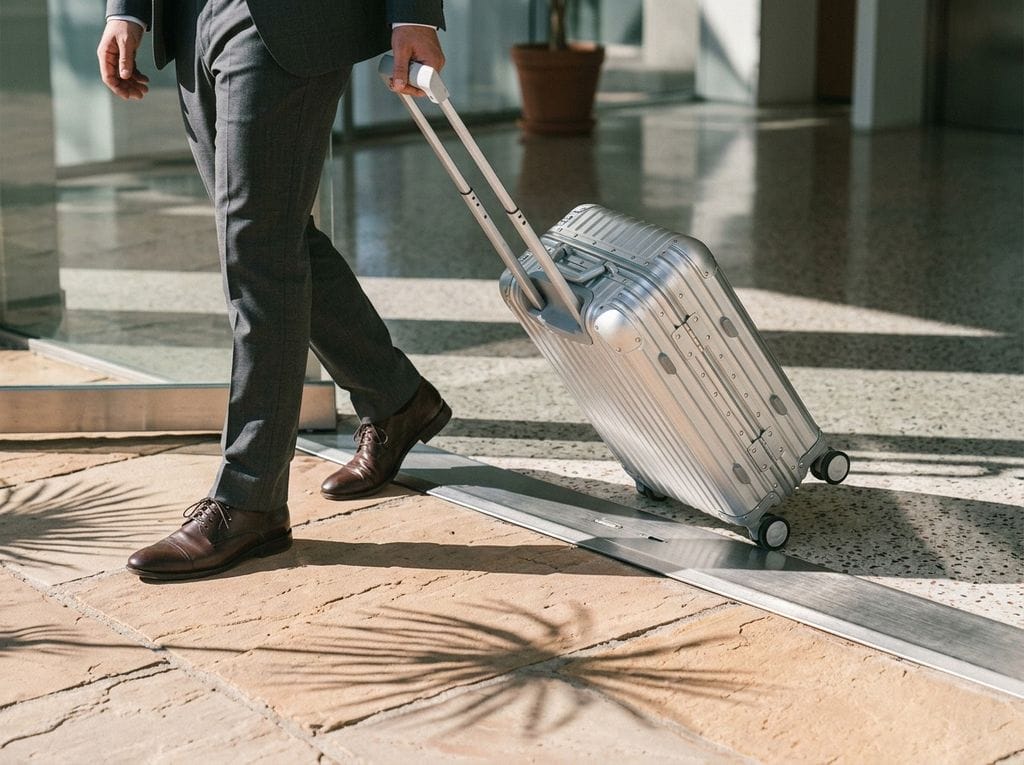
The wheels and handles work across terminal floors, curbs, rideshare trunks, hotel corridors and office lobbies. They deserve as much scrutiny as the shell.
Wheels Under a Real Load
Test the case packed, not empty. Roll it over tile, carpet and a door threshold, then take a tight turn around a column. You want straight tracking, even rotation and wheel housings that don’t rattle.
Telescoping and Carry Handles
Does the handle sit at a comfortable height for you? Does it lock firmly at each stop? Can you grab the top or side handle easily when the bag is up in the bin? MVST lists RIVA™ tri-bearing wheels, a multi-stage aluminum telescoping handle and slow-release carry handles on TREVA, and Monos lists four handle heights on the Carry-On Pro. Spec sheets tell you what’s there. Rolling it tells you how it feels.
Zipperless vs Zippered Carry-Ons
Closure style changes how a bag packs and opens more than it changes how secure it is.
A zipperless, framed case closes with latches and keeps a fixed shape. It won’t expand, and there’s usually no outside pocket. A zippered case is often lighter, may expand, and can carry a front compartment. TREVA uses a zipperless frame with integrated combination locks, according to MVST’s product page, while the Monos Carry-On Pro uses zippers and a front pocket.
Built-in locks labeled TSA-approved or TSA-accepted are designed so security officers can open them for inspection. That makes screening easier. It doesn’t make a bag theft-proof.
Three Carry-On Architectures for Business Travelers
These three aren’t ranked. Each one shows a different way to set up a one-bag work trip, with details as each brand published them on 30 September 2026.
| MVST TREVA Carry-On | RIMOWA Original Cabin | Monos Carry-On Pro | |
| Build | 5083-O aluminum; zipperless frame | Anodized aluminum | Polycarbonate; zippered with front pocket |
| Exterior | 21.7 × 14.8 × 8.7 in, incl. wheels | 55 × 40 × 23 cm (about 21.7 × 15.7 × 9.1 in) | 22 × 14 × 9 in, incl. wheels and fixed handles |
| Capacity / weight | 34 L / 9.37 lb | 35 L / 4.3 kg (about 9.5 lb) | 36 L / 7.8 lb |
| Workflow it shows | Full-aluminum closed shell, paired with a separate work bag | Heritage aluminum with divider-based organization | Lighter case with a front laptop compartment (up to 16 in) |
| Trade-off | Heavier than many polycarbonate cases; 14.8 in width can exceed a 14 in limit; shows wear | Wider and deeper than some carrier limits; premium price | Front pocket uses interior space; different closure |
A full-aluminum, closed-shell case suits someone who packs to a fixed shape and keeps work tech in a separate bag. For that setup, the TREVA collection at mvstselect.com/collections/treva is one example to run through the checks above, alongside the RIMOWA Original Cabin, long the reference point for grooved aluminum. If you’d rather carry less weight and pull a laptop out of the front of the suitcase, the Monos Carry-On Pro is designed around that routine.
Whichever way you lean, judge it on the same list: airline fit, empty weight, wheels and handle, access and how your clothes arrive.
The One-Bag Business Travel Preflight Check
Before you leave home, check the packed system rather than trusting the luggage label.
- Look up the operating carrier’s current cabin-bag and personal-item rules for every segment.
- Measure the packed case, wheels, fixed handles and any expanded section included.
- Weigh it if the carrier publishes a cabin weight limit.
- Make sure the laptop, documents and medication come out fast if the case gets gate-checked.
- Check anything unusual in TSA’s What Can I Bring? tool.
- Pack liquids to the 3-1-1 liquids rule for US screening, and check local rules abroad.
- Close the bag normally. Don’t force a zipper or a latch to squeeze in more.
Conclusion
The right one-bag system is the one that fits the airline you fly, is not too heavy with your work, clothes, and other items, and operates in a consistent manner through each handoff, while conforming to how you actually access your items when you are travelling. Plan your route, fare, tech and dress beforehand. Next, choose the design that will suit them best, such as a closed aluminum shell with a work bag or a more lightweight design with a front pocket to store the bag.
FAQs
What qualifies as a carry-on?
A bag is a carry-on if it is accepted by the airline for the flight and meets the airline’s size, weight and item-count requirements. Those limits, however, are based on carrier, aircraft and sometimes fare, with the same bag being accepted on one flight and not on another.
What does “carry-on” mean at an airport?
It’s the items that the airline will allow you to carry in the cabin, typically in the overhead locker. It is still subject to security screening and the size of it, as well as whether it will be permitted on your flight, is determined by the airline’s own regulations.
Can I bring a backpack and a carry-on?
Yes, often, if it is in your personal item compartment and fits under the seat. Some basic fares will only permit the personal item, however, size restrictions apply. This is determined by your airline and fare type.
Can I bring three bags as carry-on?
Typically, no. Airlines usually have a limit of one carry-on and one personal item, so check your airline’s policy.
Is a handbag classed as hand luggage?
It can be. A lot of airlines consider a handbag your personal item, others consider it as part of your cabin space if it’s large or you have two handbags. The size limit is determined by the airline and fare.
What is forbidden in carry-on luggage?
Some will not be allowed, some will be in checked bags and some will be allowed in restricted quantities. If you are traveling from a U.S. airport, check the item on TSA’s What Can I Bring? tool. In other countries look at the local security authority and your airline.
What happens if my carry-on is 1 inch too big?
It might not fit the airline’s sizer, and you may be required to check it—this could cost you money. It depends on the individual flight and the safest option is to purchase and pack within the published limit.
Do airlines actually check carry-on size?
Yes they can enforce their stated limits at check-in or gate. How often and how strictly depends on the carrier, the airport, the aircraft and how full the flight is.
Aluminum vs polycarbonate: which works better for one-bag business travel?
Neither wins every time. Aluminum is rigid, often heavier and dents with use.
Sources
- Federal Aviation Administration, Carry-On Baggage Tips. Most airlines’ 45-linear-inch maximum, stricter airline rules, and checking with the airline before packing. Accessed 30 September 2026.
- Transportation Security Administration, TSA Travel Tips. US screening basics, including the 3-1-1 liquids rule. Accessed 30 September 2026.
- Transportation Security Administration, What Can I Bring? Item-by-item carry-on and checked-bag guidance for US screening. Accessed 30 September 2026.
- Federal Trade Commission, Native Advertising: A Guide for Businesses. Clear, prominent disclosure for sponsored and partner content. Accessed 30 September 2026.