The “Yellowstone” franchise may have turned Montana into a national obsession — more than 12 million viewers tuned in for the season‑five premiere — but the state’s real drama doesn’t live on television. Under that enormous, almost impossibly blue sky, Montana is quieter, wilder and far stranger than anything the Duttons could script — and it’s more than ranches.
Beyond the show’s dusty ranch roads lie huckleberries (huckleberries and more huckleberries), alpacas, art‑driven mountain towns, stalactites and stalagmites, and steakhouses for miles.
Bozeman Yellowstone International Airport immediately sets the tone. Feeling more like a lodge than a terminal, the airport emits ranch vibes with its wood trim and glowing fireplace. The décor is Montana’s way of saying, “It’s time to ditch the laptop and slow down.”
THINGS TO DO: Arizona’s best experiences, voted by readers
Stay
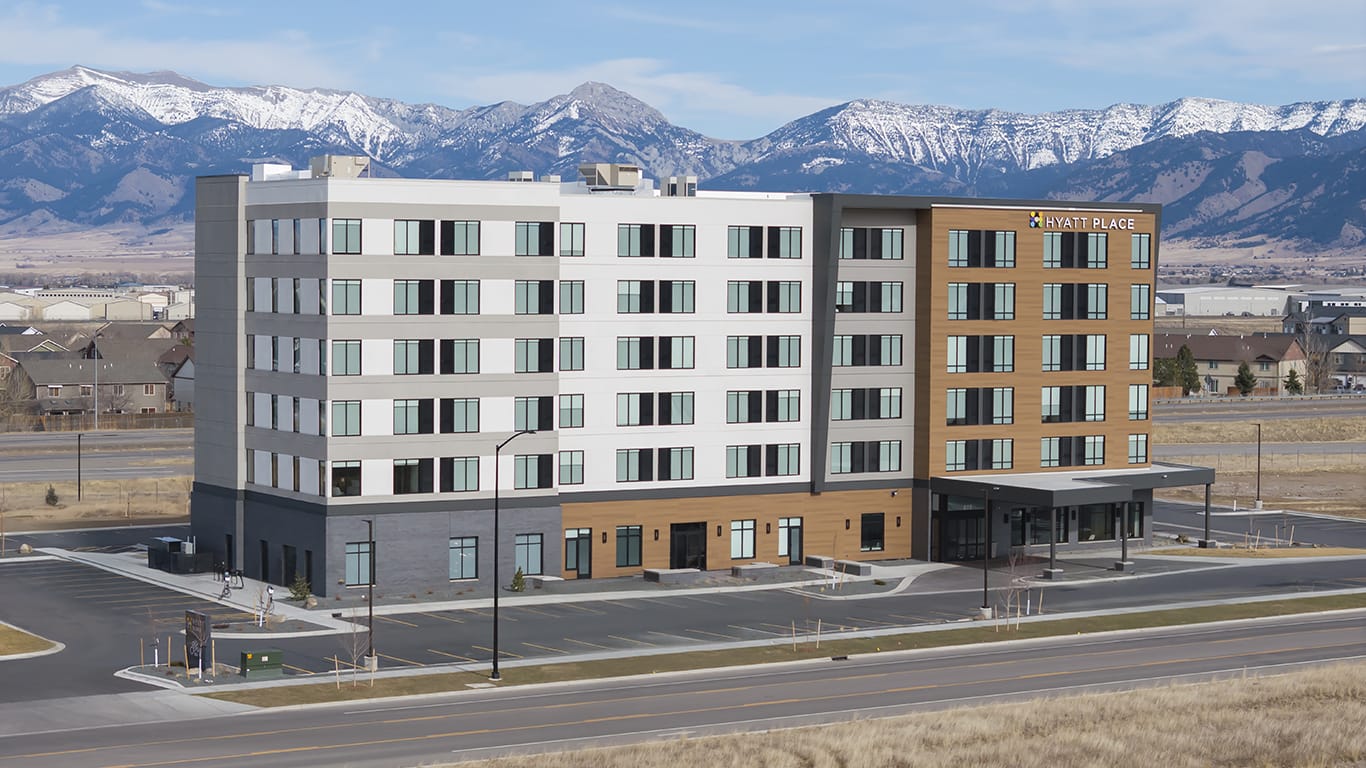
That warmth continues at Hyatt Place Bozeman Yellowstone Airport, a 5‑month‑old property about 10 minutes from its namesake. The front desk team runs the place with calm, unhurried efficiency — including agent Newt Nienhuis, who greets guests, genuinely interested in their day and their souvenirs.
Hyatt Place Bozeman Yellowstone Airport stands out from other properties in its chain. Two miles from the airport, the noise is muted, even with ceiling-to-floor windows in select rooms. The Hyatt Place is the only elevated hotel and food-and-beverage provider near the airport.
The newly built rooms are pristine and welcoming, starting with the wood flooring and cozy sleeper sofa. The spacious suites have large windows with 360-degree mountain views. A large kitchenette with a food-prep island table with a microwave — finally, somewhere to conveniently heat restaurant leftovers — sink, refrigerator and dishwasher.
Even the one-bedroom suites have actual breathing room.
The bed runs firm‑but‑comfortable, the blackout curtains actually work, and the bathroom has enough counter space to make getting ready feel civilized. Most importantly, the Hyatt Place Bozeman Yellowstone Airport is quiet.
Speaking of F&B, Hyatt Place’s restaurant, The Story Social, replaces The Placery, the standard at its other hotels. The eatery reads like a book with three chapters: a warm dining room arranged around a fireplace; a bar with just enough energy; and an outdoor patio that faces Big Sky country.
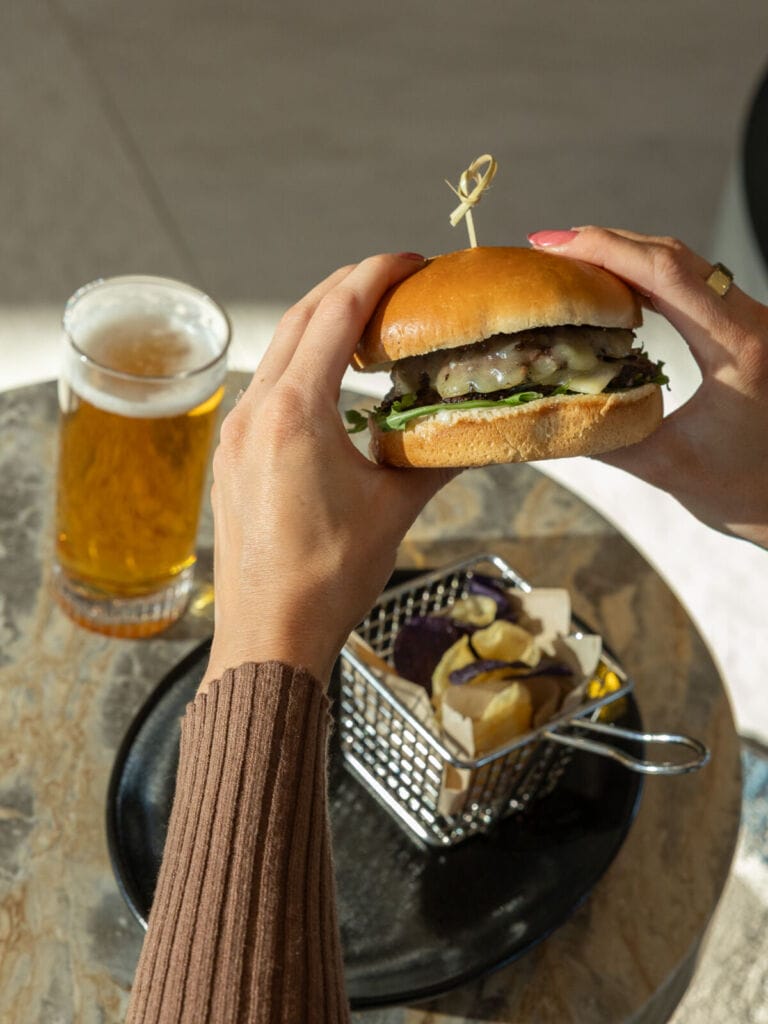
Breakfast is the quiet standout: warm eggs, seasoned homey potatoes, and waffles with the right amount of crisp. Evenings lean toward — once again — comfort with Montana chili, a blend of smoky beef, beans, roasted peppers, jalapeno, cilantro and shredded cheese ($12); and a juicy, flavorful bison burger, with melted white cheddar, bacon-onion jam, arugula and roasted garlic aioli, between a brioche bun ($22). The bar stays lively enough to feel social but never frantic.
The flatbreads are stacked with creativity: elk sausage with roasted tomato, cherry pepper, arugula, roasted garlic and mozzarella and parmesan cheese ($16); and burnt ends piled high with pickled onion, jalapeno, cilantro, cheese and spicy huckleberry barbecue sauce ($15).
Managed by Concord Hospitality, Hyatt Place serves the stream of early‑morning arrivals into Bozeman International Yellowstone Airport, a base for anyone planning the drive toward Big Sky — at least when the weather cooperates. When a storm rolls in, the hotel becomes less a waypoint and more a shelter: warm, close, and built for waiting out Montana’s mood swings.
Hotel Instagram: instagram.com/hyattplace_bozeman
Hotel Facebook: facebook.com/hyattplacebozeman
Eat
Charming Downtown Bozeman boasts polished dining and Western comfort. This is where the huckleberries come in. Stores sell huckleberry jam, honey, pies, barbecue sauce, moisturizing cream, lip balm, ice cream and candy. At J.W. Heist Steakhouse, dinner ends with a baked Alaska flambé — a mountain of huckleberry, pistachio and flaming kirsch. Down the street, Olivelle stocks Naked Mixers’ wild huckleberry lemon drop and huckleberry ginger mule mixers. The real winner here is the strawberry lemonade white barrel-aged balsamic.
A few huckleberry facts: They’re not commercially farmed. They’re hand‑picked in the wild, usually on north‑facing slopes above 5,000 feet. They ripen from June through August. And yes — grizzly bears love them. Just an FYI.
But Montana’s flavors stretch far beyond the berry.
In the heart of Downtown Bozeman, J.W. Heist Steakhouse leans modern, with a subtly smoked loaded baked potato ($13); roasted black cod with sherry mushroom cream, mustard haricot vert and crispy pancetta ($46). The state’s farming industry is celebrated with the 48-ounce Montana-raised tomahawk for two ($190).
The prime rib special is thick, slow‑roasted and tender.
Co-founded by CNN brainchild Ted Turner, Ted’s Montana Grill is an anchor for comfort and culture. As cliché as it sounds, Ted’s Montana Grill has something for everyone: starters (warning: the homemade chips are addictive), salads, burgers, poultry, seafood, bison, steaks, kids’ meals and gluten-free dishes.
Bison and huckleberries are pretty much on brand. Ted’s Montana Grill’s menu is bison-heavy, as Turner and his partner, George W. McKerrow, reintroduced the protein-rich, nutrient-dense meat to the market. The bison French dip special — lean, flavorful bison shaved thin, piled high, served with jus — was a bit chewy. Outside of the special, bison is served as a meatloaf sandwich or plated, brisket and short ribs. The grilled herb chicken is deceptively simple, well‑seasoned, and paired with hot, crisp sides.
Play
Lewis & Clark Caverns State Park
Lewis & Clark Caverns State Park’s Paradise Tour begins high on Cave Mountain, 1,200 to 1,400 feet above the Jefferson River. The overlook bursts with deep‑green Douglas fir, sage‑toned Rocky Mountain juniper, and pale limber pine twisting across the slopes. Snow-capped mountains peek through the blue sky.
Lillie Giono, a fourth‑generation ranger, leads the tour, stressing to guests that they cannot touch the stalactites and stalagmites. (Yes, they’re real; not just a prop in “A Year Without a Santa Claus.”) The ecosystem is fragile; human contact can undo thousands of years of growth. Fun fact: To remember the difference, stalactites hang “tight” to the ceiling, while stalagmites push up with all of their “might.” (Stalagmites also has a “g” for ground.)
The caverns’ entrance uses an airlock system to maintain the climate inside, which is around 48 degrees year‑round. Before Teddy Roosevelt named the caverns, Native tribes called the mountain “Smoke Mountain” for the winter steam that rose from its vents.
The cavern is chilly, so bring a light jacket, and expect a 10- to 15-minute hike to and from the entrance. Be careful in the cave, the steps are slippery when wet.
Yellowstone National Park’s West Entrance
Yellowstone National Park’s West Entrance sits about 90 minutes from the Hyatt Place Bozeman Yellowstone Airport along U.S. Highway 191, which is essentially a Montana-Wyoming highlight reel. Bison graze on the horizon — yet close enough for clean iPhone shots, while bighorn sheep linger on the shoulder.
Steam vents rise from roadside basins, building anticipation for Old Faithful. (The $35 West Entrance fee covers Old Faithful.)
Old Faithful doesn’t rush for anyone. Rangers post a predicted eruption time, but it’s only an estimate; Old Faithful can show up 10 minutes early or 10 minutes late.
Crowds gather on the boardwalk, checking watches and weather apps, and FaceTiming family. Smart-mouthed Aussies crack NSFW jokes about, let’s just say, the build-up to Old Faithful. Planned for 12:10 p.m., Old Faithful wasn’t “faithful” to the clock. Ten minutes late, Old Faithful displayed its raw geothermal power, blasting 3,700 to 8,400 gallons of boiling water 100 to 180 feet in the air for about 5 minutes. When it finally stirs, tourists are mum, the scream and applaud.
Keep in mind that altitude sickness is a thing. Most areas of the park are above 7,500 feet, so drink plenty of water. Dress in layers, as well, as Montana’s weather is unpredictable. In May, snow surrounded the Old Faithful Visitor Education Center, which offers gorgeous views of the geyser and provides park information, souvenirs and exhibits — and the nicest rangers.
On the drive back to Bozeman, take Highway 20 out of West Yellowstone to Highway 287. Tourists can tell friends they visited three states — Idaho, Wyoming and Montana — in one day.
In Ennis, visit the diner Bynee’s. The server was a little cranky, but a scoreboard is lined — randomly and curiously — with Arizona D-backs bobbleheads. (The server wasn’t quite sure why.)
American Computer & Robotics Museum
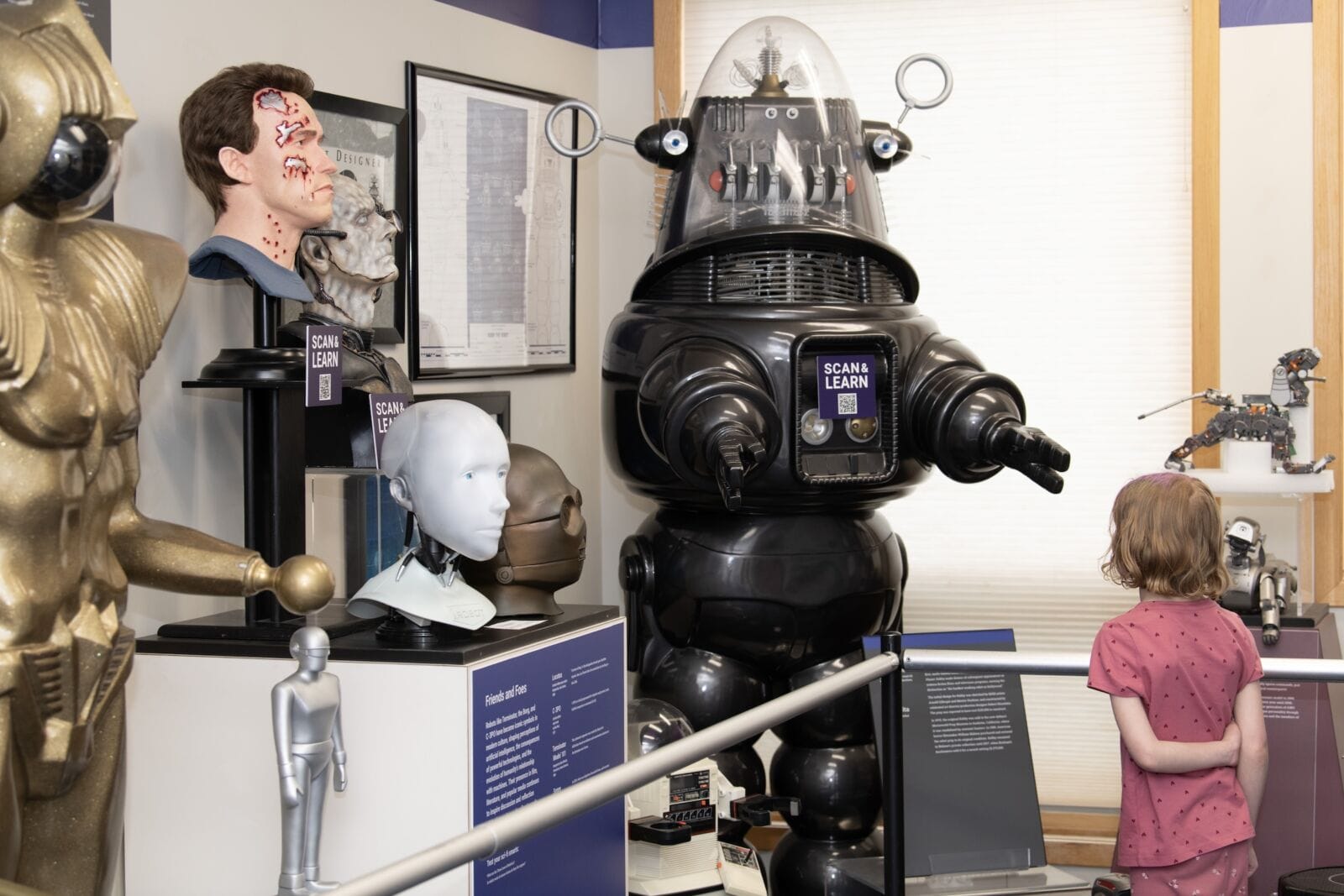
The American Computer & Robotics Museum in Bozeman is a museum that traces over 4,000 years of human invention, a mishmash of laboratories, capsules and garage-inventor fever dreams. The tour starts with a cuneiform tablet.
“Four thousand years of information technology,” the museum’s executive director, Eleanor Barker, said, and pointed at a wall of beige Macs. They’re unassuming and yet visitors respond like old friends.
“People have real emotional connections and memory connections to these machines,” she said.
In a glass case sits a watch that went to the moon. “This watch was worn on the moon by Cmdr. David Scott,” Barker said.
Nearby, a display keyboard from the Apollo guidance computer marks the moment NASA abandoned punch cards forever. “You cannot carry all those punch cards to space,” she said. “It’s all about payload with NASA.”
The museum’s storytelling is crisp, human and surprisingly funny. When explaining the Enigma machine, she notes that the Nazis never cracked the Navajo code because “you had to first know the language and then break it.” When describing the Jacquard loom, Barker added, “The weavers of Lyon, France, were up in arms — this machine is going to take our jobs.”
The quantum computing exhibit is honest and technical. “It’s very hard to understand, but if they ever build one that actually works, it could be revolutionary,” Barker said.
But the museum’s charm peaks in its origins. Founder George Keremedjiev bought his first artifact — a mechanical calculator mislabeled as a check printer — at a Florida thrift store.
“He thought, ‘It’s not a check printer. It’s a mechanical calculator,’” Barker said with a laugh.
Funny how “That’s so Yellowstone of you” stops being a dig once you realize Yellowstone is an entire Montana mood — not just a TV show.