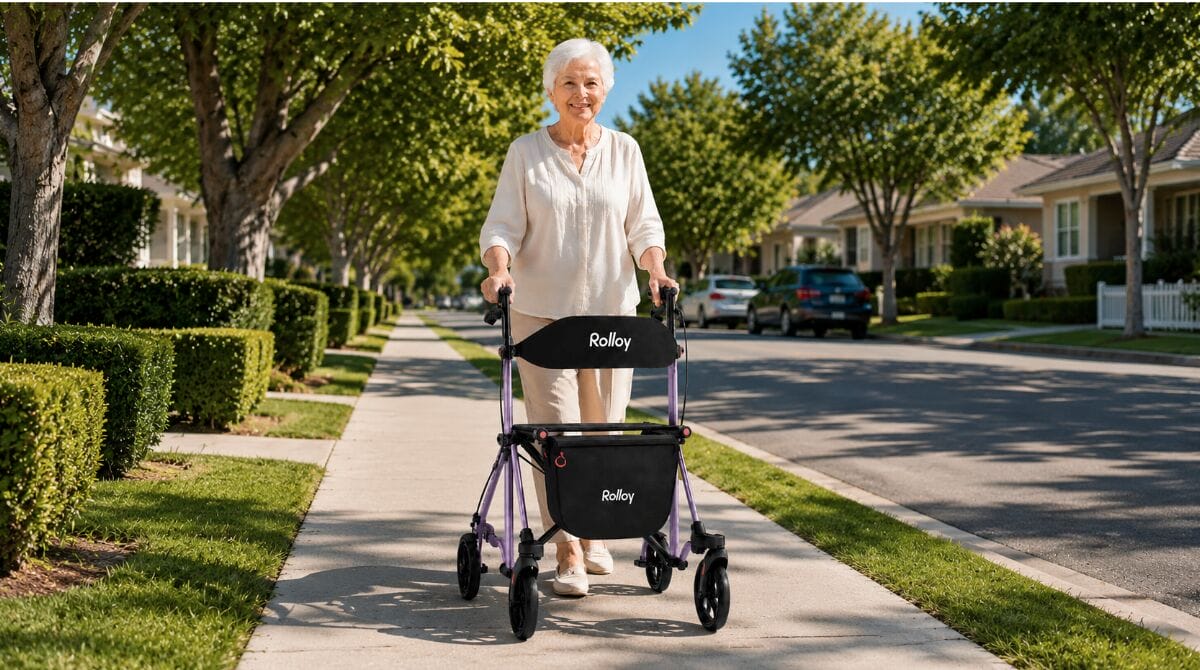
If your main goal is to walk upright and reduce a hunched back, an Upright Walker is usually better for posture support than a Standard Rollator. The upright model shifts the weight from the wrists to the forearms. This prompts the user to keep their head up and chest out. But if you also need walking endurance, stability, and a comfortable place to rest, a Standard Rollator is still the practical choice for most families. This article breaks down the differences between the two across four categories. We will look at product structure, ergonomics, real-world usage, and buying specs. At the end, we offer specific suggestions based on height, weight, and environment. This will help you make a solid decision in 15 minutes.
Upright Walker vs Standard Rollator: The Main Difference
The core difference is hand and forearm placement. An upright walker places padded forearm supports higher than a standard rollator, usually around forearm or chest level depending on the model. A standard rollator uses lower hand grips. For example, the Rolloy Compact Master II has a handle height range of 32 to 40 inches, while its Standard model fits wrist-to-floor measurements of 31 to 39 inches.
| Feature | Upright Walker | Standard Rollator |
| Handle Position | Higher forearm supports | Lower hand grips |
| Weight-Bearing Area | Forearms and hands | Hands, wrists, and palms |
| Posture Tendency | More upright walking position | May allow slight forward leaning |
| Seat | Usually included | Included |
| Seat Width | Varies by model | 18 to 19 inches on Rolloy |
| Product Weight | Often around 20 lbs, varies by model | About 16 to 17 lbs on Rolloy |
| Folded Size | Usually larger | 10 x 14 x 26 inches on Rolloy |
| Best For | Posture-focused walking support | Daily errands, travel, and rest breaks |
What Is an Upright Walker?
The Upright Walker is also known as a stand-up rollator. It is often used by people who want more forearm support, a higher walking position, or less pressure on the hands and wrists. The core design uses forearm platforms and upright handles. Users place their forearms on padded trays and lightly grip the vertical handles. This encourages the upper body to stay more upright. The benefit is that your shoulder blades retract and you look straight ahead. The downside is the weight. Many upright walkers are around 20 lbs or heavier, depending on the model, and they often take up more space when folded than a compact standard rollator.
What Is a Standard Rollator Walker?
The Standard Rollator is the most common four-wheel walker in North American homes. It features 8-inch front and rear wheels, brakes, a seat, and a storage bag. The main goal is to combine walking, stopping, and sitting. For example, the Rolloy Compact Master II Rollator Walker weighs about 16 lbs, depending on how the product details are listed. When folded, it measures 10 by 14 by 26 inches, making it easy to load into a car trunk. It supports users around 5 feet 2 inches to 6 feet 4 inches, with the Standard version rated for 300 lbs and the Wide version rated for 400 lbs. It does not force posture correction. Instead, it uses adjustable handle heights and brake layouts to make standing and long walks more manageable.
Which One Helps Posture More?
The answer comes down to where the user bears weight. An upright walker lets the forearms rest on higher supports, so the user is more likely to keep the shoulders back and look forward. A standard rollator puts more load through the hands and wrists. If the handles are set too low, the user may lean slightly forward. That means an upright walker is usually better for posture-focused walking, while a standard rollator is often easier for everyday use, errands, and rest breaks.
Why Upright Walkers Can Support a Straighter Walking Position
Upright walkers can support a straighter walking position because of three design changes. First, the forearm pads support part of the upper body instead of placing most pressure on the hands. Second, the higher grip position makes it easier to keep the head and chest up. Third, the user is more likely to look forward instead of down at the ground. This does not mean an upright walker can medically correct posture, but it may help some users walk in a more upright position.
When a Standard Rollator Walker May Be Easier to Use
Not everyone needs to be corrected. For seniors who are still mobile and mostly visit supermarkets or community parks, the lightweight and agile nature of a standard rollator walker is more important.
Following this logic, here are three typical scenarios where a Standard Rollator is the more convenient choice:
- Quick Grocery Runs: An about 16 to 17 lb frame and a storage bag rated up to 22 lbs can help carry light groceries, personal items, or small purchases.
- Travel and Flying:The 10 by 14 by 26 inch folded size makes it easier to load into a car trunk or move through an airport. For flights, do not assume it will fit in an overhead bin. Airline storage depends on the aircraft and carrier policy, and many walkers may be handled as gate-checked assistive devices.
- Hospital Visits: The seat and brake combination gives the user a place to rest while waiting or moving through long hallways.
Upright Walker vs Standard Rollator: Key Buying Factors
Posture is only one part of the buying process. Your height, the handles, and where you plan to use it are what really determine how satisfied you will be. We have broken these down into three sections below.
Match the Walker to Your Height
The rule of thumb for height matching is that the handle height should roughly match the distance from the user’s wrist to the floor when the arm hangs naturally. For an upright walker, the forearm platforms should sit at a comfortable height without forcing the shoulders upward. For a standard rollator, the hand grips should allow the elbows to bend slightly while the user stands tall. For example, the Rolloy Compact Master II offers 8-level handle adjustment and supports users around 5 feet 2 inches to 6 feet 4 inches. If the user is shorter than 5 feet 2 inches, measure wrist-to-floor height first or look for a petite rollator model designed for shorter users.
Check Brakes, Seat, and Handle Comfort
Brake feel determines the safety floor. High-quality loop brakes should be easy to lock with one hand and snap back instantly when released. For the seat, I recommend a width 1 to 2 inches wider than your hip measurement. Standard models are typically 18 inches, while wide versions are 19 inches. Check the handles for non-slip soft rubber and a slight curve. These features help prevent pressure sores on your palms.
Think About Indoor and Outdoor Use
For outdoor use, wheel diameter is the priority. The Rolloy Standard model uses 8-inch front and rear wheels, which are better for sidewalks, small bumps, and outdoor paths than 6-inch indoor wheels. It also includes a curb climber to help clear small obstacles smoothly.
Who Should Choose an Upright Walker?
An upright walker may be worth considering for users who mainly struggle with forward leaning, wrist pressure, or keeping their eyes up while walking. It may also suit users who have been advised by a clinician to use forearm support. For Parkinson’s disease, scoliosis, osteoporosis, spinal surgery recovery, or severe kyphosis, users should ask a doctor or physical therapist before choosing a walker based on posture alone.
Who Should Choose a Standard Rollator?
In contrast, the target audience for the Standard Rollator is much broader. This includes independent seniors like Richard from Texas who drives for weekly groceries, or social butterflies like Annette in Florida who dines out often and needs to tuck her walker under a restaurant table. It also fits retired travelers who need a walker that folds compactly for car trunks, airport movement, and gate-check situations. A lightweight four-wheel rollator around 16 to 17 lbs can support the daily cycle of walking, stopping, sitting, and loading into a car.
If the user does not need a seat or storage bag, a 2-wheel walker can also be considered as a lighter alternative. For example, the Rolloy Compact Master 2-Wheel Standard Walker weighs 8.8 lbs, so it may be easier for caregivers to lift, move, or store. However, it is not the same as a standard rollator. It is better for short indoor walks, basic support, and users who want a simpler walking frame rather than a seated rollator for errands and longer outings.
Final Verdict: Which Walker Is Better for Posture?
When it comes to posture correction alone, the Upright Walker wins. For overall quality of life, the Standard Rollator offers a better balance. The best solution is often not picking one over the other, but rather a combination of short-term rehab and long-term daily use.For posture-focused rehab, follow the plan given by a doctor or physical therapist. For long-term daily use, many families may find a standard rollator easier to fold, transport, and use during errands.