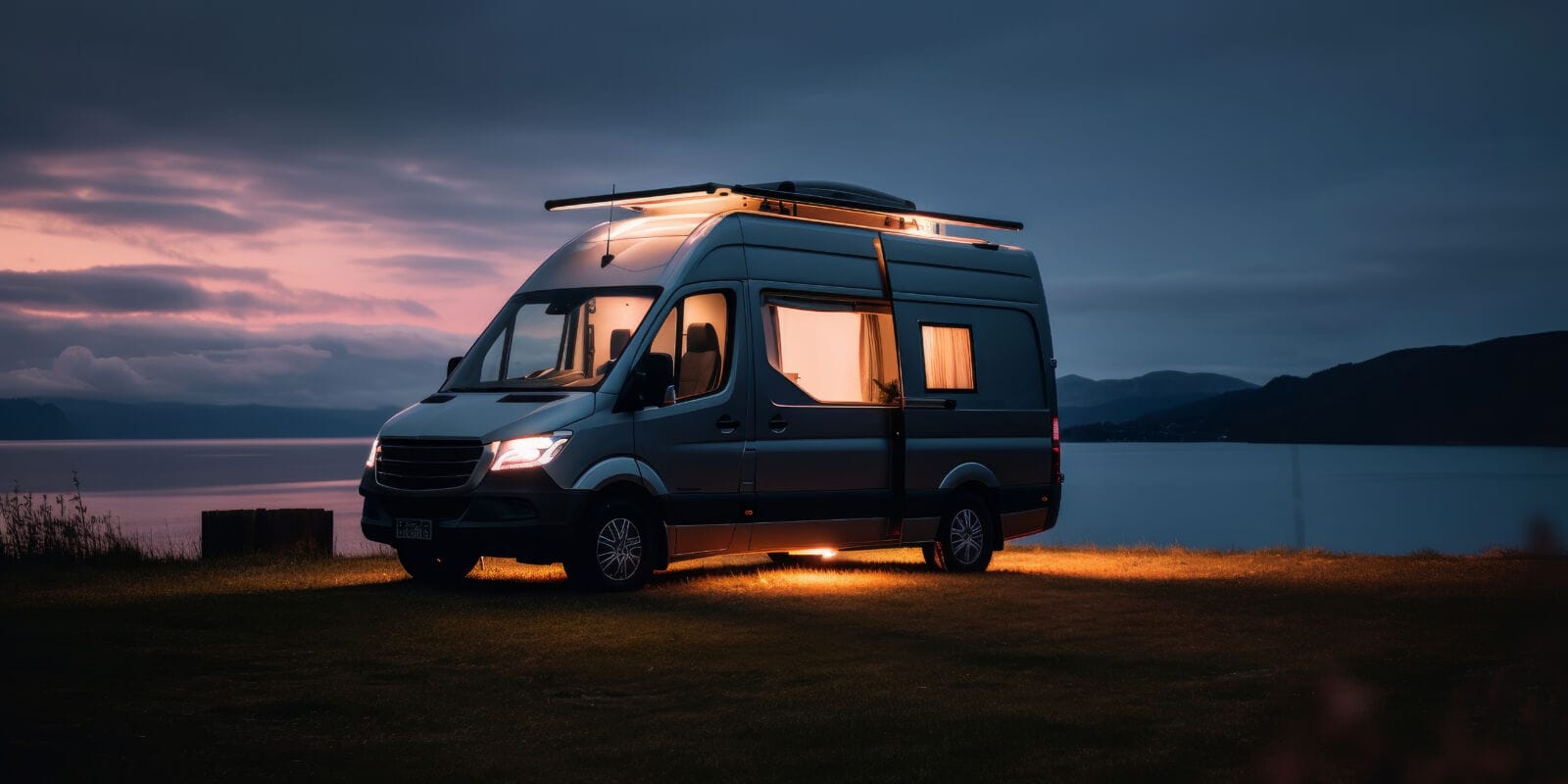
Here’s a number that surprised me when I went looking. The RV industry is having a bad year. Through August, manufacturers shipped about 207,000 units nationally, down 14 percent from 2025, and the drop is coming from travel trailers and big motorhomes. One category is going the other way. Van campers, the industry’s name for cargo vans converted into small motorhomes, are up almost 9 percent year to date according to the RV Industry Association.
Arizona has a lot to do with that. We have the winter weather, more open BLM land than almost any state, and a five hour drive radius that takes in the Grand Canyon, Sedona, Monument Valley, the White Mountains and the Sky Islands. If you’ve noticed more high roof Sprinters at the Whole Foods in Tempe or parked along Forest Road 525 outside Sedona, you’re not imagining it.
The problem is that if you decide you want one, the pricing makes no sense at first glance. You’ll see “custom camper van” quoted anywhere from $9,000 to $230,000, and most builders don’t explain what lives between those numbers. So I did the work. This is what each price tier actually buys, using current chassis prices and published builder pricing, plus the parts of the math that only apply if you live here.
Half the bill is the van itself
Every custom build starts with an empty cargo van. Either you buy it or the builder buys it and folds it into the price. This is the part shoppers skip past, and it’s the reason the cheap tiers aren’t cheap.
A 2026 Mercedes Sprinter 2500 with the 144 inch wheelbase lists at $50,830 as a bare cargo van. Add all wheel drive, which you’ll want for most Arizona dirt roads, and the sticker is $60,500. The high roof, which you need if you want to stand up inside, adds roughly $3,700 on top. Dealers are currently moving Sprinters at about 7 percent under MSRP, so a negotiated all wheel drive, high roof 144 comes in somewhere between $60,000 and $65,000. A Ford Transit with the equivalent spec is usually $8,000 to $12,000 less, and it’s what a lot of builders now use for their entry models.
Keep that $60,000 in your head. Every tier below is either added to it or includes it.
Under $10,000: the prepared shell
The cheapest thing a professional shop will sell you isn’t really a camper. For around $9,000, they insulate the van, lay flooring, panel the walls and ceiling, and install mounting brackets so you can bolt in a bed, cabinets and electrical later. There’s no furniture and no systems. You get a warm, quiet, finished box.
Who buys this: people who already own a Sprinter or Transit, usually from a previous business, and want to finish the interior over two or three seasons.
Why it matters in Arizona: insulation is the one job you don’t want to do yourself. An uninsulated white van parked in Mesa in June reaches 140 degrees inside by early afternoon. Most DIY insulation jobs skip the floor because it’s tedious, and the floor is where a good chunk of the summer heat comes through when you’re parked on hot asphalt. A shop that does this every week uses closed cell foam or sheep’s wool, seals the ribs, and knows which cavities condense in a Flagstaff winter. Pay for it.

$45,000 to $55,000: the conversion package
This is the tier where a van becomes a place you can live for a week, and it’s the biggest jump in value on the list. A full conversion installed into a van you already own runs $47,000 to $52,000 depending on the layout.
What you get: a fixed or convertible bed with a real mattress, a galley with a sink, a 12 volt fridge and an induction cooktop, hardwood or bamboo cabinetry, a 20 gallon fresh water tank with a small gray tank, and an off grid electrical system with solar on the roof and lithium batteries under the bed. Most packages include swivel front seats, a roof fan, and a diesel or gasoline heater that runs off the van’s own tank.
Where the money goes: roughly a third of the price is the electrical system. A 5 kilowatt hour lithium bank, 400 watts of solar, an inverter, and a charger that pulls from the alternator while you drive costs $8,000 to $12,000 installed. Cabinetry is another 20 to 25 percent, and that number climbs quickly if you want real wood instead of laminate. The bed platform, water system and insulation make up most of the rest. Labor is baked into all of it. A conversion at this level takes a two person crew around four to six weeks.
For reference, Boulder based Vansmith, which builds camper vans on both the Sprinter and Transit and delivers to all 50 states, prices its couples layout at $46,950 and its four seat family layout at $51,950 on a customer supplied van. Add the chassis price from above and you land at $107,000 to $117,000, which is why very few first time buyers actually stop in this tier. They either already own the van or they move up to turnkey.
$110,000 to $130,000: turnkey
One purchase, van included, ready to drive home. Complete vans from established custom shops start around $112,000 to $118,000, and that puts them head to head with factory built Class B motorhomes from Winnebago, Thor and Coachmen.
The honest comparison goes like this. The factory brands win on dealer networks. If something breaks in Kingman, there’s a Camping World that will look at a Winnebago. The custom shops win on insulation, on electrical capacity, and on the fact that you choose the layout. Factory Class Bs are built to a national average buyer. A custom van built for Arizona gets a bigger battery, a lift, and no propane.
Inside this tier you have one more choice: build to order or prebuilt. Build to order means you pick the layout, the cabinet color, the options, and you wait. Reputable shops are booked four to eight months out right now. Prebuilt means the van is already finished and sitting in inventory. It costs a few thousand more and you have it in weeks.
If you’re going to use the van the way most Arizonans do, three specs matter more than anything else on the sheet:
- All wheel drive with a suspension lift. Schnebly Hill Road above Sedona, the road into Alamo Lake, the approach to most dispersed sites around Quartzsite and nearly everything on the Arizona Strip is unpaved and washboarded. A two wheel drive van with stock clearance will get you to the trailhead parking lot and not much further.
- At least 5 kilowatt hours of battery. A 12 volt fridge and two roof fans running through a May night at Lake Havasu draw between 1.5 and 2 kilowatt hours. Five gives you margin for a laptop, phones and a water pump. Less than that and you’re driving to charge.
- Some kind of shower. BLM sites don’t have one. An exterior shower with a curtain is enough for most people and costs a fraction of an enclosed wet bath.
$140,000 to $230,000: fully loaded
Above $140,000 you’re no longer paying for capability. You’re paying for comfort, and one piece of comfort in particular.
The premium tier adds enclosed hot water showers, 10 to 15 kilowatt hour battery banks, a second alternator to charge them faster, pop tops that sleep four, and rooftop air conditioning. Custom builds at this level top out around $190,000 to $230,000, which is still below the $235,000 to $307,000 range of an Airstream Interstate.
Air conditioning is the upgrade that rewrites the Arizona math, so it’s worth understanding why it costs so much. A rooftop 12 volt air conditioner draws 40 to 60 amps while running. To sleep through a July night in Phoenix with it on, you need 8 to 10 kilowatt hours of battery just for the AC, which is why builders pair it with a 15 kilowatt hour bank and a second alternator. The AC unit itself is $3,000 to $4,000. The electrical system to run it overnight is $15,000 to $20,000. That’s the real cost of “I want to use the van in summer.”
Without it, a camper van in Arizona is a nine month vehicle. Mid September through mid June, then it sits. With it, you can be at Lake Pleasant in August. Whether that’s worth $40,000 to you is the whole decision at this tier.
The Arizona details nobody puts on the quote
These are the things I wish someone had told me before I started pricing builds.
Solar underperforms in our heat. Solar panels are rated at 77 degrees Fahrenheit and lose roughly 0.4 percent of output for every degree Celsius above that. On a 110 degree day the panel surface can hit 160, and you’re getting 15 to 20 percent less power than the sticker says, right when the fridge is working hardest. Builders in cooler states size solar for the label. Ask your builder to size it for a Yuma afternoon.
Lithium batteries have a temperature window. Most lithium iron phosphate batteries stop accepting a charge below freezing and throttle above about 130 degrees. In Flagstaff in January the batteries need to be inside the insulated cabin or have a heating pad. In a Phoenix summer they need to be away from the floor and out of direct sun. Where the batteries sit in the van is a real design question here, and a lot of out of state builds get it wrong.
Weight adds up fast. A Sprinter 2500 has a gross vehicle weight rating of about 9,050 pounds and a payload around 4,000. A mid tier conversion adds 1,500 to 2,200 pounds of cabinets, batteries, water and insulation. Twenty gallons of water alone is 167 pounds. Two people, a dog, bikes and a week of groceries can push a build close to the limit, and an overloaded van handles badly on the grade down into Oak Creek Canyon. Ask for the finished curb weight in writing.
Monsoon season changes the rules. July through September, a wash you drove across dry at noon can be running two feet deep by four. Dust storms on I-10 drop visibility to nothing in seconds. This isn’t a reason not to travel in summer, but it’s a reason your van needs a good weather app, an air filter you check monthly, and a habit of not camping in washes.
Arizona’s vehicle license tax is based on value. Arizona charges an annual vehicle license tax calculated on 60 percent of the manufacturer’s base retail price, at $2.80 per $100 for a new vehicle, dropping about 16 percent each year after. On a $115,000 turnkey van, that’s roughly $1,900 the first year. It’s not a deal breaker, but it’s a line item that surprises people moving over from a $30,000 trailer, and it’s one reason to keep the chassis price and the conversion price separated on your paperwork.
The Quartzsite math
Ninety minutes west of Phoenix on I-10, Quartzsite is the clearest example of why camper van ownership pays off in this state. The BLM’s La Posa Long Term Visitor Areas allow stays from September 15 through April 15, a full seven months, on a $180 permit that includes potable water, dump stations, trash service and pit toilets. A 14 day permit is $40. The free dispersed land surrounding town, more than a million acres managed by the Yuma field office, allows two weeks at a time with no permit at all.
Work that out. The seven month permit is 85 cents a night. A proposed increase to $600 was floated a couple of years ago and never approved, so the price holds for the 2026 to 2027 season.
Now compare a Phoenix area RV resort, where a winter season runs $3,000 to $6,000, or a second home in Sun City. A $115,000 turnkey van financed over seven years through one of the adventure vehicle lenders costs roughly $1,200 to $1,500 a month. For a snowbird couple, that payment replaces the second home and the second car, and the van goes to Colorado in July when Phoenix is unlivable.
What it costs to own after you buy
Nobody puts this on the brochure either. Camper vans are cheaper to own than larger RVs in ways that show up a year later.
Storage is zero, because it fits in a driveway. That’s $100 to $250 a month you’re not paying compared to a 30 foot trailer. Fuel is 18 to 22 miles per gallon on a Sprinter diesel, against 8 to 10 for a Class C. Insurance runs $1,200 to $2,500 a year depending on the build value, and you’ll want an agent who insures the conversion, not just the van.
The one line item that runs higher than trailer owners expect is Mercedes maintenance. Budget $1,000 to $1,500 a year and find an independent Sprinter specialist in the Valley instead of relying on the dealer for oil changes. The Transit is meaningfully cheaper to service, which is part of its appeal.
Resale is the quiet advantage. A well built van from a recognized shop typically holds 60 to 70 percent of its value at five years, better than most Class A or C motorhomes, because the chassis is a commercial vehicle with a deep used market and the conversion carries its own premium as builder names get known.
Five questions before you sign
After all of this, the difference between a good purchase and an expensive regret comes down to a short conversation with the builder.
- What’s the battery capacity in kilowatt hours, and how fast does it charge while driving? If they answer in amp hours without a voltage, that’s a flag.
- What insulation is in the floor, and where do the batteries sit relative to it?
- What’s the finished curb weight, and how much payload is left?
- What’s the cabinetry warranty? Lifetime warranties exist in this industry and they tell you a lot about how a shop builds.
- Is the chassis price separated from the build price on the quote?
Ask those five and you’ll know more than most buyers. And if you order this fall from a build to order shop, plan on picking it up right around the time the Cactus League starts, which is about the best week of the year to have one.