The things that most reliably improve a child’s focus are unglamorous: enough sleep, a predictable routine, daily physical movement, and fewer things competing for attention during homework. Screens matter mostly through what they displace. A tablet at bedtime costs sleep, and lost sleep costs focus the next day.
That order is worth holding onto, because the research on screens and attention is more modest than the headlines. The measurable effects are real and small. What is larger, and far easier to change, is the shape of the day around the screen.
If your child seems harder to hold on task than you were at that age, you are noticing something real. What follows is the routine, in the order that matters. Avantera Elevate Kids Gummies come up near the end, well behind sleep and habits.
What the Research Actually Says About Screens and Attention Span
A lot of what you read about the effects of screen time on children overstates the case. A link between screens and attention exists, but it is smaller and shakier than the headlines imply. A cognitive scientist reviewing the evidence in 2026 put it plainly, saying screen time may modestly degrade attention, with no strong causal evidence.
He also noted the correlation comes and goes between studies. That is worth holding onto when you meet the scary version. Nobody has shown that screens are rewiring your child into someone who cannot concentrate.
What is clearer is the design. Phones, games and feeds are built to pull attention sideways, over and over. The same review describes platforms that encourage rapid shifts of attention, with eyes darting for targets and apps constantly asking to be checked.
So the fair way to think about it is practice. A child who spends hours a day switching quickly gets a lot of practice at switching quickly.
The kind of screen is worth as much of your attention as the clock is. A slow story, a video call with a grandparent, or a building game asks a child to hold one thread. Fast-cut clips and endless feeds ask for the opposite, and an hour of each leaves a child practicing very different things.
None of this means something is wrong with your child. It is a habit worth balancing, like any other.
DEEPER DIVE: Here are Arizona’s Most Admired Companies of 2026
It’s Not Just Screen Time: It’s What’s Being Displaced (sleep, outdoor play, reading)
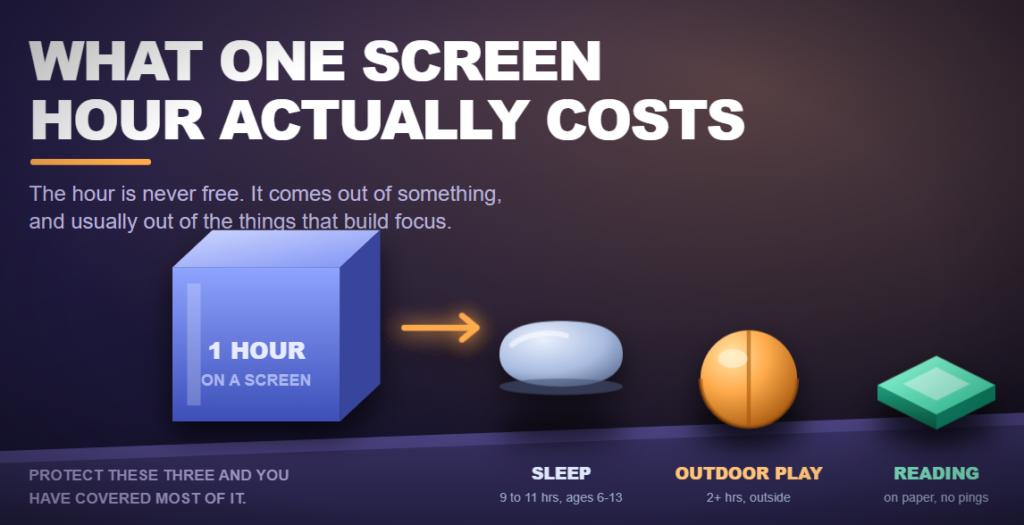
The bigger issue with kids’ screen time and focus isn’t the screen itself. An hour on a tablet is also an hour not spent somewhere else, and that somewhere else is usually what was quietly building focus in the first place. Three things get squeezed first.
| What gets squeezed | Why it builds focus | What to protect |
|---|---|---|
| Sleep | Rest is when attention resets. Ages 6 to 13 need 9 to 11 hours a night. | Turn off screens an hour before bed; charge devices outside the bedroom. |
| Outdoor play | Unstructured, physical play asks a child to hold their attention without prompts. | At least two hours of activity a day, ideally outside. |
| Reading on paper | A book has no notifications, so it trains you to stay with one thing. | A few pages a day beats a long session nobody enjoys. |
Sleep is the one to guard hardest. The American Academy of Pediatrics recommends keeping devices out of bedrooms and away for the hour before bed, and recommends 9 to 11 hours of sleep for children aged 6 to 13. A tired child looks a lot like an unfocused one.
Outdoor time does quiet work. Pediatric specialists at Cedars-Sinai suggest at least two hours of physical activity a day, ideally outside, and note that children retain more from a paper book than from the same words on a screen.
None of this needs a dramatic intervention. In practice, the easiest way to address the effects of screen time on children is to put the displaced things back. Protect sleep, get them outside, keep something printed in the house, and you have covered most of it.
Building Healthier Screen Habits Without a Fight
Screen time limits for children by age are a useful starting point, but rules work better when they apply to places and times instead of minutes. That way you are not negotiating a countdown every evening, and your child knows the shape of the day without being policed.
- Make zones, not countdowns. Keep bedrooms screen-free, which AACAP advises, and keep meals screen-free too. Both are easier to hold than a stopwatch.
- Protect the hour before bed. Turn off screens; charge devices in the kitchen. If you only change one thing, make it this one.
- Use a number as a guide, not a law. For school-age children, the AAP’s family media guidance points to about one to two hours a day of entertainment screens, separate from schoolwork.
- Trade, don’t confiscate. Swapping in a bike, a book, or a board game lands far better than removing something and offering nothing in its place.
- Watch some of it with them. Talking about what they are seeing turns a solo habit into a shared one, and you learn a lot about what they actually do on there.
- Write it down together. The AAP hosts a free Family Media Plan that lets a household agree on the rules once, as a family, rather than re-arguing them nightly.
Expect some pushback at first. Hold the bedtime rule steadily and let the smaller ones flex, so you are defending one line instead of six.
Model it too. Children take their cue from what adults do with phones, so your own hour before bed is part of the same rule.
Where Nutritional Support Fits Into the Picture
Habits come first, and nothing here changes that. No supplement replaces sleep, outdoor time, or a screen-free bedroom, and any product sold to you as a fix for a child’s focus deserves suspicion. Nutrition supports a good routine.
If the basics are steady and you want something small to add, a few things are worth checking on any children’s focus product:
- No caffeine. Children do not need a stimulant to concentrate. Avantera Elevate Kids Gummies are caffeine-free, which is the first thing we would look for on any label.
- Low added sugar. Ours carry 2 g of added sugar per serving, with no artificial sweeteners or dyes.
- Ingredients you can look up. Five active ingredients: Bacopa Monnieri, Citicoline, L-Theanine, Vitamin B12, and Vitamin B6.
- A clear age range. Made for children aged 6 and older. Ages 6 to 11 take one gummy a day; ages 12 and up take two.
- Made somewhere you can name. Produced in the USA in an FDA-registered, GMP-certified facility and third-party tested.
They are meant to support focus, mental energy, and learning alongside good habits, never to change a child’s behavior on their own. You can see the full ingredient list on the Kids Gummies product page.
Two practical notes. Give it at the same time each day so it rides an existing habit instead of becoming another thing to remember, and check with your pediatrician first if your child takes any medication.
A Realistic Daily Routine for Better Focus
A routine is easier to sustain than a rule list, because it removes daily negotiation while still supporting a child’s attention span. Here is a weekday shape that fits most families without turning the house into a boot camp. Adjust the timings as you like; the order is the useful part.
Morning: Breakfast without a screen on the table. If Avantera Elevate Kids Gummies are part of your routine, this is the easy anchor point, since breakfast happens at the same time every day.
After school, go outdoors or move first; screens second: Getting the physical part done before the tablet appears avoids the day’s hardest argument, and it protects the activity that gets squeezed out most easily.
Homework: Put the phone in another room, not face down on the desk. A visible device pulls at attention even when nobody touches it.
Evening: Screens off an hour before bed, devices charging outside the bedroom, then something printed if they will take it. Johns Hopkins gives the same advice: put devices down well before sleep.
Weekends: Loosen it. A routine that only survives perfect weeks isn’t a routine, and a Saturday film afternoon isn’t a setback.
On a hard day, keep two things and let the rest go: the hour before bed, and getting outside at some point. Holding those on a bad Tuesday is worth more than a perfect week you cannot repeat.
Give any change a fair stretch before you judge it. Sleep and habit shifts show up gradually, and the first few nights of a new bedtime rule are usually the hardest ones.
When to Talk to a Pediatrician
Deciding when to raise a child’s attention span with a pediatrician is simpler than it feels. There is no threshold you need to cross before you call. AACAP’s guidance is to consult one if you have concerns, so being unsure is reason enough.
What helps is arriving with specifics rather than a general worry. Before the appointment, jot down:
- How bedtime actually goes, and whether protecting the hour before bed changed anything.
- What a normal homework evening looks like in your house.
- Roughly how long screens are on, and what kind they mostly are.
- What you have already tried, and how long you gave it.
- Anything that has stayed on your mind for a while.
That gives a pediatrician something concrete to work with, and it saves you trying to recall months of evenings on the spot.
Asking is a low-stakes step. Going in with notes means the conversation starts from what is actually happening at home rather than from a blank page.
It also helps to say what you are hoping for. Whether you want reassurance, a second opinion, or a plan to try, saying so early usually makes the visit more useful.
Start with sleep and the hour before bed, since that change has the clearest guidance behind it. If you want a small, caffeine-free addition once the routine is steady, our Kids Gummies fit there.
Disclaimers
Health disclaimer. This article is for general information and is not medical advice. It is not intended to diagnose, treat, cure, or prevent any condition. Speak with your child’s pediatrician about any concerns regarding attention, sleep, development, or behavior.