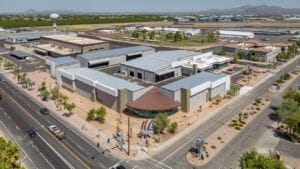
Commercial real estate marketing in competitive metropolitan markets demands immaculate visual presentation. Whether leasing class-A office space in downtown Phoenix or marketing prime industrial distribution centers in the East Valley, commercial brokers know that initial online engagement happens through photographic listings. However, capturing pristine architectural photography in active business corridors is notoriously difficult. Deploying a purpose-built AI Photo Editor allows commercial listing teams to clean up exterior photos, eliminate temporary site clutter, and present properties at their highest commercial potential.
In commercial property sales, every week an asset sits idle on digital exchanges erodes net operating yield. When photography crews shoot an active office park, they routinely battle real-world obstacles: commercial utility vans parked across prime frontage, overflowing waste dumpsters awaiting collection, or temporary construction barricades along access drives. Waiting for specialized architectural retouchers to manually clone out these distractions adds days of friction to property marketing timelines. Evaluating modern browser-based editing platforms against traditional retouching methods reveals how automated tools streamline commercial asset marketing.

The Commercial Reality Of Modern Architectural Photography
Commercial listing platforms like CoStar, Crexi, and regional commercial listing networks present properties alongside dozens of comparable regional assets. Prospective corporate tenants and institutional investors make immediate judgments based on curb appeal, parking lot maintenance, and structural condition. A stray maintenance vehicle or oil stain on the main approach can create a subconscious impression of deferred property management.
Scheduling commercial photo shoots around active tenant operations requires extensive coordination. Delivery schedules and service visits rarely align with ideal afternoon sun angles. Post-shoot visual cleanup is not about creating deceptive architectural fantasies; it is about stripping away transient, non-structural nuisances so the physical asset and its architectural lines can be evaluated honestly.
PicEditor AI provides commercial brokerage teams and real estate marketing coordinators with a rapid, browser-based workspace. Without installing heavy desktop suites on brokerage laptops, marketing managers can ingest high-resolution architectural photography and perform precise, localized touch-ups within minutes.
Overcoming Parking Congestion Along Commercial Frontage
Addressing transient parking lot clutter is the most frequent requirement in commercial exterior photography. In our field testing across regional commercial listings, manually brushing out service trucks using traditional clone stamps took up to forty minutes per exterior angle. Using targeted object removal, that same cleanup takes under two minutes, seamlessly blending asphalt textures, parking stall striping, and curb contours.
Furthermore, Southwestern commercial properties face extreme dynamic range challenges, where intense exterior desert sunlight creates harsh shadows beneath deep entryway canopies. Automated enhancement algorithms lift shadow exposure across recessed lobby windows while preserving highlight detail on light-toned stucco and glass facades, revealing welcoming foyer spaces without creating unnatural artificial glow.
Evaluating Core Production Criteria For Real Estate Workspaces
Commercial marketing coordinators require tools that balance turnaround speed with realistic architectural fidelity. Software that over-smooths building facades or warps window mullions fails commercial appraisal and brokerage standards.
The comparative matrix below outlines how modern generative browser workspaces evaluate against legacy desktop retouching and budget offshore editing services for commercial property marketing:
| Evaluation Dimension | Legacy Desktop Suites | Offshore Retouching Services | Generative Browser Workspaces |
| Turnaround Timeline | Two to four hours per property package | Twenty-four to forty-eight hours delay | Under ten minutes per complete listing |
| Cost Structure | Expensive annual workstation licenses | Recurring per-image outsourcing invoices | Scalable credits with transparent rollover |
| Texture Reconstruction | Manual cloning requiring expert skill | Variable quality; frequent texture smudging | Context-aware inpainting matching asphalt and masonry |
| Interface Accessibility | Steep technical learning curve | Complex email ticketing and review loops | Intuitive action chips and natural language prompts |
| Data Handling And Privacy | Local files; secure on-premise storage | Third-party file transfers across overseas teams | Secure cloud browser sessions with 30 MB ingest |
This side-by-side evaluation demonstrates that browser-based generative editing provides an ideal balance for commercial real estate marketing teams. It combines the immediacy of self-serve editing with the texture realism required for professional property marketing.
Practical Inpainting Workflow For Property Listings

Executing clean property adjustments requires an orderly hands-on approach. The workspace homepage accommodates raw architectural captures in JPEG, PNG, and WEBP formats with file sizes up to 30 MB, easily supporting 40-megapixel camera captures directly from professional wide-angle lenses.
Rather than managing complex layer masks and adjustment channels, real estate marketers utilize dedicated action chips including Erase object, Enhance photo, and Upscale image. These purpose-built modules guide the model to perform specific, restrained adjustments that respect underlying architectural geometry.
Executing Targeted Inpainting For Architectural Assets
To eliminate a commercial dumpster or a stray traffic cone from a property approach, drag the raw capture into the workspace and select Erase object. Brush over the unwanted obstacle, including its cast shadow on the pavement.
Leveraging a natural language tool like a ChatGPT Photo Editor allows brokers to specify exact contextual requirements: “Remove the green commercial waste bin and extend the clean asphalt pavement with matching concrete curb lines.” The generative engine evaluates surrounding aggregate textures, filling the area with consistent asphalt grain rather than blurry gray smudges.
Monument signs at commercial park entrances frequently require visual updates, especially when previous tenant vinyl lettering has been stripped, leaving faint ghost lettering on stone panels. Manual digital restoration often blurs stone textures.
Highlighting the sign surface and prompting for clean, uniform travertine or brushed aluminum restores the monument to a pristine leasing state. PicEditor AI executes these localized surface updates while preserving structural shadow edges and landscaping foliage.
This localized precision proves invaluable when preparing multi-page commercial leasing brochures, allowing marketing coordinators to standardize exterior entrance aesthetics across diverse lighting angles without waiting on outside retouching agencies.
Furthermore, taking the time to verify that color temperatures and white balances remain uniform across morning and afternoon property angles ensures investor pitch books present a cohesive visual narrative.
Compliance Guardrails And Recommendations For Commercial Brokerages
Commercial brokers must adhere strictly to fair marketing standards and industry disclosure rules. Visual enhancements must never misrepresent material physical facts concerning the property.
In our workflow evaluation tests, aggressive algorithmic passes occasionally produced warped window frames or blurred concrete expansion joints under direct scrutiny. When curb lines drift or street address numbers become unreadable, that candidate export must be rejected and discarded immediately rather than published to public investor portals.
Automated photo editing should never be used to digitally remove permanent overhead high-voltage power lines, erase adjacent highway infrastructure, or eliminate structural wall cracks. If a building feature is permanent, masking it out constitutes deceptive advertising. Automated inpainting is not a substitute for accurate physical property condition disclosures.
Accelerating property listing velocity while elevating visual marketing standards provides a distinct competitive edge in commercial real estate. PicEditor AI equips brokerage marketing departments with an agile, high-precision visual tool that turns time-consuming architectural retouching into a rapid self-serve routine.
By empowering listing coordinators to eliminate transient parking lot clutter, balance entryway illumination, and enhance monument signage in minutes, commercial teams launch marketing packages faster and attract higher-caliber tenant inquiries. Deploy browser-based generative editing across your brokerage to keep listings sharp, professional, and deal-ready.
Maintaining high visual fidelity protects brand equity and ensures institutional investors perceive your property portfolio as meticulously managed from first impression to final lease execution.