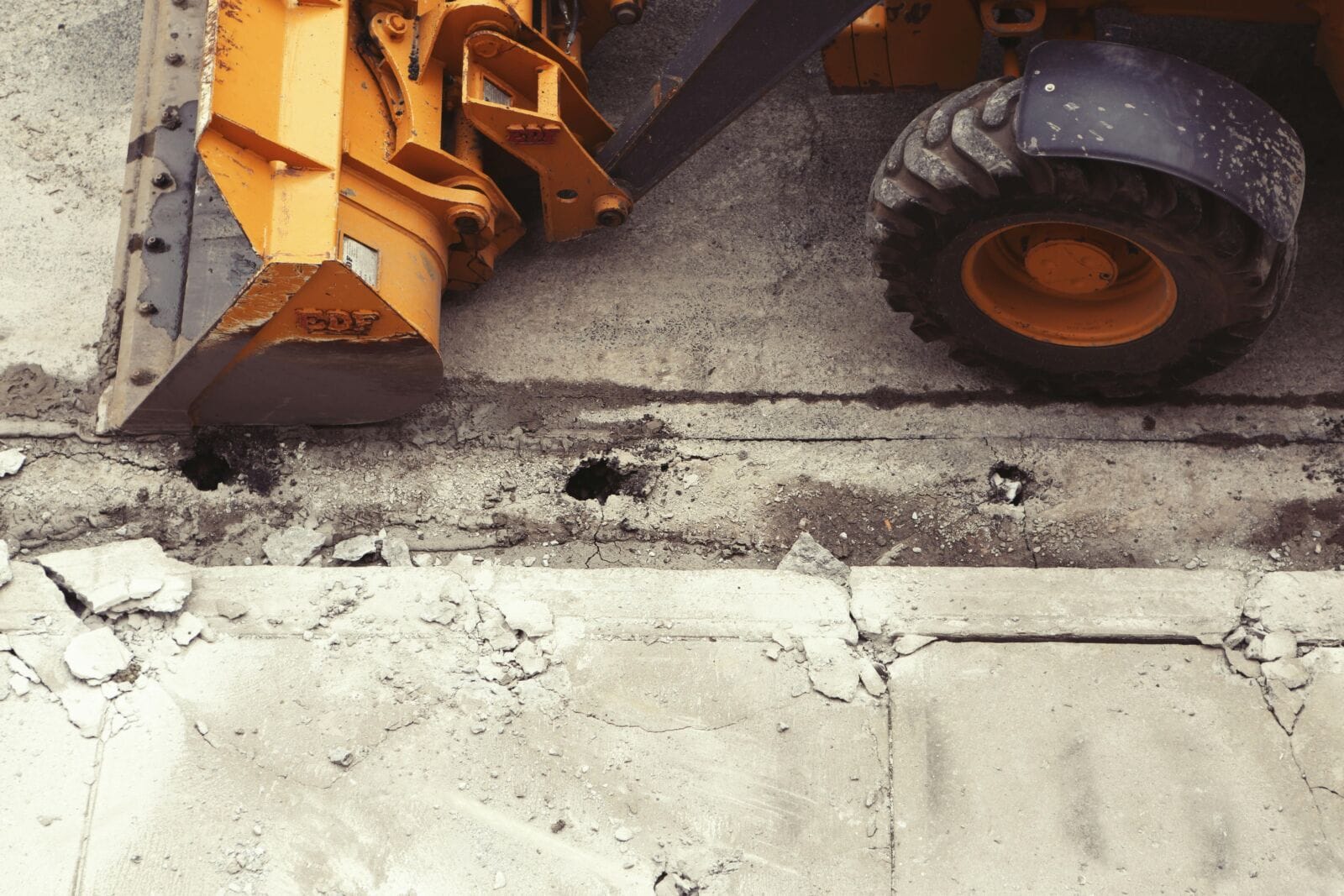
Each year, U.S. crews damage underground utilities hundreds of thousands of times. Estimates range from 400,000 to 800,000 incidents. The Common Ground Alliance reported 196,977 registered damage events in the U.S. and Canada in 2024. Nearly half involved telecom lines. Another 39% involved gas systems.
The cost is high. Direct and indirect losses reach tens of billions of dollars a year, with common estimates around $30 billion annually. One strike can cost about $56,000 in repairs, downtime, fines, claims, and legal expenses. For a small contractor, that can erase 10–20% of profit. Over the past decades, utility and pipeline strikes in the U.S. have killed more than 400 people and injured almost 2,000. Injury numbers continue to rise.
Most strikes are preventable. More than 60–75% of incidents trace back to weak planning or poor field procedures: no 811 ticket, digging errors, outdated maps, missed markings, or failed verification. That makes prevention a core job for construction teams.
Before work starts, crews need a reliable utility identification plan. That means using 811 “Call Before You Dig,” reviewing records, verifying locations, and applying subsurface utility engineering where risk justifies it. During work, crews need safe excavation methods: hand digging, hydro vacuum excavation, potholing, live tracking, and controlled work zones.
This report covers the scale of the problem, costs, U.S. regulations, state rules, standards, root causes, field failures, best practices, tools and technologies, U.S. case examples, implementation steps, checklists, risk controls, KPIs, and priority recommendations for small, mid-size, and large contractors. The findings rely on U.S. government, industry, and recent research sources. Where data is unavailable, the report says so directly.
Scale and Trends in the U.S.
The U.S. sees an estimated 400,000–800,000 utility strikes each year — roughly one to two strikes per minute. CGA reports captured about 197,000 damage events in the U.S. and Canada in 2024, but the real number is likely higher because many incidents go unreported. Most strikes happen during general construction work.
Telecom and natural gas lines account for most damage. Telecom makes up about 49% of reported incidents, and natural gas about 39%. Together, they represent more than 85% of all reported utility strikes. Water, sewer, and other systems appear less often in reports.
Regional risk varies. Some estimates point to Florida as one of the highest-risk states. Peoples Gas alone reports more than 1,700 gas-line damages per year. Heavy equipment, especially excavators and loaders, drives many incidents when crews encounter dense or poorly marked utility corridors.
Costs range widely. A single strike can cost $4,000–$56,000 in direct repair costs. When downtime, fines, claims, and legal costs are included, total U.S. losses reach about $30 billion per year. FHWA/Purdue research found that subsurface utility engineering can return $4.62 for every $1 spent. Florida reports a similar benefit ratio of about 3:1.
The trend remains negative. Damage rates stay high and, in some datasets, continue to rise. CGA’s Damage Index increased from 94 in 2022 to 96.7 in 2023. Infrastructure growth adds pressure: more underground work, more 5G expansion, and more buried assets. Field procedures have not kept pace.
U.S. Laws, Standards, and Guidance
U.S. utility-strike prevention is shaped by federal rules, state One-Call laws, and industry standards.
OSHA. Under 29 CFR 1926.651, crews must identify the approximate location of underground utilities before excavation and notify utility owners so they can mark their lines. When work approaches marked utilities, crews must expose the line safely before using mechanical equipment. OSHA also requires a competent person to inspect excavations daily and identify hazards, including utility risks.
PHMSA. Under 49 CFR 192.614 and 49 CFR 195.442, gas and hazardous-liquid pipeline operators must run damage-prevention programs and participate in qualified One-Call systems where they exist. In practice, this ties pipeline excavation work to the 811 “Call Before You Dig” process.
811 system. 811 is the national notification number for excavation. Contractors usually submit a ticket at least two working days before digging, though exact timing depends on the state. Utility owners then mark their public lines at no cost. Digging without an 811 ticket can trigger fines, liability, repair costs, and local code violations. But 811 does not cover every asset. Private, abandoned, old, or unmapped lines may remain unmarked, so high-risk jobs still need SUE, private locating, potholing, or other verification methods.
State One-Call laws. All 50 states have their own excavation notification laws. They define notice periods, ticket rules, documentation duties, tolerance zones, emergency exceptions, and penalties. Many states require contractors to keep proof of notification and may hold them liable if they damage a line after skipping required steps.
Funding and contract incentives. FHWA encourages the use of subsurface utility engineering (SUE) on transportation projects and allows federal funds to cover this work. Many public owners also require utility coordination, records review, and verification in project contracts.
Industry standards. ASCE/CI 38-22 sets the main U.S. standard for investigating and documenting underground utilities, including SUE quality levels. CGA Best Practices give field guidance for damage prevention. FHWA, PHMSA, OSHA, utility owners, and damage-prevention councils also publish guidance for safer excavation, drilling, and utility coordination.
Root Causes and Common Failure Points
CGA data and industry reports point to the same main causes behind underground utility damage.
No 811 ticket or late notification. This is one of the most common causes. Crews either skip 811 or file the request too late. The system is free and simple, but many contractors still miss this step.
Incomplete or wrong utility records. Utility maps are often outdated. Private lines, old mains, service lines, and undocumented installations may not appear in records. Reports also show that up to 20% of damages involve missed or incorrectly marked utilities.
Tolerance zone violations. Marked utilities usually carry a protected zone of about 18 inches on each side. Mechanical digging inside this zone without safe exposure creates high strike risk. Many crews misunderstand the rule or ignore it under schedule pressure.
Faded or expired markings. Paint and surface markings can fade or wear off in 10–14 days. If a project runs longer and crews do not request remarking, the field marks may disappear before excavation reaches that area.
Wrong depth assumptions. Crews often assume a “standard” depth, such as 3 feet or 1 meter. Real depth can change because of grading, erosion, shallow installation, repairs, or old construction methods. Without SUE or potholing, exact depth is usually unknown.
Human error. Strikes often come from rushed work, weak site communication, poor training, or bad handoffs between shifts. CGA data shows that damage can occur when crews do not receive or understand key marking information.
These failures often stack. A late 811 ticket leads to missing marks. Missing marks lead to mechanical digging. Mechanical digging near unknown utilities leads to a strike. Industry estimates suggest that 63–75% of utility damage is preventable with proper planning, verification, and field controls.
Best Practices for Construction Teams
U.S. experience shows that utility strikes drop when crews use a fixed process before and during excavation: planning, locating, safe digging, training, and documentation.
Plan before excavation. Before fieldwork starts, collect all available utility records, owner data, site plans, visible utility features, and past as-builts. For higher-risk projects, use
Subsurface Utility Engineering (SUE) before finalizing the work plan. Add time and budget for unknown or unexpected utilities.
Choose the right SUE level. ASCE 38-22 defines four quality levels:
- QL-D: records only
- QL-C: records plus visible site features
- QL-B: geophysical locating, such as GPR or EM
- QL-A: physical exposure for exact location and depth
High-risk projects need QL-B or QL-A. Smaller jobs may use QL-C or QL-D, but only with strict field controls.
File the 811 ticket on time. Submit the local 811 request before any excavation, usually 2–3 working days in advance. Keep the ticket confirmation in the project file. Check the marks in the field before work starts.
811 is required, but it is not enough. It may not cover private lines, old assets, undocumented utilities, abandoned lines, or facilities outside the One-Call system. Use private locating, SUE, or potholing where risk remains.
Use the right locating tools. EM locators work well for metallic or traceable lines. GPR can detect non-metallic pipes, concrete, PVC, abandoned lines, and depth changes, but it costs more and needs skilled interpretation. For HDD work, crews can also use walkover locating systems such as the DigiTrak Falcon F5 to track the drill head, verify depth, and reduce the risk of crossing unknown utilities.
Put locating results into the project map, GIS, CAD, or BIM model. Crews should work from one updated utility plan, not separate field notes.
Hold a pre-construction utility meeting. Before digging, gather the foreman, project engineer, locator, subcontractors, and utility representatives when needed. Confirm marked lines, unmarked risk areas, emergency contacts, tolerance-zone rules, and who controls the excavation log.
Respect the tolerance zone. A marked utility usually has a protected zone of about 18 inches on each side. Do not use mechanical excavation inside this zone until the line has been safely exposed. Use hand digging, soft digging, potholing, or vacuum excavation.
Use vacuum excavation in high-risk areas. Hydro vacuum or air vacuum excavation is safer near dense, fragile, or poorly documented utilities. It costs more than a bucket, but it reduces strike risk. Backhoes and excavators cause a large share of utility damage, while vacuum excavation lowers that risk around marks and unknown crossings.
Monitor the excavation. On complex sites, assign a trained spotter or SUE specialist to watch the work. The spotter checks tolerance zones, stops unsafe digging, and reacts to unexpected findings. Crews should log depths, exposed utilities, anomalies, photos, and field changes.
Train the crew. Run short toolbox talks before work starts. Cover 811, color codes, tolerance zones, safe exposure methods, stop-work rules, and what to do after a strike. Train crews to pass utility information between shifts so marks, risks, and changes are not lost.
Put the process into contracts. Contracts should require 811 tickets, proof of notification, locating work, tolerance-zone compliance, safe excavation methods, subcontractor compliance, and incident response steps. If a contractor skips required procedures, the contract should assign repair costs and liability clearly.
Audit the work. Project managers or inspectors should check that tickets are valid, marks are visible, records are current, and crews follow the digging plan. Prepare a written strike-response plan with emergency contacts, evacuation steps, shutdown rules, and reporting duties.
Technologies and Tools: Comparison Table
The table below compares the main technologies used to detect, verify, and manage underground utilities.
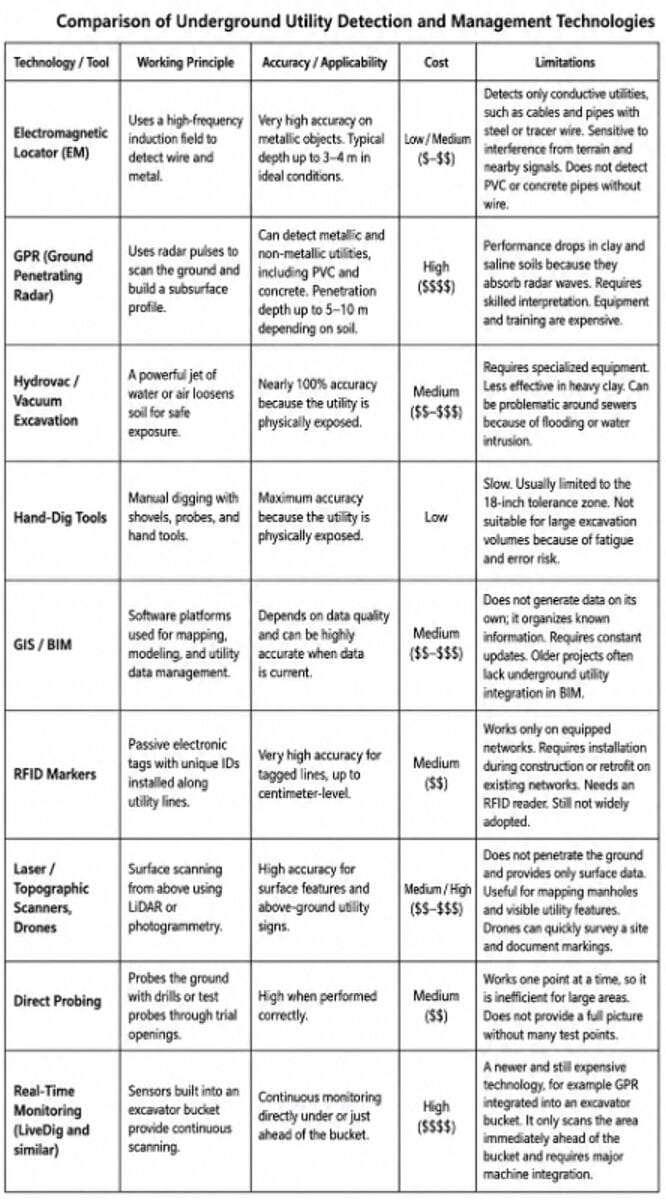
EM locators and GPR are the core tools for professional utility locating.
EM locators are fast, affordable, and effective on steel or traceable conductive assets. They do not detect plastic, concrete, or other non-conductive lines without tracer wire.
GPR can detect plastic pipes and help estimate depth, but it requires skilled operation and careful interpretation.
GIS and BIM do not locate utilities by themselves. They combine design records, field data, survey results, and verified utility locations in one model.
RFID markers can provide very high accuracy for tagged “smart” utility networks, but they require wide installation across the asset base.
Vacuum excavation and hand digging provide the highest certainty because they physically expose the utility. Crews use them when mechanical excavation must stop inside a high-risk zone.
Successful U.S. Project Examples
I-64, Virginia DOT. Virginia DOT used SUE before finalizing an I-64 widening project in Richmond. The consultant completed 156 QL-A test holes in potential conflict areas and found 75 utility conflicts. Designers adjusted the alignment and avoided about $731,425 in utility relocation costs. The test holes cost $93,553, so net savings reached $637,872. DOT also reported lower project costs and about 20% schedule savings.
Columbus Southern Power, Ohio. Columbus Southern Power used SUE before installing 2 km of 138 kV underground cable in downtown Columbus. Better utility data reduced bidder uncertainty. The gap between the two lowest bids was $400,000. SUE cost less than $100,000. The project had zero utility damages and no change-order claims tied to unknown utilities.
NC 168, North Carolina. On the NC 168 widening project, the team used SUE and completed 40 vacuum test holes to verify a water main. The findings showed that 6.5 km of water line could stay in place instead of being relocated. SUE cost less than $10,000 and saved about $500,000 in avoided relocation work.
Florida DOT SUE analysis. Florida DOT found that every $1 spent on SUE returned about $3 in savings, mainly by reducing contractor delay claims and utility-related conflicts.
Bear Contracting, WV/OH/PA. Bear Contracting adopted a digital 811 ticket-management system after West Virginia updated its 811 rules. The company moved from Excel and phone tracking to real-time ticket status updates and field alerts. Since implementation, Bear reported no delays from expired tickets and zero damages to marked utilities. The system also saved several staff hours each week.
Los Angeles hospital, GPR + EM scanning. GPRS scanned a hospital parking area in Los Angeles using both GPR and EM locators. The team found more utilities than expected and uploaded the data into SiteMap®. The hospital used the map to relocate and shut down utilities without disrupting critical operations. The scan identified 99.8% of utilities, reducing strike risk and downtime.
Implementation Roadmap and Checklist
A utility-damage prevention program requires coordinated work at every project stage. The flowchart below shows the main process for reducing utility-strike risk on a construction site:
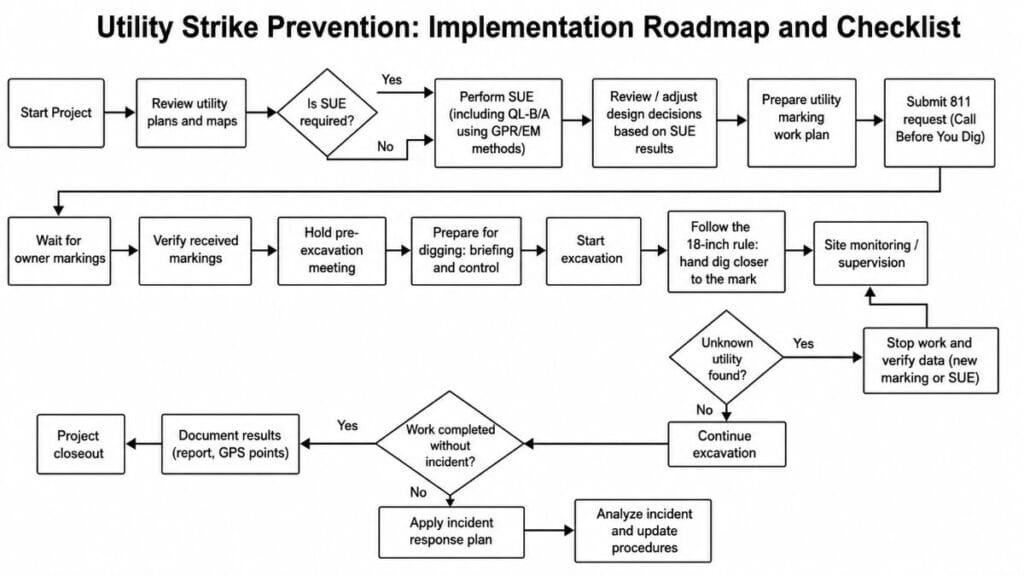
The diagram shows the main stages: planning, locating, excavation control, documentation, and incident response.
Preparation: Review utility plans, decide whether SUE is needed, bring in GPR/EM specialists if required, and adjust the route if utilities create conflicts.
811 request: File the ticket before work starts, usually at least two working days in advance. Wait for markings, then verify them on site.
Pre-excavation meeting: Bring together the crew, locators, engineers, and key subcontractors. Review 811 marks, SUE findings, risk zones, and responsibilities.
Excavation: Follow the 18-inch rule: hand dig inside the tolerance zone. Use vacuum excavation in dense or high-risk utility areas. Assign a responsible person on site and maintain OSHA-required competent-person oversight.
Control and documentation: Photograph exposed utilities, keep excavation logs, and record verified utility routes with GPS or survey data.
Incident response: If a strike occurs, follow the prepared response plan. After the incident, review the cause and update procedures.
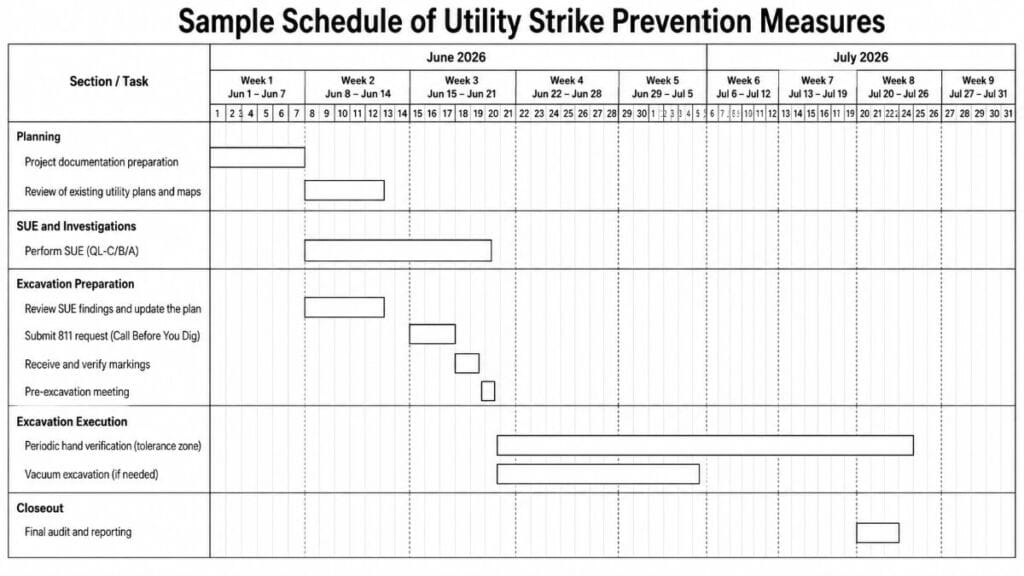
This schedule shows the main milestones. The project starts on June 1. The team spends the first week preparing project documentation and reviewing utility plans. SUE takes about 10 days. After that, the team reviews the findings and updates the work plan.
The 811 request takes three days. Markings are then received, checked, and reviewed during the pre-excavation meeting. Field excavation starts on June 21. During excavation, crews follow tolerance-zone rules and use hand digging or vacuum excavation where needed.
The main excavation controls run through July. The project ends with a final audit and report in mid-to-late July. This schedule is a template and should be adjusted to the actual project scope, site risk, and local 811 timing.
Bottom line: small contractors must lock down the basics: 811 compliance, safe hand digging, and clear field controls. They have little margin for downtime or repair costs.
Mid-size contractors should add SUE, written procedures, assigned safety responsibility, and regular checks.
Large contractors should automate the process, use digital utility data, track compliance, and build a zero-strike culture.
Sources: This report uses CGA, OSHA, DOT/FHWA, PHMSA, industry studies, U.S. case studies, and professional utility-locating sources. Where data is unavailable, the report states that directly. All findings are focused on U.S. practice.