
The Metro Phoenix housing market continued to favor buyers in October 2026 as inventory increased, home sales slowed and prices edged lower, according to the latest housing market data.
With more homes available and fewer properties going under contract, buyers are gaining negotiating power across Greater Phoenix. Meanwhile, sellers face growing pressure to price their properties competitively as the market enters the final months of the year.
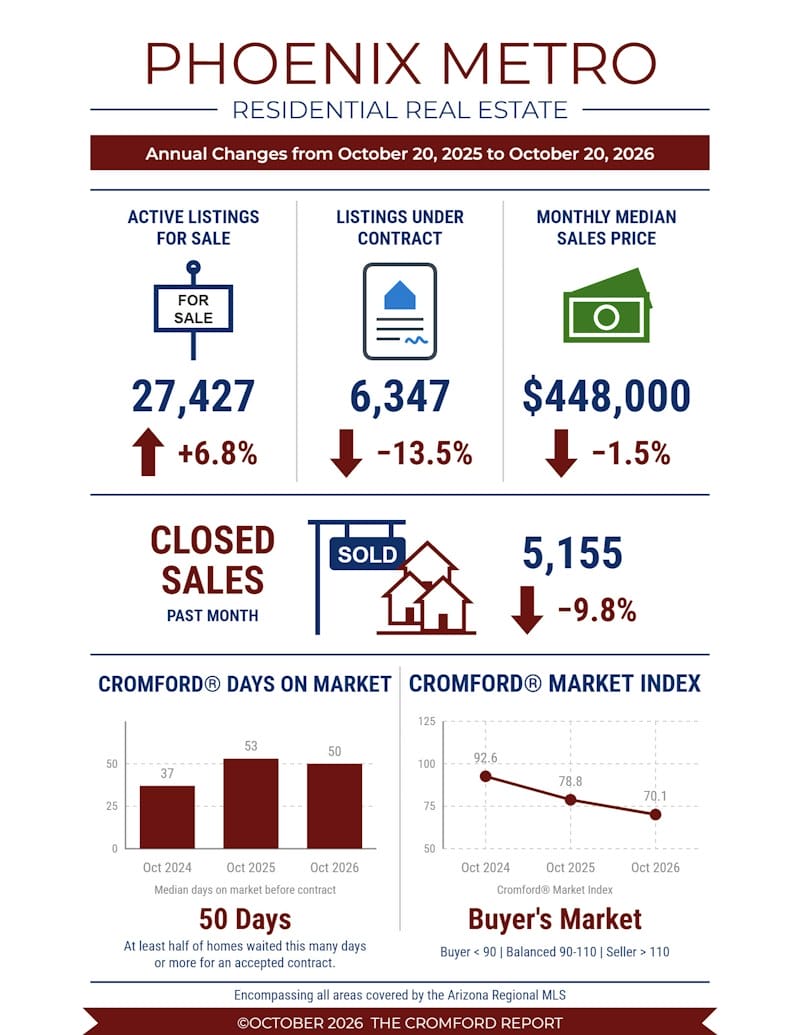
Active listings across Metro Phoenix increased 6.8% year over year to 27,427 in October, while listings under contract dropped 13.5% to 6,347.
Closed sales totaled 5,155, representing a 9.8% decline from a year earlier. The median sales price slipped 1.5% to $448,000, reflecting continued price sensitivity among buyers.
One of the clearest indicators of the changing market is the Cromford Market Index, which measures the balance between supply and demand.
The index fell to 70.1 in October, compared with 78.8 a year earlier and 92.6 in October 2024. An index below 100 indicates a buyer’s market, meaning supply exceeds demand.
The latest reading suggests that buyers have gained additional leverage as inventory builds and demand remains subdued.
Despite slower sales activity, homes are securing contracts slightly faster than a year ago. The median time to secure a contract was 50 days in October, compared with 53 days in October 2025.
MORE NEWS: Atari Hotels breaks ground in Roosevelt Row
DEEPER DIVE: 10 Arizona restaurants make Yelp’s Top 100 Mexican food spots
Buyers gain negotiating power
The growing supply of available homes is creating opportunities for buyers who have been waiting for more favorable market conditions.
With more properties to choose from and less competition, buyers may have greater flexibility to negotiate purchase prices, closing costs, repairs and other seller concessions.
Higher mortgage rates remain a challenge, however, particularly for first-time buyers and households facing affordability constraints. While refinancing could become an option if rates decline, future interest rate movements remain uncertain.
For sellers, the shifting market reinforces the importance of realistic pricing, effective marketing and property presentation.
Homes that are competitively priced and move-in ready may be better positioned to attract buyers, while overpriced listings could face longer marketing periods or price reductions.
The broader Metro Phoenix numbers also mask significant differences among individual communities.
Scottsdale leads in median home prices
Scottsdale remained the most expensive of the four communities included in the local market snapshots, recording a median sales price of $1.1 million.
The city reported 325 closed sales during the reporting period, generating approximately $483.4 million in sales volume.
Scottsdale homes sold for an average of 97% of their asking prices, while properties spent an average of 83 days on the market.
The city’s higher price points and longer marketing times highlight the differences between Scottsdale’s luxury-oriented market and more moderately priced communities elsewhere in the Valley.
Of the 325 homes sold, 246 were single-family residences, 77 were townhouses and two were condominiums.
Phoenix records more than $700 million in sales
Phoenix generated the largest sales volume among the four communities, with 1,034 closed transactions totaling approximately $706.5 million.
The city’s median sales price reached $470,000, while the average sale-to-list price ratio was 98%.
Homes spent an average of 68 days on the market.
Single-family homes accounted for 882 sales, followed by 149 townhouses and three condominiums.
Phoenix’s median price remained relatively close to the broader Metro Phoenix median of $448,000, although pricing varies substantially across the city’s neighborhoods and housing types.
Gilbert maintains higher median prices
Gilbert recorded 185 home sales and approximately $127.5 million in sales volume during the reporting period.
The East Valley community posted a median sales price of $605,000, the second-highest among the four cities examined.
Gilbert homes sold for an average of 98% of their asking prices and spent an average of 76 days on the market.
Single-family residences dominated sales activity, accounting for 172 transactions, while townhouses represented 13 sales.
Gilbert’s relatively high median price reflects its position as one of the Valley’s more expensive suburban housing markets.
Chandler sees shorter marketing times
Chandler recorded 178 closed sales totaling approximately $103 million in transaction volume.
The city’s median sales price was $513,000, while the average sale-to-list price ratio stood at 98%.
Homes spent an average of 59 days on the market, the shortest average marketing period among the four communities.
Single-family homes accounted for 159 sales, while townhouses represented 19 transactions.
Chandler’s shorter marketing period suggests that appropriately priced properties continue to attract buyers despite the broader slowdown in housing activity.
Metro Phoenix housing market by city
The following figures provide a snapshot of housing market activity in four major Greater Phoenix communities.
| City | Homes sold | Median sales price | Average days on market |
|---|---|---|---|
| Scottsdale | 325 | $1.1 million | 83 |
| Phoenix | 1,034 | $470,000 | 68 |
| Gilbert | 185 | $605,000 | 76 |
| Chandler | 178 | $513,000 | 59 |
What comes next for Metro Phoenix housing?
As 2026 draws to a close, the Metro Phoenix housing market appears likely to remain sensitive to mortgage rates, affordability pressures and changing inventory levels.
The combination of rising listings, declining pending sales and modest price reductions indicates that buyers have gained leverage compared with previous years.
However, the market remains highly localized. Conditions in Scottsdale’s luxury neighborhoods can differ considerably from those in Phoenix, Gilbert, Chandler and other Valley communities.
For buyers, the current environment offers opportunities to negotiate and explore a wider selection of properties.
For sellers, success increasingly depends on competitive pricing, strong marketing and realistic expectations.
The latest numbers suggest that Metro Phoenix has moved further away from the highly competitive housing conditions of recent years and toward a market where buyers have more choices — and more influence over the terms of a sale.