Miracle Mile — a stretch of pavement about 10 minutes north of Downtown Tucson — was once the glimmering gateway into Arizona’s second-largest city. During its heyday in the 1950s, glowing neon signs advertised lodging for road weary motorists visiting the Southwest. The completion of I-10, however, changed travel patterns and investor interest, setting the area on a decades-long trajectory of decline.
But earlier this year, Teen Challenge of Arizona proved the corridor is still a place where miracles happen. The organization cut the ribbon on its newly renovated Tucson Men’s Center on May 1 — a 51,541-square-foot redevelopment project that expands Teen Challenge’s capacity to help men struggling with addiction find respite and a path to sustained recovery.
“I have the best job in the world,” says Klayton Kirkwood, director of the Tucson Men’s Center. “Every week, I watch fathers repair relationships with their kids, husbands patch up their marriages and the faces of parents light up with joy seeing their son heal.”
Redeeming the corner
Teen Challenge — a nationwide religious nonprofit affiliated with the Assemblies of God — has served the Tucson community for more than four decades, with the original men’s center operating out a converted motel built in 1942 called Thunderbird Lodge.
Over time, however, the facility began showing its age. Kirkwood recalls fixing cracked pipes, only to have the water line burst somewhere else due to the increased pressure.
“We had to replace the roof every few years as new leaks would start,” he continues. “[The campus] needed a major refresh, but God had something greater planned.”
MORE NEWS: The office trends that are redefining the Phoenix market
When Teen Challenge occupied the former Thunderbird Lodge, its next-door neighbor was another relic from Miracle Mile’s golden age: the Tiki Motel. The neglected property had fallen into disrepair and attracted dangerous criminal behavior.
“There was prostitution, drug use and violence. It was so bad that the SWAT team would ask our permission to prepare for raids on the Tiki Motel at the center,” Kirkwood says. “There’s also a school right around the corner, so kids had to walk by it every day.”
The organization attempted to purchase the property multiple times, but in 2021, the owner of the Tiki Motel finally agreed to sell. Kirkwood, who had just started his tenure as the center’s director, found himself tasked with finding $350,000 in eight weeks.
“After the first month, we’d only raised $14,000. I kept thinking, ‘We finally have this opportunity and I’m going to fail,” he recalls. “But after a lot of work and faith that it would come together, we ended the second month with about $1.4 million.”
The fundraising effort, which Kirkwood named “Redeem the Corner,” caught the attention of anonymous donors who believed in Teen Challenge’s mission.
“They had been reintroduced to [the organization] through the campaign to purchase the Tiki Motel,” he continues. “The donors asked us, ‘Could we build you a brand-new facility?’ And my jaw dropped.”
Renewed purpose
Thanks to the generosity of the community and large anonymous donations, the “Redeem the Corner” initiative raised enough funds for Teen Challenge to realize its goal: make the neighborhood safer by removing a dilapidated building and expand the nonprofit’s capacity to serve through a complete rebuild of the Tucson Men’s Center.
Even though purchasing the Tiki Motel expanded the total area of the site, Kevin Illige, project director at Concord General Contracting, says erecting four buildings “on a postage stamp size lot” introduced challenges.
“One of them was the construction sequence,” he explains. “You have to build from the inside out so you don’t block yourself in. Once the buildings in the front go up, that restricts access to the back.”
Concord worked with Light+Path Architecture during the preconstruction phase to ensure each of the structures functioned according to the needs of staff and residents.
“But that design evolved as construction went on,” Illige adds. “We worked with the architect to make sure we were filling in the details and updating permits.”
Brian Hagedon, principal of Light+Path Architecture, says the project required a unique approach because of the faith-based character of the organization.
“Design is always about the people who occupy the space, but it’s even more so with Teen Challenge,” he continues. “These guys have struggled with abuse, addiction, anger problems — so the challenge was creating a place where they can be comfortable and open to healing.”
Recovery facilities often have a camp-like environment with very little privacy. Hagedon explains that one of the goals for the new Tucson Men’s Center was to give the men some sort of personal space.
In lieu of bunk beds, each resident sleeps in a cubicle-like environment with their own bed, dresser and desk. The area is still open so staff can check in, but Kirkwood says that setting up the rooms this way helps the men reclaim a sense of dignity during one of the most humbling and vulnerable periods of their lives.
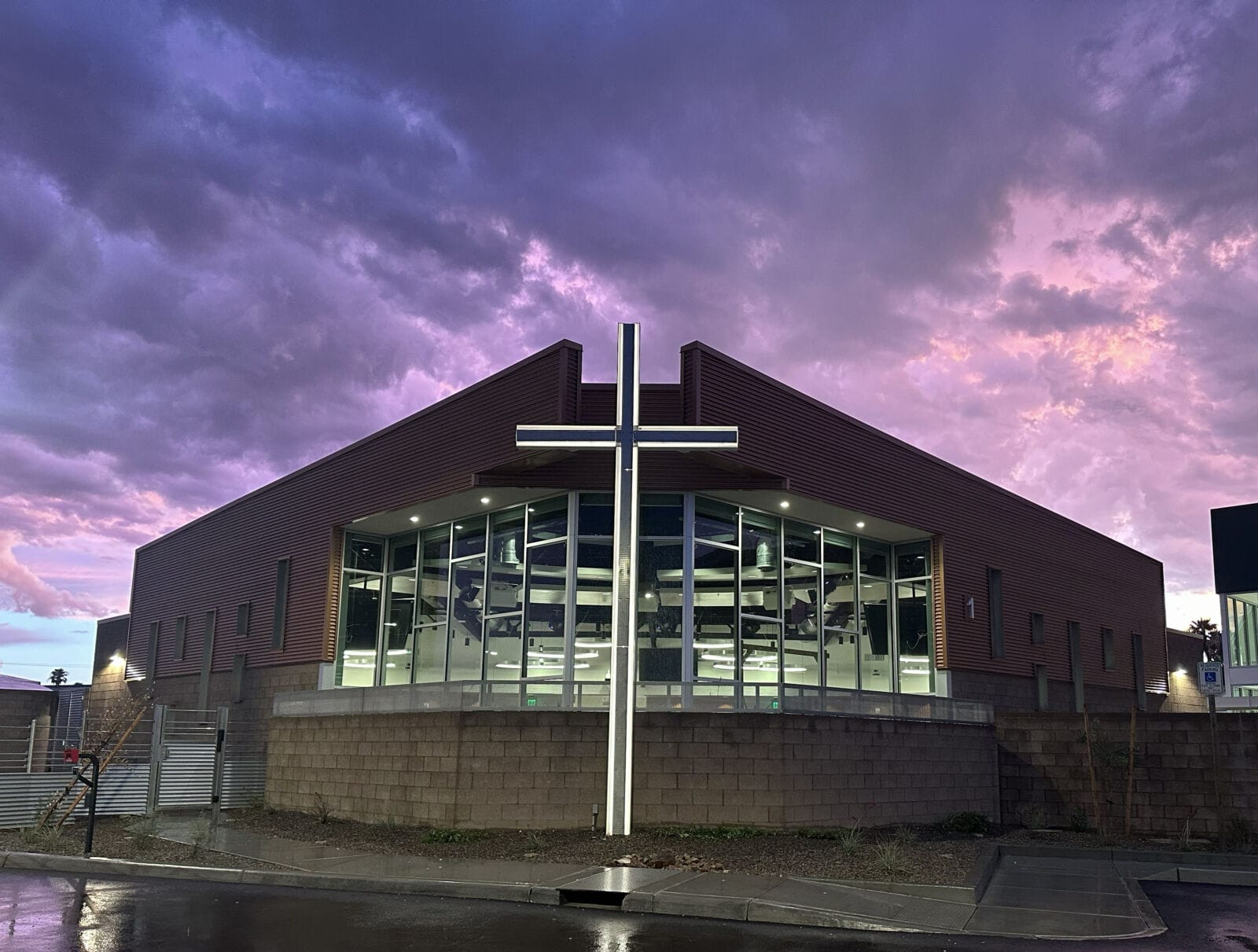
The focal point of the campus is the chapel and sits in the center of the site. Hagedon notes that the building is angled slightly northward, bringing the Santa Catalina Mountains into view through expansive glass paneling inside the sanctuary. A large cross stands just outside, but he says it’s more than a religious symbol.
“The chapel is roughly square, but one of the corners is cut out. We worked with a structural engineer, and the cross is actually a support element for the building tied into the roof structure,” Hagedon concludes. “You literally can’t take the cross away.”