
For Arizona real estate investors, the new tax headline sounds simple: 100% bonus depreciation is back permanently. That should remove the pressure, right? Not exactly. A Phoenix duplex, Scottsdale triplex, or Mesa fourplex can still see a major difference between closing and placing a property in service in December versus waiting until January, and that’s before we factor in what an engineering-based cost segregation study adds to the math.
The One Big Beautiful Bill Act, passed as H.R. 1, made significant federal tax changes after being signed into law on July 4, 2025. According to IRS guidance, Section 168(k) now provides a permanent 100% additional first-year depreciation deduction for qualified property acquired and placed in service after January 19, 2025.
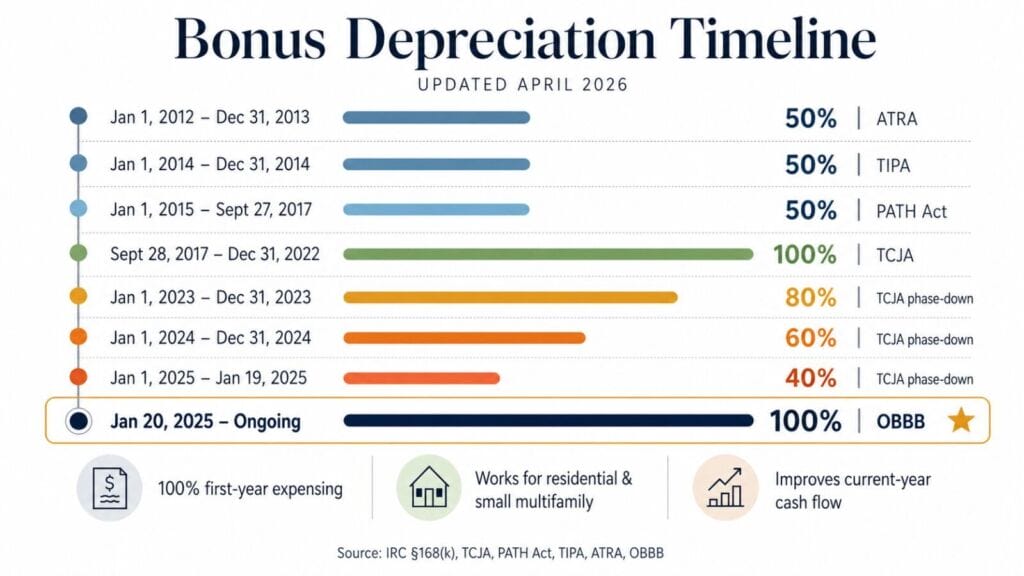
The word “permanent” is what many investors hear. The phrase “placed in service” is what matters when tax year timing affects which return gets the deduction and whether a deal cash-flows after taxes.
What Permanent 100% Bonus Depreciation Actually Changed
Before the law change, bonus depreciation was phasing down. Investors had to model shrinking first-year deductions, which made timing feel urgent because the percentage itself was disappearing. Now the percentage is no longer the problem.
For eligible property, the 100% bonus depreciation rule gives investors more certainty. Qualified shorter-life components identified through cost segregation can be written off immediately, rather than spread over long schedules. That is a major planning win for real estate buyers who want tax savings close to the purchase date.
But permanence does not mean every year is equal. If a property is placed in service in 2026, the accelerated deductions belong to the 2026 tax year. If the same property is not ready and placed in service until early 2027, those deductions move with it.
Why Small Arizona Multifamily Benefits More Than It Used To
Arizona’s small multifamily market is built on practical buyers. These are not always institutional transactions with giant tax teams and $20 million acquisition budgets. Many are local investors buying 1-10 unit properties in Phoenix, Scottsdale, Mesa, and Tucson, often with bank debt, private capital, and tight renovation budgets.
That is exactly where small multifamily cost segregation can matter. A duplex, triplex, fourplex, or small apartment building may contain a meaningful amount of five-, seven-, and 15-year property inside the purchase price. Flooring, appliances, cabinets, certain electrical components, site improvements, and other items may be pulled out of the 27.5-year residential rental schedule when properly documented.
For years, the problem was not the tax theory. The problem was the price. Engineering-based cost segregation studies were often quoted at $8,000 to $15,000, which made sense on larger assets but not on many small residential deals.
Firms that offer virtual site visits nationwide like SMF Cost Segregation Advisors changed that equation with small residential pricing that starts at $1,750 for a 1-unit property and $2,750 for 2-10 unit properties. That matters because engineering-based cost segregation was often priced for larger assets, making it hard to justify on smaller residential deals.
With purchase prices as low as $100,000 still potentially showing material ROI relative to the cost of a study, Arizona investors can now evaluate an engineering-based cost segregation study with a virtual site visit and IRS audit protection included.
The Phoenix Fourplex Math
Take a $900,000 Phoenix fourplex. Land is not depreciable, so the exact basis depends on the allocation between land and building. But for a simple illustration, assume the depreciable building basis supports accelerated deductions in the 20% to 30% range.
That creates a potential first-year acceleration of roughly $180,000 to $270,000. For a buyer using Arizona cost segregation planning, that is not a small footnote. It can be the difference between a deal that feels thin on monthly cash flow and one that works after tax.
The timing matters even more in the current rate environment. Higher debt service has made small multifamily underwriting tighter across Arizona. Cap rates have not always widened enough to fully offset financing costs, so investors are looking harder at tax-adjusted returns.
A $200,000 accelerated deduction will not fix a bad deal. It will not turn weak rent rolls into strong ones or make deferred maintenance disappear. But on a solid property with tight first-year cash flow, it can improve the after-tax picture enough to change how the investor thinks about reserves, renovation pacing, and debt coverage.
After seeing the basic example, investors can run the numbers on your property to get a more realistic estimate before they talk to a CPA or finalize year-end planning.
Why Closing December 15 Is Not The Same As January 5
The key phrase is not “closed.” It is “placed in service.” For rental property, that generally means the property is ready and available for its intended rental use, not merely under contract or sitting in escrow.
That distinction creates real year-end pressure. If an investor closes on Dec. 15, completes the minimum work needed, has units available for rent, and places the property in service before Dec. 31, the accelerated deductions may fall into that tax year. If the same investor closes Jan. 5, the benefit shifts to the following year.
That is not a technicality for small investors. A Phoenix buyer with W-2 income, passive income, short-term rental income, or multiple rental properties may be planning liquidity around a specific tax year. Moving a six-figure deduction from 2026 to 2027 can change estimated payments, reinvestment plans, and repair reserves.
It also changes investor psychology. A buyer who expects first-year tax relief may bid differently, hold more reserves, or move faster on improvements. Push the deduction a year later, and the same deal may feel much less attractive.
Why The Old Cost Segregation Economics Did Not Fit Small Residential
Traditional cost segregation was built around larger commercial and multifamily properties. The studies were detailed, engineering-based, and often expensive. That made sense for a $10 million warehouse or a 150-unit apartment complex.
Small Arizona multifamily sat in an awkward middle. The tax savings could be real, but the fixed cost of the study could eat too much of the benefit. A buyer might know that cost segregation was available and still decide not to use it because the fee structure was designed for larger assets.
That is why lower fixed pricing changes the conversation. With pricing starting at $1,750 for a 1-unit property and $2,750 for 2-10 unit properties, an engineering-based cost segregation study can make sense on smaller assets if the accelerated deduction is large enough. It also lets investors evaluate more deals without assuming the strategy is only for institutional buyers.
This is especially relevant for cost segregations studies in Phoenix MSA neighborhoods, where small multifamily properties trade as local investor assets. Many of these buyers are not acquiring 100 doors at a time. They are buying one duplex, one fourplex or one small building, then repeating the model.
For that audience, cost segregation does not need to be overbuilt. It needs to be accurate, affordable, and supported well enough that the investor’s CPA can use it confidently.
The Arizona Investor’s Year-End Checklist
The first step is to know whether the property can realistically be placed in service before year-end. If major renovations will keep units offline until January or February, the investor should not pretend the deduction belongs to the current year. The tax plan has to follow the operating facts.
Next, investors should coordinate early with their CPA. Bonus depreciation, passive activity rules, short-term rental treatment, material participation, and state-level considerations all affect how useful a deduction is in practice. A cost segregation study identifies accelerated components, but the tax return still has to apply the rules correctly.
Then comes the practical timing. Order the study early enough that it does not become a bottleneck. Make sure closing documents, settlement statements, inspection notes, rent-readiness details, and renovation records are organized.

That kind of recordkeeping may feel tedious, but it matters. If a large deduction lands on a return, investors should be able to explain how the property was acquired, when it was ready for rental use, and how the cost segregation study allocated basis.
Unlocking Institutional-Level Tax Strategies For The Average Real Estate Investor
Arizona’s small multifamily investors are often competing in a narrow lane. They face higher borrowing costs, insurance pressure, repair surprises, and rent growth that varies block by block. They need every legitimate planning tool available.
Permanent 100% bonus depreciation gives them certainty. Affordable cost segregation gives them access. Placed-in-service timing gives them urgency.
That combination is why year-end still matters. It is not about fear of a disappearing deduction anymore. It is about choosing whether the deduction supports this year’s return or next year’s.
For Phoenix, Scottsdale, Mesa, and Tucson investors, that can change how quickly a property stabilizes on an after-tax basis. A small building may look only modestly attractive before tax planning, then become more compelling when depreciation is modeled correctly.
The Bottom Line For Arizona Small Multifamily Buyers
The OBBBA made 100% bonus depreciation permanent, but it did not make timing irrelevant. For small multifamily investors, the calendar still matters because tax years matter. A Dec. 15 closing and a Jan. 5 closing can produce very different first-year outcomes if the property is placed in service on opposite sides of year-end.
The bigger shift is access. Engineering-based cost segregation used to feel like a large-property tool because the pricing often made small residential deals uneconomic. With SMF Cost Segregation Advisor’s small residential pricing, Arizona duplex, triplex, and fourplex buyers can now evaluate the strategy on deals older pricing models would have ignored.
That does not mean every property qualifies or every investor should claim the same benefits. It means the question is finally worth asking before the year closes. Arizona investors who are close to the finish line should talk with their CPA, gather the property facts, and see if your property qualifies before letting the deduction slide into another tax year.