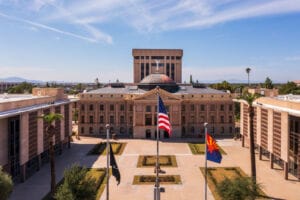
Each session, Arizona’s lawmakers consider stacks of new bills and revisions to current statutes, each one having the capacity to reshape the lives of residents and the way companies conduct business. According to statistics from the Arizona State Legislature’s website, 1,854 bills, memorials and resolutions were introduced in 2025. Of those, 439 were delivered to Gov. Katie Hobbs, with only 265 signed into law.
With less than 15% of all items surviving the crucible of lawmaking, many industries rely on associations to advocate at the Capitol on their behalf. In Arizona’s commercial real estate sector, NAIOP seeks to do just that — even if the process isn’t as simple as “Schoolhouse Rock!” made it seem.
“If you’re not in this world, it’s easy to think that all you have to do is come up with a great idea, write a bill and it gets signed into law,” explains John Baumer, NAIOP’s director of government relations. “But the reality is that it’s not common to be successful on the first try, especially with more nuanced and technical matters.”
Enacting policy is, by design, a deliberative and thorough process. For professionals like Baumer, the journey starts with convincing one of the 90 members of the legislature to sponsor a bill. It then gets sent to a committee where it must be voted on before being presented to the wider legislative body.
“There are many hurdles to overcome just to have something make it to the governor’s desk — and even then it can be vetoed,” Baumer says. “You need to engage with stakeholders from the start, whether they support or oppose your policy. If a committee chairperson agrees to hear the bill and you tell them you haven’t talked with these other groups, they may hold the bill or just vote it down.”
Lobbying often evokes images of smoke-filled rooms and closed-door deals, but Baumer argues that much of what he does involves education. The real-world implications of a measure can get lost when looking at statutory language, so Baumer provides the commercial real estate industry’s perspective on issues so policymakers understand the positive or negative consequences of a piece of legislation.
“At the end of the day, there are 90 elected officials who need to be well-versed on the topics that come before them. That’s a lot of information for anyone to handle,” he continues. “We want to be a resource for legislators to help them create the best policy proposals possible.”
DEEPER DIVE: Here’s where the residential real estate market stands in 2025
LOCAL NEWS: 100 best places to work and live in Arizona for 2025
INDUSTRY INSIGHTS: Want more news like this? Get our free newsletter here
Speaking as one
To authentically represent the views of its members, NAIOP has two groups dedicated to the association’s advocacy efforts. The Government Affairs Advisory Committee serves as the primary group tasked with monitoring legislative issues and engaging with elected officials.
Those with a high level of commitment and expertise may be asked to take on a larger role in positioning NAIOP as the voice of commercial real estate by joining the Public Policy Executive Committee (PPEC).
Byron Sarhangian, partner at Snell & Wilmer and co-chair of the PPEC, helped form the committee with the goal of strengthening NAIOP’s ability to shape the lawmaking process. The PPEC works closely with NAIOP’s board of directors to identify legislative priorities, as well as other organizations such as GPEC and the Arizona Chamber of Commerce & Industry to find areas of alignment.
“Historically, the commercial real estate community has been underrepresented at the legislature. That’s unfortunate considering the industry’s significant role in the state’s economy,” he explains. “But we want our elected officials to have groups they can go to and hear what the impact of their decisions will be, because oftentimes it’s not entirely clear to them.”
Developers, contractors and attorneys all participate in the committee, each bringing their own thoughts on how to address these problems. By having a diversity of perspectives, the PPEC is better equipped to uncover what friction points exist across the whole spectrum of commercial real estate rather than fixating on a particular subsector.
That collaboration, Sarhangian says, resulted in a list of what the group believes to be the top issues facing the industry from a legislative standpoint.
“We are advocating for down-the-fairway solutions and talking with lawmakers about them, so at the very least our voice is being heard,” he says.
Promoting progress
Thanks to a series of high-profile investments from world-renown companies, Arizona’s reputation as a fruitful place to operate is spreading. Maintaining that status is crucial as more businesses consider coming to the state, and beating the competition may require action from the legislature.
“Arizona is at an inflection point,” Baumer says. “There will come a time where more assistance from the government will be needed to land the next big project. Right now, we’re fairly limited in what we can offer as incentives for any type of development.”
For example, Baumer notes that Arizona stands alone as the only state without tax increment financing, or TIFF, after the legislature did away with it after a brief period in place. Even though Arizona has enjoyed great success in attracting businesses, the minimal economic development tools available today may throttle growth in the future.
That’s why NAIOP supported Rep. Michael Carbone’s legislation during the 2025 session that would have applied transaction privilege tax (TPT) reimbursements towards the on-site infrastructure built for projects, so long as they met statutory criteria. Allowing developers to recoup the TPT generated from creating these core facilities would help drive down overall costs and make further growth more manageable.
“This would’ve ensured no one was running afoul of the state constitution’s gift clause while understanding that water and power infrastructure have become huge expenses,” Baumer says.
Due to concerns surrounding potential impacts to the state’s general fund, the effort stalled out. Despite it failing, Baumer is encouraged to see more policymakers recognize that with all the headwinds facing the commercial real estate industry — from interest rates squeezing capital markets to uncertainty around tariffs — more robust incentives for development may be needed.
Another effort NAIOP advocated for was reforming Arizona’s construction defect statutes. Sarhangian explains that the status quo is overly harsh towards sellers of condominiums, constricting housing supply during a time of scarcity. He notes that the goal isn’t to eliminate consumer protections but create more thoughtful mechanisms that don’t make condo construction unfeasible.
As currently written, if a construction defect issue occurs within the prescribed eight-year timeframe, there are grounds to initiate a class action lawsuit. This exposure discourages many developers and lenders from building condos, functionally removing an entire residential asset class from the market.
“Luxury condos are going up, but that’s because those projects can absorb the high insurance costs required thanks to the construction defect laws,” Baumer adds. “If we want this type of housing to be attainable for middle-income Arizonans, something has to change.”
A menu of reforms was presented to lawmakers, including having an independent third-party review claims and empowering condo associations to vote on whether to pursue a construction defect lawsuit instead of just the board, as is the case today.
“We had a number of other provisions that would’ve cleaned up the process, but unfortunately, that did not go far this session,” Baumer continues. “There was a lot of vocal opposition going into the committee hearing, so we opted to pull the bill back. We’re taking this intervening period to engage with more stakeholders and build a broader coalition to see what we can accomplish in 2026.”
Measuring success
While not every item backed by NAIOP survived the gauntlet of policymaking, the 2025 legislative session did not adjourn without any wins for the commercial real estate industry. Baumer highlights a pair of bills pertaining to utilities as two achievements worthy of celebration.
“One had to do with mitigating wildfire liability, and the other dealt with utility securitization,” he continues. “We’ve grown considerably over the last few years, causing the demand for energy to spike. Those new pieces of legislation will help utilities manage their current load requirements while also enabling them to finance future developments related to power generation. That will allow our economy to continue expanding.”
The signing of House Bill 2110 was another victory, which revised statutory language around converting commercial buildings into multifamily or mixed-use properties. But in the world of policymaking, success isn’t defined solely by what becomes law.
“We opposed the [Government Property Lease Excise Tax (GPLET)] reduction bill that passed this year, and we were very appreciative of Gov. Hobbs for vetoing it for the second year in a row,” Baumer says. “It’s a nuanced issue, but the governor and her team understood that GPLET is one of the few economic development incentives we still have in the state, and the legislation would have severely limited the ability for state and local governments to use that tool.”
Even when the passage of an imperfect law seems imminent, there is an opportunity to provide input and reduce potential downsides. This session, a push to restrict the ownership of property by foreign adversaries found a strong base of support, but Baumer notes that the original wording of the bill would’ve led to unintended consequences.
By working with coalition partners and policymakers, amendments were made to the legislation providing clarifying language and minimizing the adverse impacts on business attraction, while still maintaining the core vision of the bill’s sponsors.
“The key to public policy is being willing to have those conversations and negotiate,” Baumer concludes. “Despite the widening political divide, 2025 was an overall good year for Arizona and the commercial real estate industry, and we’ll build on those successes again next year. It was a long six months of robust debate, but it ended with a significant state budget. No one walked away entirely happy with the result — but that means the negotiation process worked.”