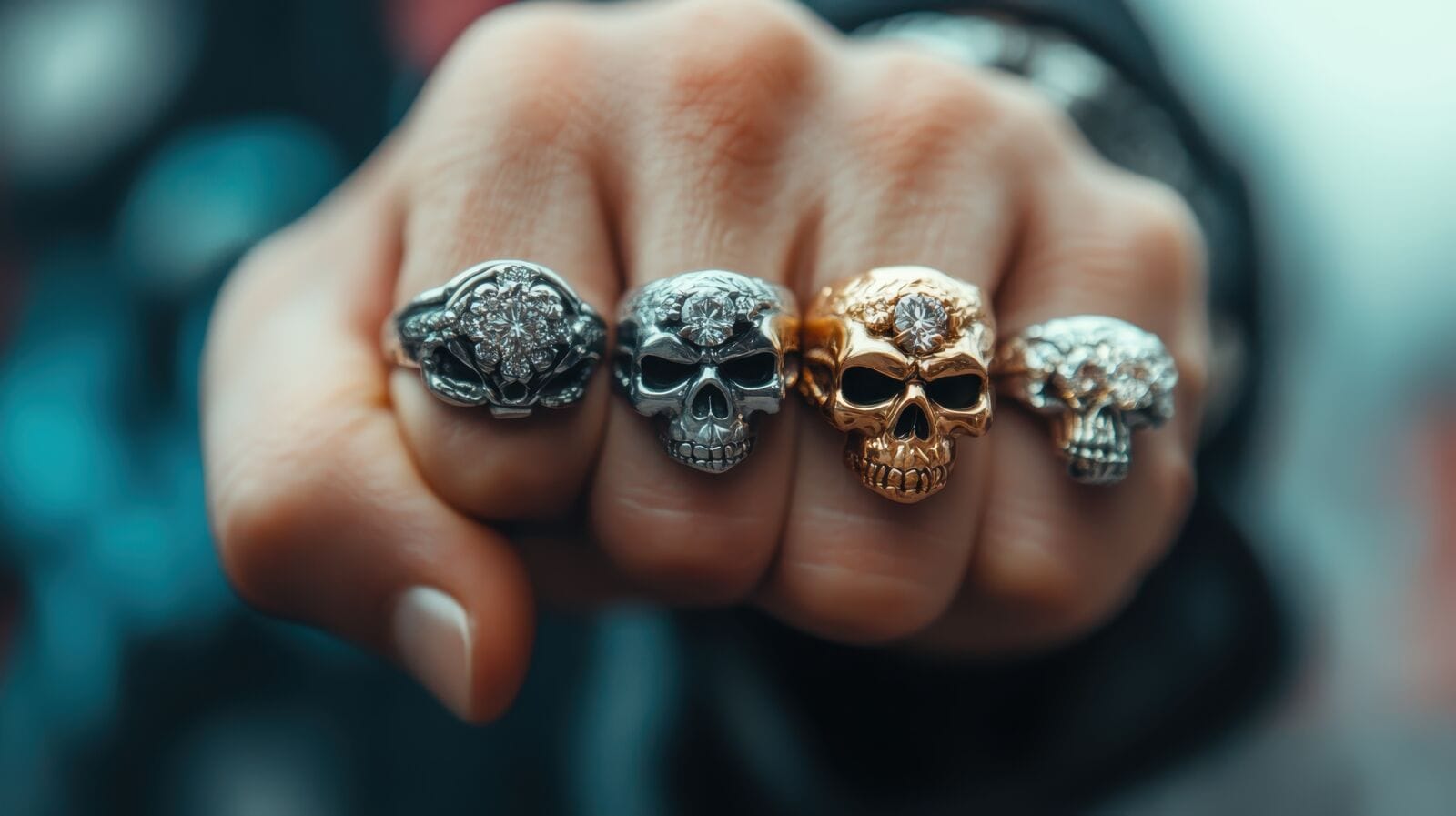
Thirty years ago, a man wearing a skull ring to a job interview would’ve raised eyebrows. Today, the U.S. men’s jewelry market sits at $5.4 billion — growing at 8.4% annually, nearly double the rate of women’s jewelry. Something shifted.
If you trace the timeline, the inflection points almost always lead back to a screen — a movie, a TV series, a music video where a ring or pendant became inseparable from a character’s identity. Gothic jewelry didn’t go mainstream because of marketing campaigns. It went mainstream because audiences watched characters wear it with conviction, then wanted that same energy for themselves.
The Costume Designers Nobody Credits
Every iconic piece of screen jewelry passed through a costume designer’s hands before it reached the actor. These decisions are deliberate — often argued over for weeks — and they shape what millions of viewers associate with dark jewelry.
Colleen Atwood, a four-time Academy Award winner, designed Wednesday Addams’ wardrobe for Netflix. In interviews, she emphasized that every accessory had to feel functional or symbolic — nothing purely decorative. The gothic silver pieces Jenna Ortega wore weren’t randomly selected. Each communicated something specific about the character’s emotional armor in that scene.
Michele Clapton took a different approach on Game of Thrones. She designed Cersei Lannister’s jewelry to track the character’s psychological arc across eight seasons. Early seasons showed delicate gold chains. As Cersei accumulated power, the pieces grew heavier, sharper, more architectural — until her final-season necklace resembled body armor more than adornment. Google searches for “Cersei necklace” and “lion pendant gold” spiked after every major episode.
This is the part audiences never see. When a character’s ring catches light during a close-up, that moment was planned — sometimes storyboarded. Costume departments test jewelry under specific lighting rigs, checking how oxidized surfaces read on camera versus polished ones. Dark, oxidized silver photographs better on screen than bright finishes because it doesn’t create hot spots under studio lighting. That’s why nearly every “dark hero” character — from Geralt to John Wick — wears matte or oxidized metal on screen.
Oxidized sterling silver — the matte, dark finish that costume designers prefer because it reads on camera without reflecting studio lights. Photo provided by Biker Ring Shop
Music Videos That Turned Dark Jewelry Into Streetwear
A 30-second jewelry ad gets one viewing. A hit music video gets played 50 million times — and the artist’s rings are visible in every single frame. That math explains why music videos have quietly become the most powerful dark jewelry marketing channel on the planet.
Post Malone’s Psycho video — over 1.8 billion YouTube views — showed him wearing heavy skull rings, gothic crosses, and stacked silver chains throughout. His “more is more” approach wasn’t styled by a fashion team. It was his actual daily collection, worn on and off camera. That authenticity registered with viewers who could tell the difference between a costume and a commitment.
Travis Scott’s visual aesthetic pushed the boundary further. His concert footage and music videos consistently feature oversized silver rings and chains against dark, smoky backdrops — gothic jewelry reframed as streetwear, not subculture. The combination reached an audience that traditional jewelry marketing never touches: men aged 18-30 who’d never walked into a jewelry store but spend hours on YouTube.
The K-pop pipeline works differently but produces similar results. G-Dragon has worn gothic silver accessories across hundreds of performances, driving search spikes across Southeast Asia and Korea. When BTS members wore skull-motif rings during their ON choreography video, Korean retailers reported sellouts of similar designs within days of release. K-pop’s visual repetition — the same jewelry seen across music videos, dance practices, behind-the-scenes content, and fan events — creates exposure density that no Western marketing model replicates.
What makes music videos uniquely effective is repetition fused with emotion. Fans don’t just see the jewelry once — they see it every time they replay the song. The ring becomes inseparable from the feeling the music creates.
Vikings Changed Everything About Men’s Arm Rings
Before History Channel’s Vikings premiered in 2013, arm rings were an archaeological curiosity — something you’d see behind glass in a Scandinavian museum. By the time the show wrapped its sixth season in 2020, “Viking arm ring” had become a permanent search category on Etsy, Amazon, and every specialty retailer carrying Norse designs.
The show used arm rings as a plot device with genuine historical grounding. Ragnar Lothbrok’s arm ring ceremony — where warriors swore loyalty by placing their hand through a silver ring held by their jarl — mirrored actual Viking Age oath rituals documented in the Icelandic sagas. The prop department cast the rings in solid metal so the weight felt authentic during filming. You could hear them clank against sword hilts in fight scenes.
That narrative weight translated directly to consumer behavior. Retailers who carry gothic jewelry in sterling silver — including Norse and Viking-inspired designs — tracked measurable traffic increases during each season’s premiere window.
The Last Kingdom (2015–2022) reinforced the trend from a different angle. Where Vikings glorified Norse raiders, The Last Kingdom showed Saxon lords and Danish warlords using jewelry as political currency — heavy signet rings traded as oaths, Thor’s hammer pendants worn as declarations of faith in contested territory. The two shows together built a visual vocabulary for men’s jewelry that had no modern precedent: raw, heavy, historically grounded, and tied to loyalty rather than vanity.
Google Trends data tells the story clearly. “Viking jewelry men” climbed steadily from 2014 through 2022, with spikes aligning precisely to season premieres. The category barely existed in mainstream men’s fashion before these shows aired. Now it’s permanent.
Peaky Blinders vs. Wednesday — Two Paths to Gothic Rings
Peaky Blinders (2013–2022) and Wednesday (2022–present) couldn’t be more different in tone. One is a gritty British crime drama. The other is a Gen-Z gothic comedy. But both drove men toward dark, statement accessories — through different doors.
Tommy Shelby’s signet ring became one of the most searched men’s accessories on Google during the show’s run. Retailers reported spikes in vintage ring sales — particularly signet rings and pocket watch chains — every time a new season dropped. The show revived a category of men’s jewelry dormant since the actual 1920s.
Netflix’s Wednesday pulled 182 million households in its debut. Jenna Ortega’s press tour wardrobe — head-to-toe black with gothic silver accessories — triggered what the Natural Diamond Council called “a modern-day gothic jewelry revival.” Etsy searches for “gothic silver jewelry” surged within weeks of the premiere.
Together, these two shows proved gothic jewelry wasn’t just for subcultures anymore. It had mass-market appeal when paired with the right cultural moment.
A gothic claw ring worn casually at a bar — the kind of understated dark jewelry that Peaky Blinders and Wednesday brought into the mainstream. Photo provided by Biker Ring Shop
From the One Ring to the Wolf Medallion — Fantasy Built a New Category
When The Lord of the Rings arrived in 2001, Jens Hansen — the New Zealand goldsmith who crafted the original One Ring props — was overwhelmed with replica orders. Over 40 ring variations were made for the trilogy. Replicas ranged from $39 (gold-plated) to $1,200 (platinum). Bookstores couldn’t keep One Ring bookmarks in stock.
The pattern repeated. Game of Thrones (2011–2019) turned the Stark direwolf sigil into a pendant every fantasy fan wanted. Sterling silver Wolf pendants and House rings flooded Etsy and Amazon. Then The Witcher gave us Geralt’s wolf medallion — now an official Netflix replica sold through every major retailer.
Fantasy franchises created something unprecedented: men who’d never entered a jewelry store were buying pendants and rings because of fictional characters. The pieces weren’t fashion accessories in the traditional sense — they were identity markers.
Sterling silver gothic cross pendant — the kind of piece that fantasy and dark-aesthetic TV made mainstream for men. Photo provided by Biker Ring Shop
Pick Your Screen, Pick Your Ring
If you’re thinking about your first dark or gothic ring, the screen-to-style pipeline offers a useful framework. Match the energy, not the exact prop.
The music video route: Heavy skull rings, stacked silver chains, multiple rings on every finger. Post Malone and Travis Scott proved that volume works — as long as every piece has actual weight behind it. Sterling silver in the 25-40 gram range gives that heft.
The Shelby route: Signet rings, clean lines, dark onyx or flat black stones. One ring, worn with intention, says more than five. Bikerringshop’s guide to gothic style jewelry breaks down how different substyles translate to actual wearable pieces.
The Norse route: Arm rings and pendants — Thor’s hammer, wolf motifs, raw twisted metal. Vikings and The Last Kingdom made this category permanent. Start with a pendant on a leather cord. Move to a cuff or arm ring when you’re ready.
The fantasy route: A wolf medallion, dragon sigil, or House ring. The lowest-commitment entry point — and thanks to LOTR, Game of Thrones, and The Witcher, the most socially accepted one.
Pro tip: Sterling silver develops a natural patina — darker in the crevices, brighter on raised surfaces. This oxidized look is what gives gothic rings their character. It’s the same effect you see on every screen-worn piece.
Frequently Asked Questions
Why did gothic jewelry become popular with men?
Screen exposure is the biggest driver. Characters like Tommy Shelby, Ragnar Lothbrok, and Geralt of Rivia wore dark statement jewelry as part of their identity — not as decoration. Artists like Post Malone and G-Dragon reinforced it through music videos. When audiences connected emotionally with those characters and artists, the jewelry became aspirational.
Why do music videos drive jewelry trends more than traditional ads?
Repetition and emotional association. A fan replays a music video 20-50 times — seeing the artist’s rings in every frame, linked to a song that triggers a specific feeling. A jewelry ad gets one passive viewing. Music videos also reach men aged 18-30, a demographic that rarely engages with traditional jewelry marketing but spends hours on YouTube and streaming platforms.
Can you wear gothic rings to a professional job?
Yes — it depends on the piece. A slim signet ring or a small oxidized silver band works in most professional environments. The Peaky Blinders effect specifically normalized vintage-dark jewelry in business contexts.
Are movie replica rings worth the money?
It depends on the maker. Official One Ring replicas from Jens Hansen are handcrafted in the same workshop that made the film props — those hold value. Mass-produced replicas often use hollow construction and plated finishes that wear off within months. Look for solid sterling silver with actual weight to it.
The screen keeps turning. Every new show with a compelling character wearing dark silver adds another wave of men to the gothic jewelry market. What costume designers started behind the scenes, music videos amplified to billions of viewers — and now it’s a $5 billion industry that shows no sign of slowing down.
The rings change. The stones change. But the core appeal stays the same — a piece of metal that tells people something about who you are before you say a word.