
Homeowners only call the first few companies they see on the first page of Google. If your HVAC business in a competitive market like Dallas, TX, is hidden on page two, 97% of your potential customers may never find you. This highlights the critical need for robust online visibility for HVAC contractors. A specialized HVAC SEO company understands these challenges, focusing on strategies that position your business exactly where customers are looking. We will explore how data-driven digital marketing can help you capture more leads, improve local search rankings, and achieve sustainable growth in the crowded HVAC industry.
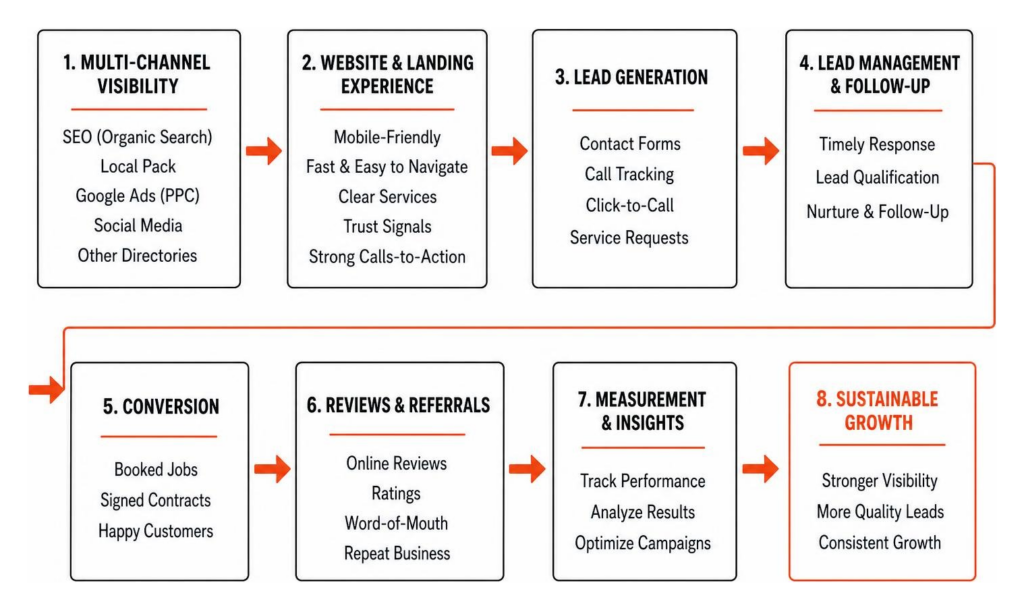
Core Pillars of Digital Marketing for Home Services
For any contracting business, especially in the HVAC sector, a successful digital marketing strategy rests on several interconnected pillars. These include driving organic traffic, securing prominent positions in the local pack, effectively managing pay-per-click campaigns, optimizing for lead generation, and consistently improving conversion rates. Neglecting any of these areas can significantly hinder your ability to reach potential customers who are actively searching for your services.
We understand that the landscape of digital marketing for home service businesses is constantly evolving. It requires a comprehensive approach that integrates various online channels to ensure your company is visible, credible, and accessible to your target audience. By focusing on these core elements, HVAC contractors can build a resilient online presence that generates consistent, high-quality leads.
Local Search Visibility and SEO
Local Search Engine Optimization (SEO) is paramount for HVAC contractors. When an air conditioner fails in July or a furnace quits in January, homeowners immediately turn to search engines like Google, often using “near me” or city-specific queries. Our goal is to ensure they find your business first. This involves optimizing your website and online presence to rank highly in the local map pack and organic search results.
Map Pack visibility, in particular, is a game-changer. Research indicates that 93% of “HVAC near me” searches trigger the Map Pack, with the top three positions capturing a significant 42% of clicks. Achieving and maintaining these top spots requires a meticulous approach to technical SEO, including ensuring your website has excellent crawlability, fast site speed, and is fully optimized for mobile indexing. Google’s mobile-first indexing means your site’s performance on smartphones is crucial for its overall ranking.

To illustrate the different approaches to gaining local visibility, consider the comparison between organic search optimization and paid local service ads:
Feature Organic Search Optimization (SEO) Paid Local Service Ads (LSAs) Visibility Type Appears in Map Pack and organic search results Appears at the very top of Google, often with “Google Guaranteed” badge Cost Model No direct cost per click/lead; investment in strategy/implementation Pay-per-lead (PPL) or pay-per-click (PPC) Time to Results Typically 3-6 months for visible results, 6-12+ months for significant ROI Can generate leads within the first week of launch Longevity Long-term, compounding asset; results continue after investment stops Stops generating leads as soon as budget runs out Lead Quality Often higher quality, more qualified leads Varies; can be good but also subject to quick clicks/calls Control Full control over content, branding, user experience Limited control over ad copy, landing page is often a Google profile Competitive Advantage Builds brand authority, trust, and sustained market dominance Immediate market presence, but can be easily replicated by competitors AI Search Visibility Essential for AI search recommendations (GEO) Less direct impact on AI search results Google Business Profile Optimization
Your Google Business Profile (GBP) is arguably the single most important tool for local HVAC SEO. It’s the digital storefront that connects you directly with customers in your service area. A fully optimized GBP can significantly boost your visibility in the Map Pack and drive emergency calls.
Key aspects of GBP optimization include:
- Profile Verification: Ensuring your business is verified with Google is the foundational step.
- Category Selection: Accurately choosing your primary and secondary business categories (e.g., “HVAC Contractor,” “Air Conditioning Contractor,” “Heating Contractor”) helps Google understand your services.
- Service Menus: Listing all your services clearly within your profile provides detailed information to potential customers.
- Business Descriptions: Crafting a compelling, keyword-rich business description that highlights your unique selling propositions and service areas.
- Geotagged Images: Uploading high-quality, geotagged photos of your team, trucks, completed jobs, and office space builds trust and engagement. Profiles with 100+ photos often receive more calls than those with fewer than 10.
- Weekly Posts: Regularly publishing Google Posts about promotions, new services, or company updates keeps your profile active and engaging.
- Review Management: Actively soliciting and responding to customer reviews is crucial, as review velocity and star ratings are significant local ranking factors.
Consistent and complete GBP optimization can lead to 30-80 calls per month once fully optimized, making it an indispensable part of your local digital strategy.
Generative Engine Optimization and AI Search Integration
The digital landscape is rapidly evolving, with artificial intelligence (AI) increasingly shaping how people find information and services. Beyond traditional search algorithms, generative AI platforms and voice search assistants are becoming key citation engines, providing users with direct, generative answers rather than just lists of links. For HVAC contractors, understanding and adapting to this shift—what we call Generative Engine Optimization (GEO)—is becoming a new competitive frontier.
Applying GEO Within Digital Marketing for Home Services
Generative Engine Optimization (GEO) focuses on ensuring your HVAC business is not only found in traditional Google searches but also recommended by AI systems like ChatGPT, Perplexity, and Google AI Overviews. These platforms synthesize information to provide direct answers, and being cited by them positions your brand as an authoritative source.
This involves:
- Entity Optimization: Building a strong online presence around your business as a recognized entity, not just a collection of keywords.
- Brand Mentions: Encouraging consistent, high-quality mentions of your brand across various online platforms.
- Answer-First Content: Creating content that directly answers common customer questions in a clear, concise, and authoritative manner, making it easy for AI to extract and cite.
- Local Intent: Optimizing for hyper-local queries that AI systems can use to recommend your services for specific geographic needs.
Contractors who invest in AI search visibility now are poised to own their markets for the next decade, as these AI systems increasingly influence customer discovery and decision-making.
Structuring Technical Data and Schema Markup
To be effectively understood and cited by AI and traditional search engines, your website’s technical foundation must be robust. This includes implementing various forms of schema markup and ensuring excellent Core Web Vitals.
- LocalBusiness Schema: This specific schema type provides search engines with structured data about your business, including name, address, phone number (NAP), opening hours, services, and reviews. This is critical for local search and AI understanding.
- JSON-LD Markup: The recommended format for implementing schema, it helps search engines parse and understand the context of your content.
- FAQ Schema: For pages with frequently asked questions, FAQ schema can help your content appear directly in search results as rich snippets, enhancing visibility.
- Core Web Vitals: These are Google’s metrics for real-world user experience: Largest Contentful Paint (LCP), First Input Delay (FID), and Cumulative Layout Shift (CLS). Optimizing these ensures a fast, responsive, and stable website, which is a direct ranking factor.
- Clean Code and Site Architecture: A well-organized website with clean, semantic code and logical internal linking makes it easier for both human users and search engine bots to navigate and understand your content.
By meticulously structuring your technical data, you’re essentially providing a clear roadmap for search engines and AI to understand and recommend your HVAC services.
Conversion Strategies: Turning Local Clicks into Booked Jobs
Attracting visitors to your website is only half the battle; the ultimate goal for an HVAC SEO company is to turn those local clicks into booked jobs. This requires a strategic focus on conversion rate optimization, ensuring that every touchpoint guides the customer towards scheduling a service.
Key conversion elements include:
- High-Converting Landing Pages: Dedicated service pages optimized with clear calls-to-action, compelling offers, and relevant information that addresses buyer intent.
- Click-to-Call Functionality: Prominently displaying phone numbers with click-to-call buttons, especially on mobile, to facilitate immediate contact.
- Emergency Services Highlight: For HVAC, many searches are urgent. Clearly communicating 24/7 emergency services and response times can be a major differentiator.
- Direct Booking Options: Integrating online scheduling tools can streamline the process for customers who prefer to book at their convenience.
- Building Customer Trust: Showcasing customer testimonials, certifications, guarantees, and strong social proof (like review ratings) builds confidence.
Content Frameworks for Digital Marketing for Home Services
Content is the fuel for your HVAC SEO efforts. A well-structured content strategy ensures that you capture various stages of the customer journey, from initial research to emergency service needs.
- Service Silos: Create comprehensive, in-depth pages for each specific service you offer (e.g., “AC Repair,” “Furnace Installation,” “Duct Cleaning,” “Heat Pump Maintenance”). These pages should target high-intent keywords and provide thorough information.
- City Pages: For businesses serving multiple locations, dedicated city pages or service area pages are crucial. These should be unique, locally optimized, and provide value to residents of that specific area, rather than just being keyword-stuffed duplicates.
- Case Studies: Real-world examples of your work, detailing problems solved and customer satisfaction, build immense trust and provide valuable content for AI systems to cite.
- Buyer Intent Content: Develop content that addresses different stages of buyer intent – informational (e.g., “How to choose an AC unit”), navigational (e.g., “Your Company Name reviews”), and transactional (e.g., “AC repair near me”).
Here are some high-intent localized service page components that convert:
- Clear service title (e.g., “AC Repair in [City Name]”)
- Strong, benefit-driven headline
- Click-to-call buttons and contact forms above the fold
- Concise explanation of the service and its benefits
- List of common problems solved
- Customer testimonials or review snippets specific to that service/area
- Trust badges (e.g., “Licensed & Insured,” “NATE Certified”)
- Local address and service area map
- Relevant images or videos of technicians performing the service
- FAQs specific to the service
- Call-to-action to schedule service or request a quote
Review Generation and Reputation Systems
Online reviews are the lifeblood of local service businesses. They act as powerful social proof, influencing both potential customers and search engine algorithms. Studies show that 93% of consumers read reviews before hiring a local service provider, and listings with 4.8+ stars get clicked 3-4 times more often than 4.0-star listings.
An effective review strategy involves:
- Star Ratings: Aiming for a high average star rating (4.8+ is ideal) across platforms like Google, Yelp, and Facebook.
- Review Velocity: Consistently generating new reviews. A steady stream of recent reviews signals to Google that your business is active and customer-focused. Target 8-15 new reviews per month.
- SMS Requests: Implementing automated systems to send review requests via SMS or email immediately after service completion.
- Feedback Loops: Using customer feedback from reviews to identify areas for improvement in your service delivery.
- Dispute Resolution: Promptly and professionally addressing negative reviews to demonstrate commitment to customer satisfaction.
- Social Proof Integration: Displaying positive reviews and star ratings prominently on your website and marketing materials.
Achieving 100+ Google reviews at 4.8+ stars within 12 months is a common target for established HVAC contractors, as this significantly boosts Map Pack rankings and customer confidence.
Measuring ROI and Organic Lead Attribution
In digital marketing, “if you can’t measure it, you can’t improve it.” For an HVAC SEO company, demonstrating tangible return on investment (ROI) is crucial. This goes beyond vanity metrics like website traffic and focuses on actual business outcomes.
Effective measurement involves:
- Cost Per Lead (CPL): Tracking the average cost to acquire a new lead through your SEO efforts. SEO typically has a lower CPL than paid ads in the long run.
- Customer Acquisition Cost (CAC): The total cost of acquiring a new paying customer, encompassing all marketing and sales expenses.
- Revenue Tracking: Implementing systems to attribute actual revenue generated back to specific marketing channels.
- Call Tracking: Using dedicated phone numbers for different campaigns and channels to accurately track incoming calls and their sources.
- CRM Sync: Integrating your marketing data with your Customer Relationship Management (CRM) system to track leads through the sales funnel, from initial contact to booked job and beyond.
Tracking Revenue Versus Vanity Metrics
While metrics like keyword rankings and website traffic are indicators of progress, they are secondary to the ultimate goal: generating revenue. We focus on what truly impacts your bottom line.
- Closed Revenue: The actual money your business earns from leads generated through SEO. This is the most critical metric.
- Lifetime Value (LTV): Understanding the long-term value of a customer acquired through SEO helps justify the initial investment.
- Conversion Rates: The percentage of website visitors who complete a desired action, such as filling out a form or making a phone call.
- Pipeline Volume: The number of qualified leads moving through your sales pipeline.
- Booked Appointments: The direct result of successful lead generation and conversion efforts.
By prioritizing these revenue-focused metrics, we ensure that our HVAC SEO strategies are directly contributing to your business growth.
Managing Seasonal Demand Shifts
The HVAC industry is inherently seasonal, with demand peaking during extreme weather conditions. A robust digital marketing strategy must account for these fluctuations.
- Weather Triggers: Monitoring weather patterns to anticipate demand surges for AC repair in summer or furnace service in winter.
- Shoulder Seasons: Strategically using shoulder seasons (spring and fall) to promote maintenance plans, tune-ups, and new installations, helping to smooth out revenue gaps.
- Maintenance Plans: Promoting preventive care and service agreements through content and targeted campaigns to create recurring revenue and customer loyalty.
- Preventive Care Content: Creating educational content around the benefits of regular maintenance, filter changes, and system checks.
- Seasonal Campaigns: Developing specific SEO and PPC campaigns tailored to seasonal needs, adjusting keywords, content, and ad spend accordingly. For example, focusing on “AC repair” keywords in summer and “furnace installation” in winter.
This proactive approach helps HVAC contractors maintain a steady flow of business year-round, rather than relying solely on emergency calls.
Frequently Asked Questions About Contractor Marketing
Here are some common questions HVAC contractors have when considering digital marketing strategies:
How long does it take to see results from search optimization?
The timeline for seeing results from search optimization can vary based on several factors, including the competitiveness of your market, the current health of your website, and the intensity of the SEO strategy. Generally:
- Initial Shifts: Most HVAC companies begin to see measurable improvements in local rankings and some traffic increases within 3-4 months. Map Pack movement can often be observed within 60-90 days.
- Momentum Phase: Significant organic traffic growth and a noticeable increase in qualified leads typically occur in the 6-9 month range.
- Competitive Density: In highly competitive metros, it may take longer to achieve top rankings, while less-saturated cities might see faster results.
- Indexing Speed: Google’s indexing speed also plays a role, with consistent, quality updates helping to accelerate recognition.
SEO is a long-term investment, with results compounding over time. A year-long commitment could bring at least 1,000 new, interested visitors per month, compared to fewer than 50 visitors per month for most small HVAC contractors without an SEO strategy.
What is the difference between organic SEO and Local Service Ads?
Understanding the distinction between organic SEO and Local Service Ads (LSAs) is crucial for allocating your marketing budget effectively:
- Lead Costs: LSAs operate on a pay-per-lead model, with costs typically ranging from $150-$350+ per lead. Organic SEO, while requiring an initial investment in strategy and implementation, has a much lower cost per lead in the long run, often averaging $30-$75 once established.
- Longevity: SEO builds a long-term, compounding asset. Once your website ranks organically, it continues to generate traffic and leads without direct per-click payments. LSA leads stop as soon as your budget runs out.
- Map Visibility: Both can contribute to Map Pack visibility, but robust GBP optimization from SEO is the primary driver for organic Map Pack rankings. LSAs appear at the very top, often with a “Google Guaranteed” badge.
- Pay-per-Lead vs. Organic Traffic: LSAs are essentially paid placements where you pay for qualified leads. Organic SEO focuses on earning visibility through relevance and authority, driving free traffic.
- Margin Protection: Relying heavily on paid leads can erode profit margins. A strong organic presence provides a stream of lower-cost leads, protecting your overall profitability. Many successful HVAC companies combine both, using LSAs for immediate needs and SEO for sustainable growth.
Why is review velocity essential for local map pack rankings?
Review velocity refers to the frequency and consistency with which your business receives new customer reviews. It’s a critical factor for local Map Pack rankings for several reasons:
- Algorithm Signals: Google’s algorithm views a steady stream of recent reviews as a strong signal of an active, reputable, and customer-focused business. It indicates ongoing customer satisfaction and relevance.
- Customer Sentiment: A high volume of fresh, positive reviews reassures potential customers that your business is trustworthy and provides excellent service. This directly impacts click-through rates from the Map Pack.
- Rating Benchmarks: While the overall star rating is important, a business with many recent 4.5-star reviews might outrank a business with fewer, older 5-star reviews due to the recency factor.
- Profile Activity: Consistent review generation encourages more interaction with your Google Business Profile, including owner responses, which further signals activity to Google.
To maximize review velocity, HVAC contractors should implement systematic processes for requesting reviews after every service call, aiming for 8-15 new reviews per month indefinitely.
Conclusion
In the competitive HVAC industry, a robust digital marketing strategy is no longer optional—it’s essential for survival and growth. By focusing on core pillars like local SEO, Google Business Profile optimization, and adapting to emerging AI search trends, HVAC contractors can build compounding assets that generate consistent, high-quality leads.
The journey to digital dominance requires a commitment to data-driven decision-making, meticulous implementation of technical and content strategies, and an unwavering focus on converting online interest into booked jobs. By embracing a comprehensive, multichannel approach and ensuring operational readiness to handle increased lead volume, your HVAC business can achieve sustained growth and thrive in the ever-evolving digital landscape.