
The hardest part of planning a game staycation is rarely choosing the games. It is managing the difference between the person who already sees three moves ahead and the person who is still asking what happens next. It all comes down to creating enough shared understanding that different skill levels can play together without one side becoming a teacher and the other becoming an audience.
Start With Basic Poker Rules, Then Let the Table Learn by Seeing
A card session becomes much easier to manage when the group separates learning the sequence from learning strategy. That is the practical value of covering poker rules for beginners before starting to play: the newcomer does not need to understand every tactical choice. They first need a reliable map of what happens, in what order and why.
Begin with hand rankings. A straight flush beats four of a kind; four of a kind beats a full house; then comes a flush, straight, three of a kind, two pairs, one pair and high card. A royal flush is the highest form of straight flush. Beginners do not need probability tables at this point. They need to be able to look at two finished hands and identify the stronger one without help.
Then introduce the actions.
- Checking passes the decision without adding chips when no bet must be matched.
- Betting puts chips into the pot.
- Calling matches the current bet.
- Raising increases it.
- Folding ends that player’s involvement in the hand.
Those actions become easier to understand once players see where they occur in the sequence.
For a common community-card game, that sequence starts with private cards, followed by three shared cards on the flop, one on the turn and one on the river. Betting rounds separate those stages. Experienced players often process that structure automatically. A newcomer is processing the cards, the ranking of the hand, the order of play and the meaning of each action at the same time.
An open-card practice hand removes one of those problems.
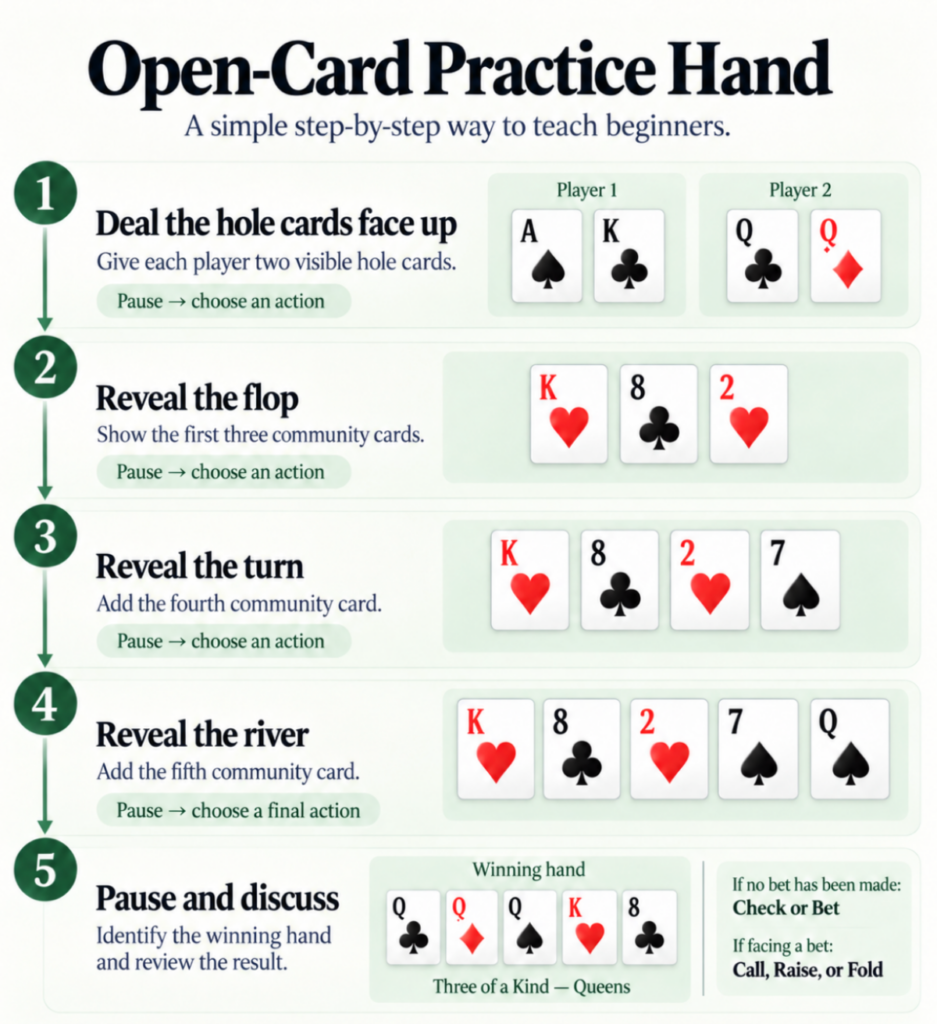
This is intentionally a simplified, generic practice hand rather than a full simulation of live Texas Hold’em. It focuses on helping beginners understand the basic sequence of community cards, decision points, and how the final hand is formed. For deeper insights, check out the video content below.
Please, embed the link:
Build the Weekend Around Sessions, Not a Marathon
Phoenix (which attracts not only tourists but also a large number of businesses) tourism data points toward a useful staycation format: several blocks of activity separated by real breaks. The metro area recorded 47.7 million visitors in 2025, and the average visitor stayed 3.1 nights. The average travel party was 2.7 people. Phoenix proper also had more than 25,749 hotel rooms across 171 hotel and resort properties as of December 2025.
The numbers do not dictate how a local group should spend a weekend. They do show that Phoenix has the lodging depth to make the room, suite or resort a base rather than the whole experience.
For a group with different skill levels, the most useful figure may be 3.1 nights. Trying to teach a game, develop confidence and reach satisfying competitive play in one sitting puts unnecessary pressure on the first evening. A two- or three-night stay allows the group to change the rhythm.
The first session can be instructional and short. A later session can introduce normal competition. Another can switch to a game with less setup or a different kind of skill. Meals, pool time, exercise or simply an hour apart create natural reset points.
Hotel choice should follow the same logic. A large table, enough chairs, a living area and space to leave a game undisturbed can matter more than decorative features. The useful question is not simply, “Where should we stay?” It is, “Will this space make four or six people comfortable for 90 minutes at a time?”
That shift turns the room from accommodation into part of the game plan.
Use Breaks as Part of the Learning Curve
There is also a research-based reason not to run every session back to back. Learning science has repeatedly found that practice spread over time can outperform the same effort packed into one continuous period.
A 2025 meta-analysis examined 22 reports containing 31 effect sizes and more than 3,000 participants. It found a moderate overall advantage for distributed practice over massed practice, with an effect size of 0.54. The researchers, Rhys Mawson and Sean Kang, summarized the underlying evidence plainly: “distributed practice produces superior learning to massed practice.”
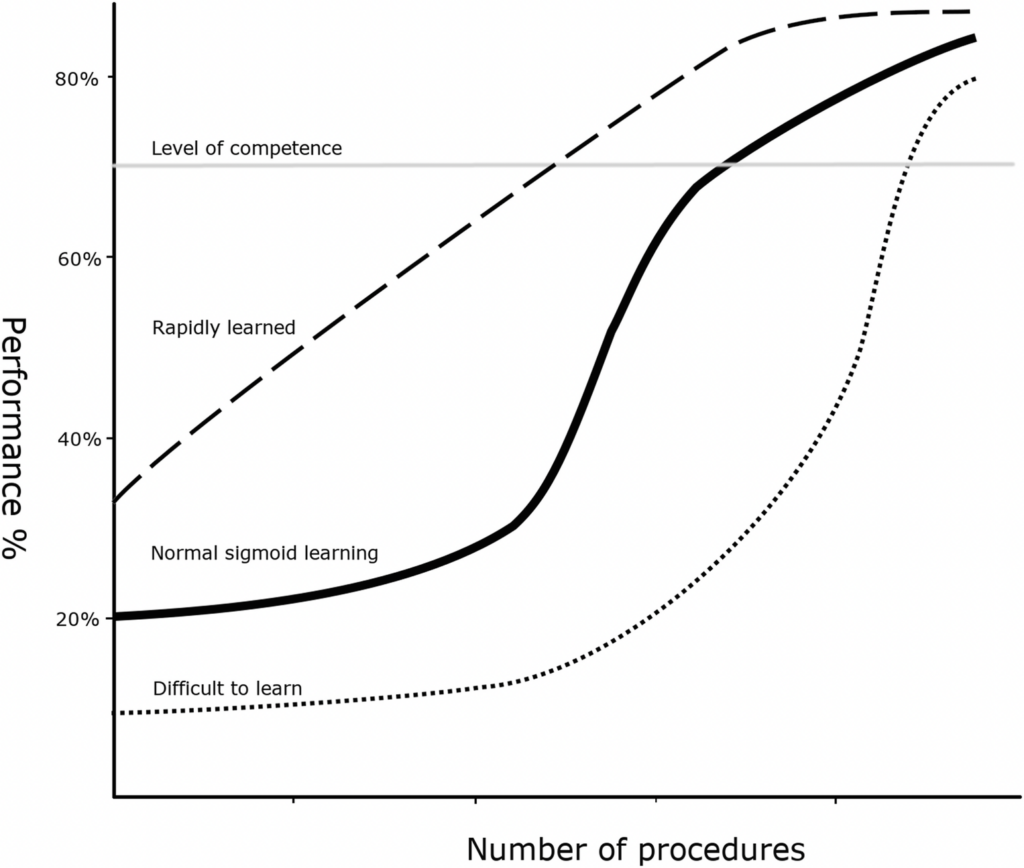
Different learning curves show why players may need different amounts of repetition before reaching the same level of competence.
Diagram Source: Here
A separate systematic review published in 2024 looked at 56 studies containing 63 experiments. Forty-three reported a significant benefit from distributed practice, retrieval practice or both compared with control or comparison conditions.
These studies examined learning rather than recreational staycations, so they should not be read as a formula for scheduling a game night. But the design lesson transfers well: people do not necessarily learn faster because they spend longer at the table.
That matters most for the least experienced member of the group. After a first session, a break gives that player time to stop consciously tracking every rule. When play resumes, some of the sequence is already familiar. The second session can spend less time on mechanics and more time on choices.
The same approach helps experienced players. Instead of repeatedly slowing a competitive game to explain fundamentals, they can concentrate the teaching in an early session and expect greater independence later.
A successful Phoenix game staycation is not one in which everyone reaches the same level but rather the one in which the weekend is designed so that nobody has to be at the same level for the group to have a good game.