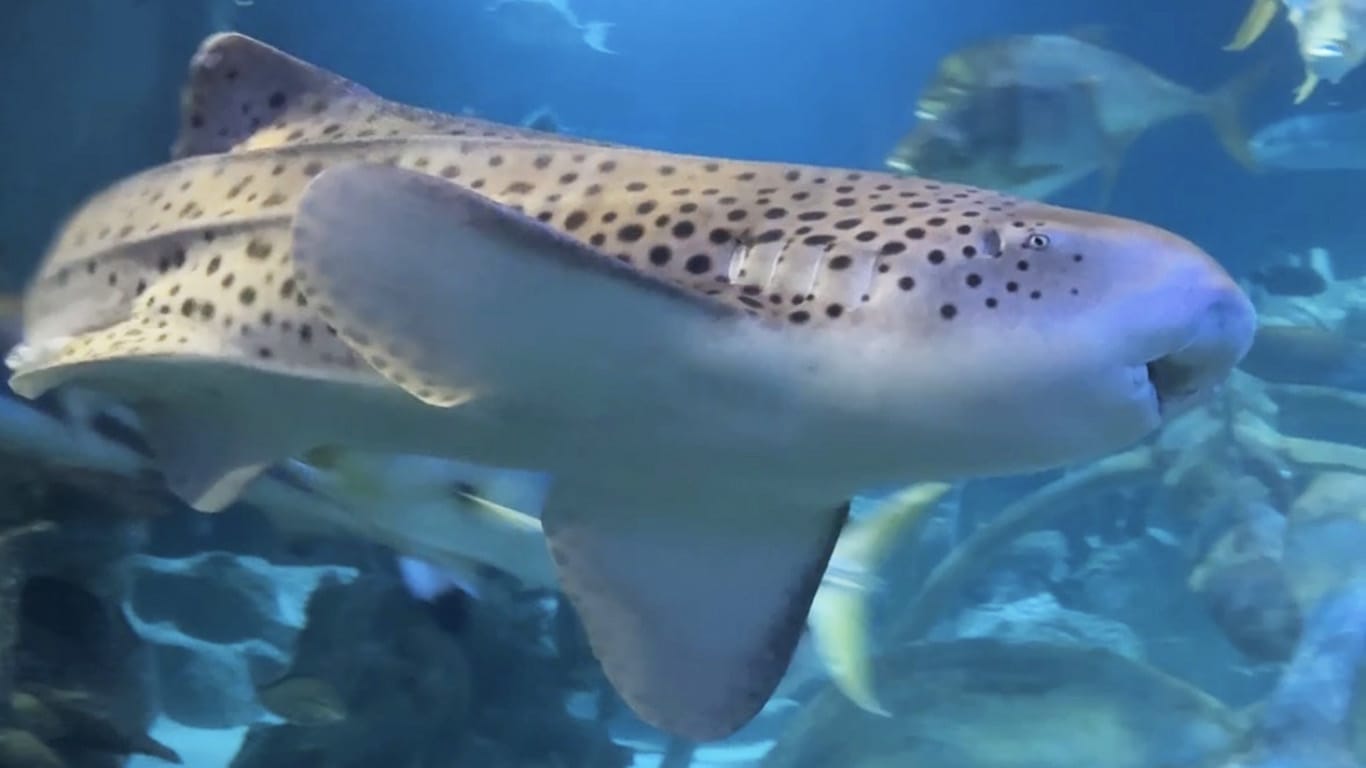
SEA LIFE Arizona Aquarium visitors have been hooked on Foreman, the zebra shark, since he began swimming slow laps around the ocean tank at Arizona Mills in February.
During July’s Shark Month — and beyond — guests can watch the staff feed the 15-year-old, 71-pound cartilaginous fish at around 11:45 a.m. Mondays, Wednesdays and Fridays. Foreman, named after boxer George Foreman, is one of SEA LIFE’s over 20 sharks. The aquarium has epaulette, bamboo, nurse and California horn sharks in the smaller exhibits.
DEEPER DIVE: Read all the Ranking Arizona Top 10 lists here
INDUSTRY INSIGHTS: Want more news like this? Get our free newsletter here
He “shore” has a personality, too, according to SEA LIFE Arizona Aquarium’s David Skomer. The registrar and level one aquarist said Foreman is “very curious and interactive,” with a personality between a cat and a dog.
“Foreman likes to be the center of attention,” Skomer added with a laugh. “He will come up and say ‘Hi’ to everyone. He’s friendly and likes to interact with people.”
Foreman isn’t the only hotshot at the aquarium. Foreman is joined by a turtle named Ziva, who, at 200 pounds, is hard to miss. A species of carpet sharks, zebra sharks are “very endangered,” Skomer said.
SEA LIFE Arizona is a 26,000-square-foot interactive aquarium with thousands of aquatic creatures, plus interactive touch pools and a 360-degree ocean tunnel.
The aquarium’s collection includes five blacktip sharks, four whitetips, Foreman the zebra shark, and a baby blacktip born on site — a rarity in aquariums. That youngster is growing up in the Bay of Rays and will eventually head to an Association of Zoos and Aquariums-accredited facility, like SEA LIFE, in Las Vegas.
“We’re very, very proud to be accredited by the AZA, too,” he added. “We work very hard to maintain it.”
Foreman came to SEA LIFE from the Wildlife World Zoo & Aquarium because he didn’t play well with his tankmates. The Litchfield Park organization acquired him in 2008 as a juvenile.
Initially, he spent his first SEA LIFE months in the rescue reef exhibit with its olive Ridley turtle named Donna before moving to the ocean tank in April.
A zebra shark is a species of carpet shark that hangs out on the seabed. They eat out of the sand. Visitors are befuddled by the name “zebra shark,” according to Skomer, whose job blends biology, engineering and a fair amount of heavy lifting.
“When zebra sharks are juveniles, they have the white stripes all over them. They look like a zebra shark,” he said. “When they get older, they become brown with spots. A lot of times, guests don’t believe that they’re zebra sharks because of their leopard pattern.”
Foreman has lived his best life. To keep his svelte figure, Foreman eats a mackerel and squid. However, he’s not picky.
“They eat about 6% of their body weight per week,” he said.
“We usually split it into three feeds. The amount of food we’re feeding him gives us an idea of how many vitamins we can give him.”
SEA LIFE Arizona Aquarium uses Mazuri brand vitamins for sharks and rays. Iodine levels must be monitored otherwise they can develop goiter and/or thyroid issues.
Skomer and his team prepare the marine animals’ diets, clean and maintain the systems, backwash the sand filters, and dive twice weekly for thorough work.
To check levels of nitrates, ammonia and other chemicals, the staff conducts water quality testing.
Training Foreman is key to his care. He responds to a green‑and‑yellow checkerboard target, a cue that guides him to his feeding station and, when needed, into the med pool for bloodwork or weighing.
“We took the time to train him and get him to build that association with his target,” Skomer said. “That way he’s not eating other animals’ foods, and we can move him safely when we need to.”
Before joining SEA LIFE, Skomer worked for the State of Hawaii conducting population surveys on ghost and mole crabs. Later, he worked for an algae farm in Gilbert, where he learned the ins and outs of life‑support systems.
Foreman may soon play a role beyond SEA LIFE. The facility recently sent blood and DNA samples to the STAR program, a global zebra shark conservation effort involving Georgia Aquarium, Seattle Aquarium and partners in Indonesia and Thailand.
If Foreman is genetically compatible, he could contribute to a breeding program aimed at releasing young zebra sharks back into the wild. It would boost a species threatened throughout much of the Indo‑Pacific.
Fans and experts have the chance to celebrate the fish in July — a summer ritual that is part science education, part pop‑culture spectacle.
This year, Discovery hosts seven days of premieres from July 26 through Aug. 1, Shark Week, which is part of Shark Month. The channel shares a mix of real research expeditions, conservation stories, and high‑adrenaline encounters.
The programming starts with actor/comedian Ken Jeong and Grammy-nominated artist REI AMI teams up for “K-Pop Shark Heroes.”
Up next is “Air Jaws: Red, White and Breach,” which has “mega shark action” as scientists investigate whether legendary breaching great whites have entered American waters.
Global explorer Josh Gates investigates the first recorded shark attack and reveals his results on “Expedition Unknown: Shark Secrets.” Later, adrenaline reaches new heights in “Ultimate Shark Dive” as cliff diver Molly Carlson attempts a record-setting dive into shark-infested waters.
“It’s great when people come here during Shark Month,” Skomer said about SEA LIFE Arizona Aquarium. “They get to see how incredible these animals really are.”