For years, the money in a video game stayed inside the game: coins, skins and levels belonged to the publisher. Blockchain changed that arrangement on paper by letting players hold items in their own wallets and trade them outside the studio. The results since then show how an economy built on tokens behaves when attention, prices and trust all move at once.
The idea reaches well beyond play-to-earn titles, and alongside services such as https://ca.parimatch.com/en/bitcoin-casino entertainment, wallets and payments now overlap in the casino world, at an online casino cashier and in mainstream online games. Whether that overlap builds lasting economies or short-lived ones is a question that recent data can start to answer.
Boom and Bust: The Axie Infinity Lesson
Axie Infinity was the best-known example of a game where players earned tokens. By the week ended 28 March 2022, Bloomberg reported, its daily active users had fallen 45 percent from the November peak to 1.48 million, which implies a peak near 2.7 million. On 23 March hackers took roughly 600 million dollars in Ether and USDC from the Ronin bridge, a figure TechCrunch put at about 625 million.
- Earnings fell as the game’s token lost value, in the words of one Nansen analyst: daily earnings dropped and so did interest.
- The attack targeted the bridge that moved assets in and out, not the gameplay itself.
- Users were already leaving before the hack became public.
The 2024 Rebound in Users, Not in Money
DappRadar counted 7.4 million daily unique active wallets in blockchain gaming in 2024, up 421 percent from a year earlier, so 2023 was close to 1.42 million. Gaming made up 26 to 29 percent of all blockchain activity, with over 5.7 billion on-chain transactions and more than 1,600 new games listed.
Pixels passed one million daily active users in 2024, The Open Network averaged about 108,000 daily active wallets, and Immutable led all chains with 330 million dollars of NFT trading volume.
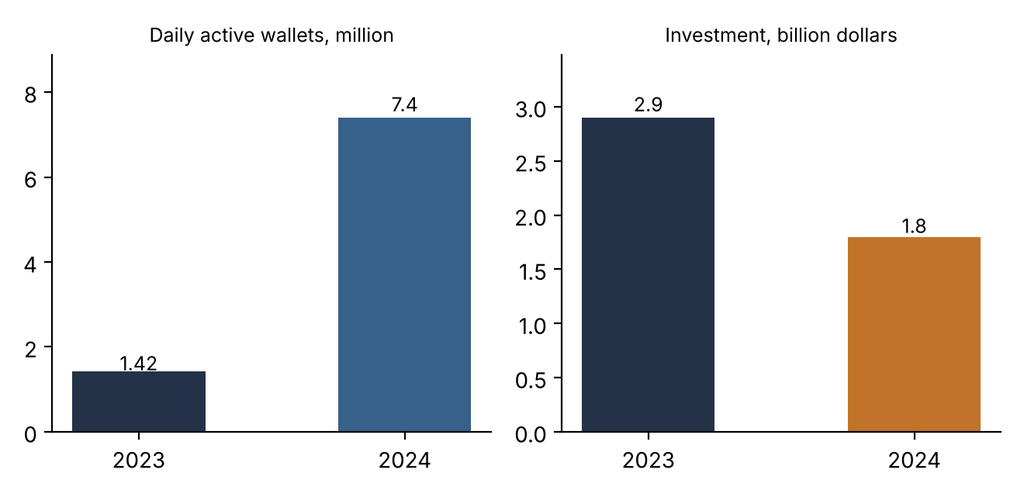
Figure. Blockchain gaming, 2023 and 2024: daily active wallets and investment. 2023 values are calculated from DappRadar’s reported growth rates.
Money moved the other way. Investment in blockchain gaming fell 38 percent to 1.8 billion dollars, the lowest since 2020, which puts 2023 near 2.9 billion. The metaverse segment was hit harder, with trading volume down 80 percent and sales counts down 71 percent.
| Recipient of 2024 investment | Share | Approx. amount, billion dollars |
| Investment firms | 58 percent | 1.04 |
| Infrastructure | 23.5 percent | 0.42 |
| Web3 game titles | 14.8 percent | 0.27 |
| Metaverse projects | 3.6 percent | 0.07 |
Only about 15 cents of each investment dollar went to the games themselves, a ratio that suggests the sector funds its plumbing more than its content.
| Example. A studio that raised 1 million dollars in 2023 would, if its funding followed the sector’s 38 percent fall, raise about 620,000 in 2024, even as the sector’s wallet count grew roughly fivefold. More wallets do not pay the bills if funding shrinks. |
Reading the Numbers Carefully
Wallet counts say how many addresses were active, not how many distinct people played, and the coverage reviewed here does not say whether bots or repeated wallets were filtered out. Headline player claims from individual apps are not wallet counts either.
A tempting comparison is Axie’s 1.48 million users in 2022 against 7.4 million wallets in 2024, exactly a fivefold gap, but one figure counts users of a single game and the other counts wallets across an entire sector, so the two are not like for like.
| Important. Digital items can lose value as quickly as they gain it, and past growth in wallets does not predict revenue. This article is informational and does not encourage gambling or buying tokens. |
What the Evidence Suggests
Crypto gave games a real market for items and a faster route for payments, but it did not remove the need for fun, security and funding. The pattern from 2022 to 2024 is that attention comes quickly, money arrives selectively, and the bridges between worlds are the weakest link.