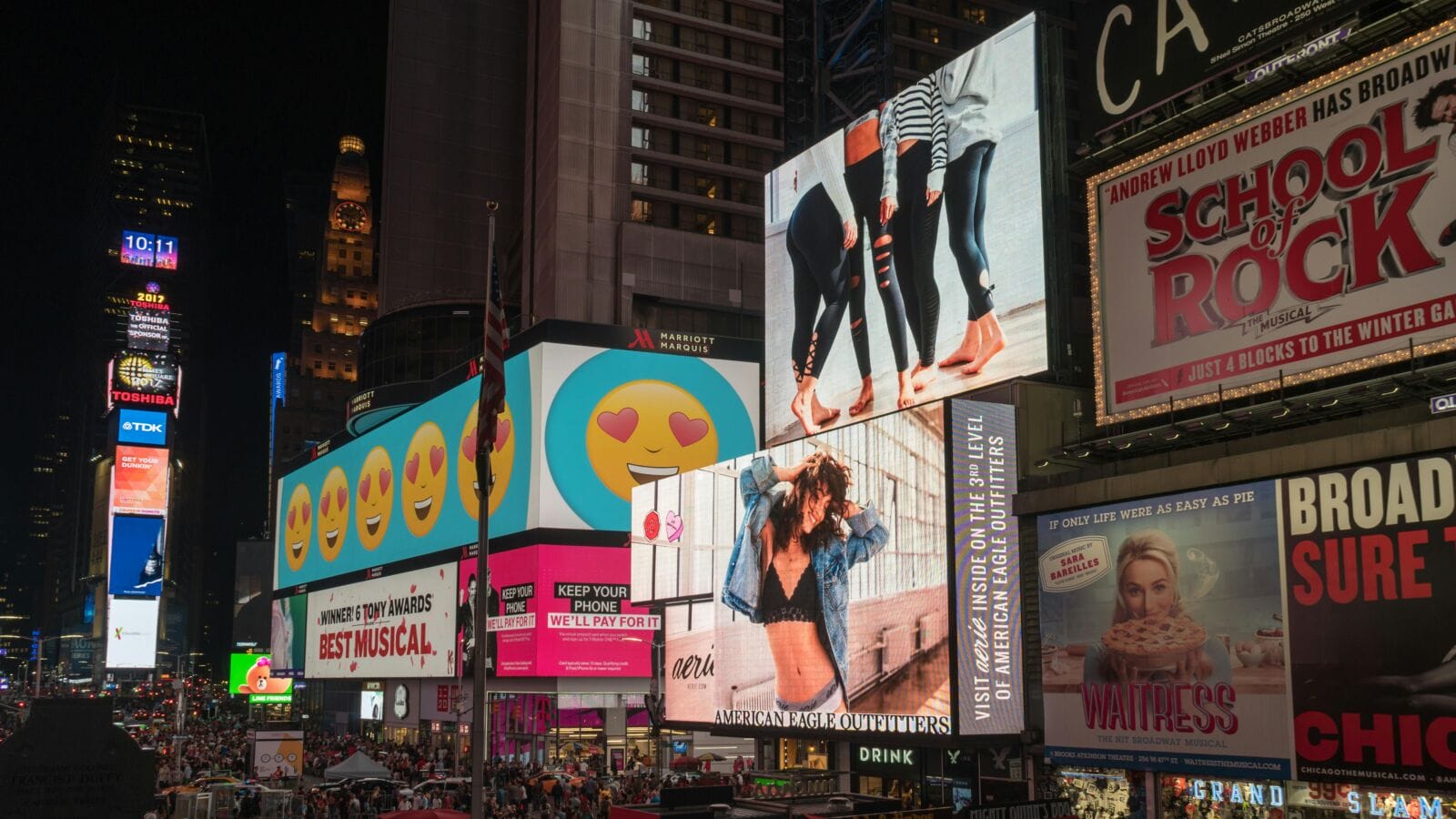
The billboard stopped meaning “one static image for thirty days” about a decade ago. Digital out of home advertising, shortened to DOOH, now covers everything from airport screens that react to live flight data to Times Square installations that physically move. The best work in this space does not just display creative. It uses the street itself as a stage. These five award-winning DOOH campaigns show what the medium can do when agencies build the screen as infrastructure for a story, not a poster frame.
1. British Airways: “Magic of Flying” (2013)
The insight. Children look up and point whenever a plane passes overhead, because flight, to them, still feels like magic. OgilvyOne London used that behavior to rewire how airline advertising works on a screen.
The execution. Two digital billboards went live in Piccadilly Circus and along the M4 in Chiswick, both picked for their angle to the Heathrow flight path. A custom ADSB antenna tracked every British Airways aircraft within a 200-kilometer radius. The moment a BA plane passed overhead, the static creative was interrupted, a child on screen stood up and pointed, and the flight number plus origin city appeared beside him in real time.
How it landed. 1.36 million video views. 45 million earned social impressions. 364 news articles across 118 countries. The #LookUp hashtag was used more than 3,400 times. The work picked up roughly 60 awards, including the Direct Grand Prix at the 2014 Cannes Lions Festival, plus Grand Prix wins at the Clios, the LIAs, and the Clear Channel Planning Awards.
The lasting lesson. It proved that interactive DOOH can do what broadcast cannot, which is react to the physical world at the second it happens.
2. Pepsi Max: “Unbelievable Bus Shelter” (2014)
What was it? A six-sheet bus shelter panel on New Oxford Street in London that looked like a clear window onto the pavement ahead. It was not a window. It was a 65-inch HD screen running a live camera feed with augmented reality overlays composited in real time.
What did people see? A tiger charging at the glass. Flying saucers snatching a commuter from the pavement. A tentacle bursting from an open manhole. A meteor punching a crater in the tarmac. Each scenario played long enough to capture the candid reaction, then reset for the next person at the stop.
Who made it? AMV BBDO (creative), OMD UK (media planning), Talon Outdoor (media buying), Grand Visual (production and AR technology), and JCDecaux (hardware). The entire rig ran on consumer-grade kit: a 65-inch HD TV, a Windows PC, a 2GB graphics card, and a Logitech camera.
Did it work? The social film cut from day-one footage passed 8 million YouTube views. The campaign collected a Gold OBIE at the 2015 OAAA Awards, plus recognition at Cannes Lions, Clio, and D&AD.
The takeaway. It showed that a global DOOH moment does not need millions in hardware. The creativity carried the format.
3. Women’s Aid: “Look at Me” (2015)
In Canary Wharf, a digital screen showed a woman’s bruised face. Ignore her and nothing changed. Stop to look, and her bruises started to fade. The more pedestrians who paid attention, the more her face recovered. That was the premise of “Look at Me,” a world first for interactive DOOH advertising.
WCRS built the campaign for the domestic violence charity Women’s Aid, with photographer Rankin shooting the imagery and Ocean Outdoor donating the digital inventory. Facial recognition cameras identified when viewers were actively looking at the screen, then triggered the healing animation. Screens ran at Canary Wharf, Westfield Shepherd’s Bush, and the Birmingham Bullring, timed to International Women’s Day in March 2015.
The average dwell time at the campaign sites ran 349% higher than the previous benchmark measured across the same inventory. The campaign reached 326.9 million people worldwide. It collected a Gold Lion in Outdoor and a Silver Lion in Cyber at Cannes 2015, a D&AD Pencil, and the Grand Prix at The Drum’s Creative Out of Home Awards.
The mechanic was the message. Attention itself is the first step toward change.
4. Coca-Cola: 3D Robotic Billboard, Times Square (2017)
- Location: Broadway and 47th Street, New York City
- Dimensions: 68 feet by 42 feet
- Build time: Roughly four years from prototype to launch
- Screen count: 1,960 LED cubes in total, 1,715 of them moving and 245 static
- Cube extension: Each movable cube can push up to 1.52 meters (about 5 feet) outward from the surface
- Launch date: 8 August 2017
- Daily foot traffic at the site: Around 300,000 people
Coca-Cola worked with agency space150 and engineering partner Radius Displays to build what Guinness World Records certified as both the first and the largest 3D robotic billboard on the planet. Every cube moves independently, choreographed to the creative on screen. The board also reads ambient weather and temperature, then adjusts programming accordingly. A 24-hour content calendar tunes creative to commuters in the morning rush, tourists through the afternoon, and meal-tied spots around lunchtime.
This is the point in the DOOH evolution where “screen” stopped being the right word. The surface now has physical depth, motion, and environmental awareness. It is closer to a kinetic sculpture that happens to advertise soda than to a traditional billboard.
5. Netflix: “Stranger Things 4” 3D Anamorphic Rift (2022)
To launch the fourth season, Netflix ran a global 3D anamorphic campaign built around one conceit: the Upside Down was breaking through the screen. Studio Squeak produced the creative, which ran across multiple DOOH sites, including several placements in Times Square, Los Angeles, and Stockholm.
Key elements that made the campaign land:
- The illusion. Anamorphic 3D only reads correctly from one specific viewing angle, so each placement was custom-animated for its individual screen shape, resolution, and pedestrian sightline.
- The iconography. Creative used the Demogorgon silhouette, the Upside Down’s vines, and floating spore particles, show elements instantly recognizable to fans without any explanatory copy.
- The complement. Netflix paired the 3D sites with an upside-down 2D billboard reading “Every Ending Has a Beginning,” plus an immersive “Rift” theatrical experience in London where fans could step physically into the show’s world.
- The difficulty. Producing anamorphic content across screens of different resolutions and aspect ratios is technically harder than a standard billboard, because the illusion collapses if any dimension is off.
The format quickly became industry shorthand for “premium entertainment launch,” and waves of 3D anamorphic work across Tokyo, Seoul, and Dubai followed in the months after the Stranger Things rollout.
The Common Thread Worth Stealing
Look closely and none of these DOOH campaigns won on spectacle alone. Each one borrowed something from outside the screen itself: real flight data, live pedestrian reactions, the gaze of a passerby, Times Square’s weather feed, the geometry of a viewing angle. The screen is the cheapest part of a DOOH advertising campaign. The context around it is where the story lives.