
As demand for digital assets grows across gaming, manufacturing, and creative industries, efficiency has become just as important as visual quality. Traditional workflows often require multiple tools, steep learning curves, and long production cycles. This is exactly where Tripo Studio stands out—as an AI 3D model generator designed to turn ideas into usable assets with far less friction.
Rather than acting as a single-purpose tool, Tripo Studio approaches 3D creation as a complete pipeline. From concept input to production-ready output, it integrates generation, optimization, and refinement into one cohesive workspace, helping creators focus on results instead of technical hurdles.
Rethinking the 3D Creation Workflow with AI
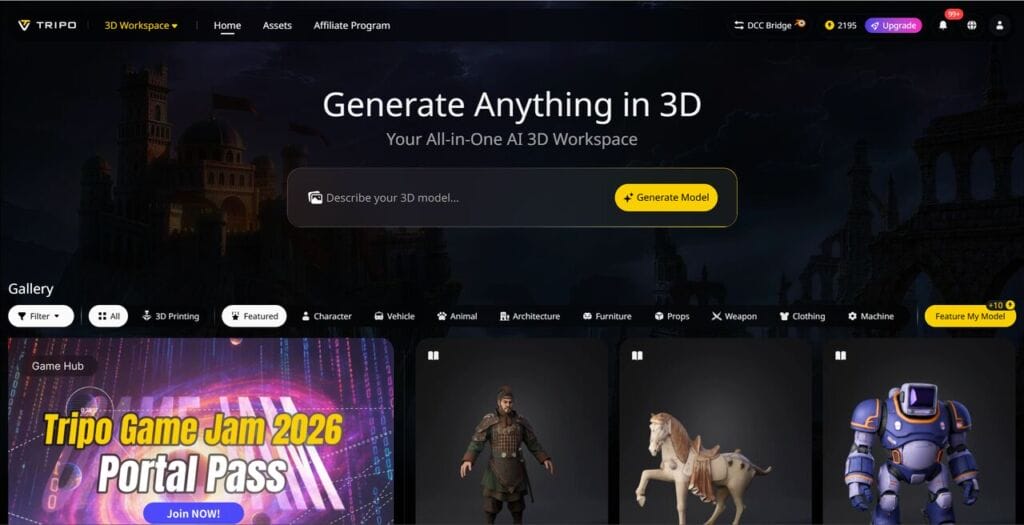
At its core, Tripo Studio is built around a simple idea: creators should spend time shaping ideas, not managing software complexity. As an AI 3D model generator, the platform enables users to move from text descriptions or reference images directly to editable assets—without switching between disconnected tools.
This approach significantly lowers the barrier to entry for AI 3D modeling while still meeting the expectations of professional pipelines. Whether you’re iterating on concepts or preparing assets for real-world deployment, Tripo emphasizes speed, structure, and usability at every stage.
Deep Dive: The Features That Make Tripo Studio Revolutionary
What sets Tripo Studio apart is not a single breakthrough feature, but how its capabilities work together as a cohesive system. Designed as a production-oriented AI 3D model generator, the platform covers the full lifecycle of 3D asset creation—from initial input to optimized, export-ready results. Below is a closer look at the core features that define its approach to modern AI 3D modeling.
Image to 3D Model: Converting Visual References into Editable Assets
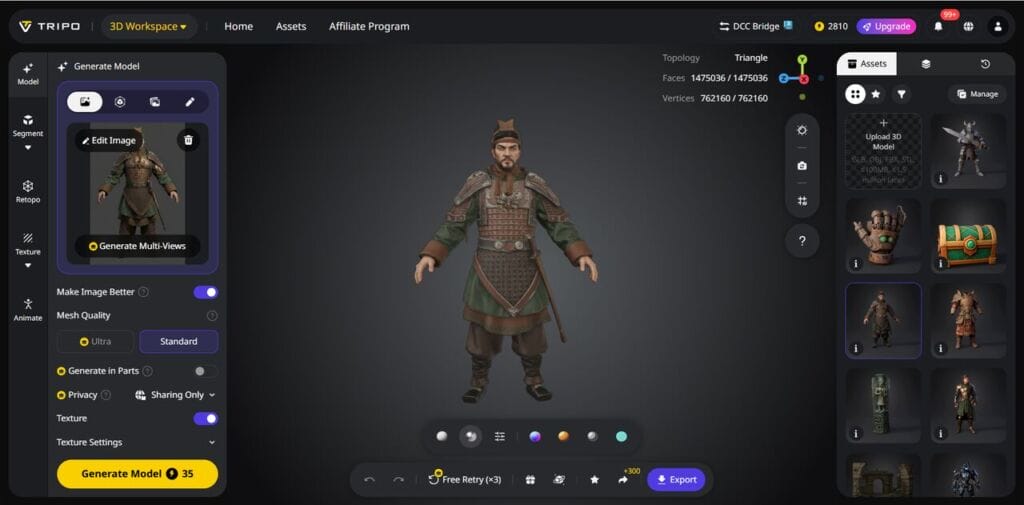
The Image to 3D Model feature enables creators to transform reference images—such as sketches, concept art, or product photos—into structured, fully editable 3D assets. By analyzing form, depth, and surface cues, the system generates geometry that closely matches the original reference while remaining flexible for refinement. Support for multi-view images improves structural accuracy, making this workflow especially suitable for props, product components, and objects intended for 3D printing or real-time use. Built-in image refinement tools help improve reference quality before generation, ensuring more stable and predictable results.
Text to 3D Model: Accelerating Concept Exploration with Language
For idea-driven workflows, Text to 3D Model allows creators to generate assets directly from natural language descriptions. Instead of starting with manual modeling, users define shape, style, and intent through text, enabling rapid ideation and experimentation. This feature is particularly effective during early design stages, where speed matters more than fine detail. Once generated, each 3D model remains fully editable and can seamlessly move through retopology, texturing, and stylization workflows within the same AI 3D model generator environment.
Intelligent Segmentation: Modular Control Without Manual Cleanup
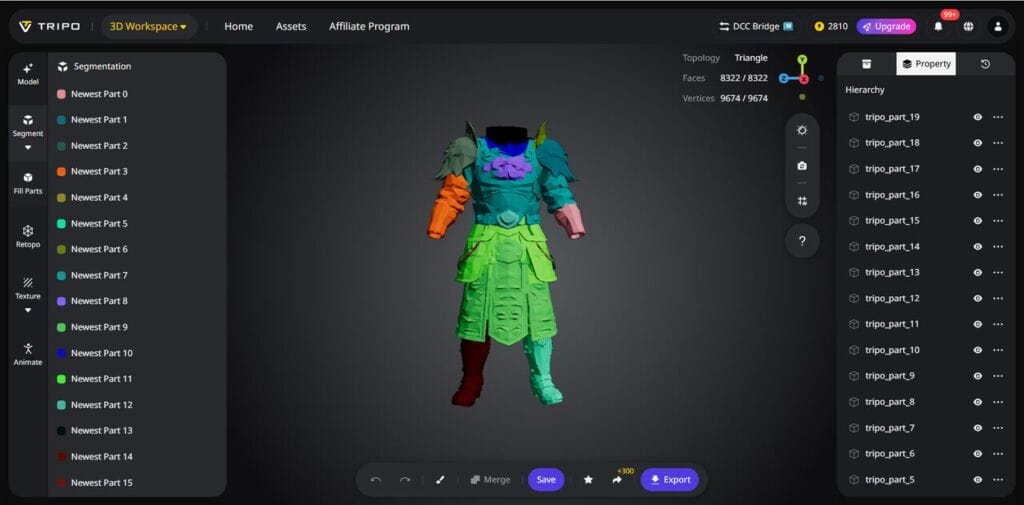
Complex meshes can slow down iteration and limit flexibility. Tripo Studio’s intelligent segmentation automatically separates a generated model into logical, editable components. This makes it easier to refine specific parts, create variations, or export individual elements as needed.
Segmentation is especially useful for modular asset creation, manufacturing workflows, and preparing models for 3D printing, where clean boundaries and structural clarity are essential.
Smart Retopology: Clean Meshes for Production Pipelines
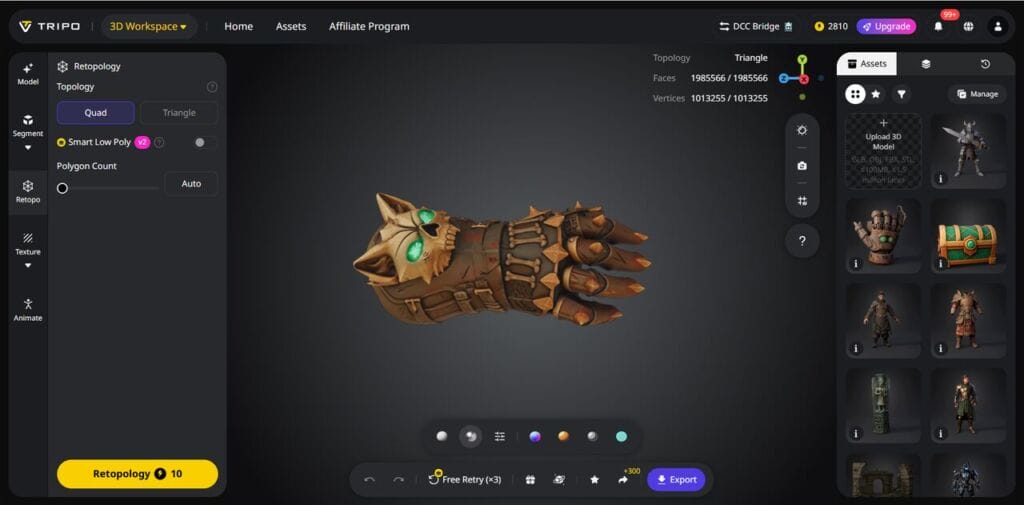
To ensure generated assets are usable beyond visualization, Tripo Studio includes automated retopology options that produce clean, optimized meshes. Creators can choose quad-based topology for animation and DCC workflows, or triangle-based meshes for compatibility and surface fidelity.
By intelligently redistributing polygons, the system preserves visual detail while reducing unnecessary complexity—resulting in lightweight, efficient 3D models ready for real-time engines and downstream production.
AI Texturing: High-Quality Materials with Precise Control
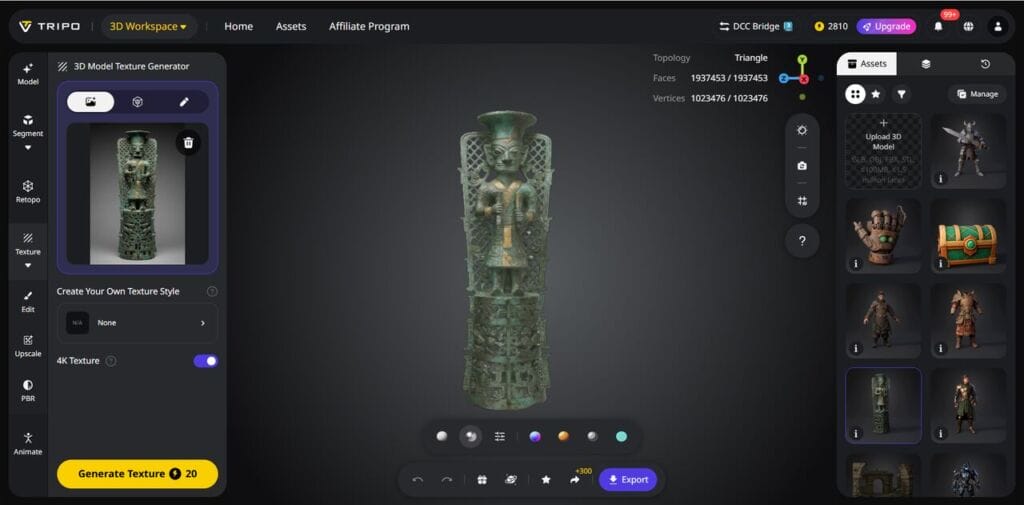
Tripo’s AI Texturing system generates physically based (PBR) materials from text prompts or reference images, delivering realistic surface detail and consistent material response. This allows assets to move directly into rendering, visualization, or interactive environments without additional setup.
For targeted adjustments, localized editing tools enable creators to refine specific areas without repainting entire textures. High-resolution outputs and texture upscaling further ensure assets meet modern quality standards across platforms.
AI Auto Rigging: From Static Mesh to Animation-Ready Asset
Character assets benefit from Tripo Studio’s automated rigging system, which converts static geometry into animation-ready models with minimal manual input. The system generates clean skeletal structures and smooth skin weights, allowing natural deformation during motion.
An integrated animation library supports quick pose and movement previews, while fixed poses can be exported for static applications such as visualization or 3D printing. All rigs remain compatible with standard engines and DCC tools, supporting professional pipelines.
Beyond the Workspace: Tools, Services, and a Growing Creator Ecosystem
While Tripo Studio is built around a unified 3D workspace, its ecosystem extends far beyond model generation alone. As a production-ready AI 3D model generator, the platform offers a set of supporting tools and services that help creators preview, integrate, share, and even bring their work into the physical world.
3D Model Viewer & Converter
The built-in 3D Model Viewer allows users to inspect assets directly in the browser, with adjustable lighting, materials, and camera controls. This makes it easy to validate geometry, textures, and overall presentation before export or sharing.
To support cross-platform workflows, the 3D Model Converter enables seamless format conversion across major standards, including STL, OBJ, FBX, GLB, USDZ, and 3MF—ensuring generated models remain compatible with game engines, DCC tools, and manufacturing pipelines.
DCC Bridge for Professional Workflows
For creators using professional software, Tripo provides a DCC Bridge for Blender that connects the browser-based workspace directly to the DCC environment. Assets can be transferred in real time without manual downloads or file management, streamlining iteration and refinement in established 3D design pipelines.
Image Generation for Creative Exploration
To support early ideation, Tripo integrates image generation tools (Chatgpt-4o, Nano Banana, and Flux Kontext) that help users explore visual styles and concepts before moving into 3D. These images can be used directly as references for image-to-3D workflows, enabling a smooth transition from inspiration to structured 3D assets within the same ecosystem.
Gallery: Share, Explore, and Remix 3D Models
Tripo’s Gallery functions as a community-driven space where creators can share their 3D models, browse user-generated assets by category, and engage through likes and creative remixing. Models can be reused, adapted, and iterated on, encouraging collaboration and experimentation across the platform.
To meet the growing demand for physical production, the Gallery is now fully 3D-printing friendly. A dedicated 3D-printing tag helps users quickly identify models compatible with slicing software, making it easier to move from digital design to real-world output.
3D Printing Services
Beyond digital workflows, Tripo also offers integrated 3D printing services, allowing creators to turn models into physical products with print-and-delivery options. This removes the need to manage separate printing pipelines and makes small-scale production, customization, and gifting more accessible.
Building Practical 3D Creation with AI
By combining generation, optimization, sharing, and real-world output into a single ecosystem, Tripo Studio demonstrates what a production-ready AI 3D model generator should look like today. Instead of treating AI as a standalone experiment, the platform integrates it directly into usable 3D workflows—supporting everything from rapid ideation to deployment and 3D printing.
For creators who value efficiency without sacrificing control, Tripo offers a clear path forward: faster creation, cleaner assets, and a connected environment where digital ideas can move smoothly toward real-world results.