
Scrum Mastery in 2026 looks completely different from what it was just a few years ago. Organizations don’t want facilitators who can only conduct ceremonies. They expect Agile leaders to lead teams, manage their delivery, and drive change at a massive and accelerated rate. As Agile practices mature, so do the skills required to stay relevant.
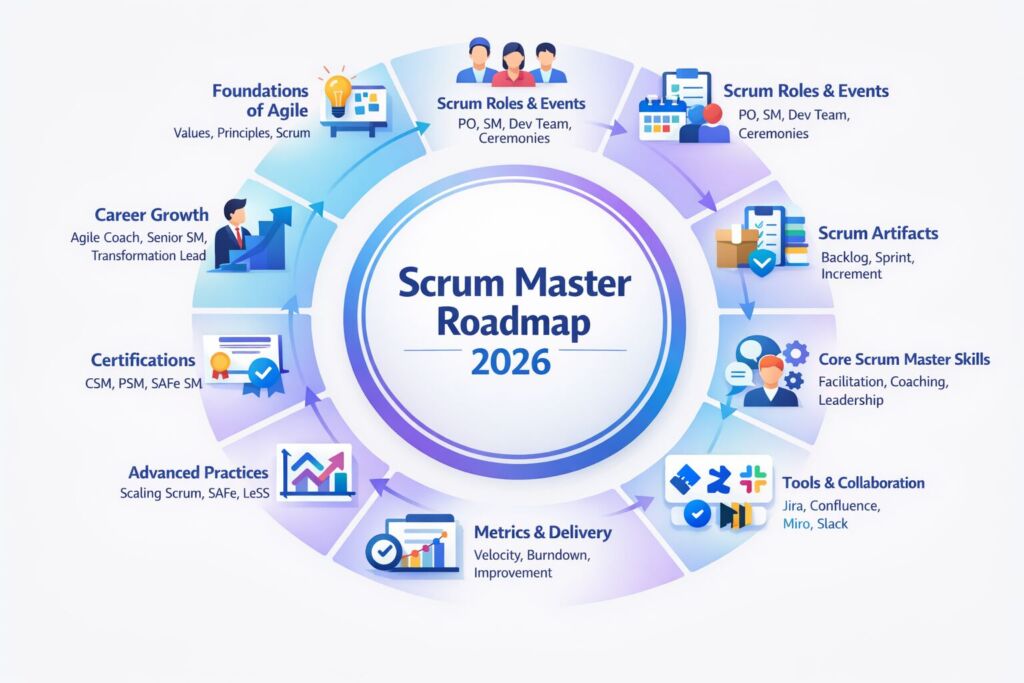
The roadmap provides a breakdown of what aspiring and working Scrum Masters need to focus on by 2026, starting from fundamental Agile skills to leadership, business impact, and ongoing learning, to help you develop a career that expands according to your position.
What Does a Scrum Master Actually Do?
A Scrum Master isn’t someone who just schedules meetings or tracks tasks; they are the person who helps teams actually work better, together. The role exists to support the Scrum Team work better over time by
- Improving collaboration
- Removing obstacles, and
- Reinforcing Scrum principles
According to the Scrum Master learning track outlined by Scrum Alliance, the Scrum Master focuses on facilitation, coaching, and helping teams understand Scrum events, roles, and artifacts in practice, not theory alone.
| A Scrum Master improves how work gets done, not what work gets done. |
Why This Role Isn’t Entry-Level
Here’s something many people don’t realize until it’s too late: Scrum Master roles are not beginner-friendly, despite how they are mostly advertised.
Professionals consistently warn that jumping straight into a Scrum Master role without prior experience in software development, project management, or team collaboration is a face the struggle.
Why? Because Scrum masters are
- Coaching people who mostly have more technical experience than you do.
- Facilitating conflict, navigating organizational politics, and making judgment calls about team dynamics, all without formal authority.
- Starting as a developer, QA analyst, business analyst, or even working on a Scrum team first gives the credibility and context needed.
The 2026 Scrum Master Roadmap: Practical First Steps to Start Your Journey
Step 1: Build Real Scrum Exposure (Before the Title)
One of the clearest insights from community discussions is this: most successful Scrum Masters start in some related role first.
Experienced practitioners recommend joining any Scrum-based team as a developer, tester, analyst, designer, or even stakeholder-facing role to see Scrum in action.
“Developer” here does not mean coding only. In Scrum terms, a Developer is anyone contributing to the product increment, including QA, analysts, researchers, or designers.
This stage builds credibility and context, both of which are necessary before guiding others.
Step 2: Earn a Foundational Scrum Certification
Once you understand how Scrum works in real teams, registering for Expert-Led CSM Training helps formalize that knowledge.
Scrum Alliance outlines a structured learning path beginning with Certified ScrumMaster® (CSM), followed by advanced and professional levels.
Importantly, these certifications focus on:
- Scrum roles, events, and artifacts
- Team facilitation and collaboration
- Practical application of Scrum values
They are not meant to replace experience, but to strengthen it.
Step 3: Transition Into a Junior or Supporting Scrum Role
Many organizations prefer to grow Scrum Masters internally. According to real-world hiring managers, junior Scrum Master roles are usually offered to people who already understand the team’s domain and workflows.
Common transition paths include:
- Business Analyst
- QA or Test Lead
- Project Coordinator
- Agile Team Member supporting ceremonies
This phase is where facilitation skills, observation, and feedback matter more than authority.
Step 4: Grow Beyond One Team
As Scrum Masters gain confidence, their responsibilities often expand.
Scrum Masters generally evolve by working with multiple teams or more complex environments rather than staying static.
This stage strengthens:
- Systems thinking
- Stakeholder communication
- Conflict resolution
- Organizational awareness
The goal is not more control, but better influence.
Step 5: Choose Your Long-Term Direction
A key insight from Mike Cohn’s research is that Scrum Master careers are not linear. Over time, professionals naturally gravitate toward different paths based on interest and strengths.
Common directions include:
- Agile Coach or Mentor
- Product Owner
- Engineering or Delivery Manager
- Senior Scrum Master handling complex programs
Some professionals also choose to remain Scrum Masters long-term, continuously improving their craft.
What About the “Scrum Master Is Dead” Debate?
You have probably heard it: “AI will replace Scrum Masters” or “Companies are eliminating the role.”
That’s partly true, but it doesn’t tell the whole story. Many organizations are moving away from full-time, dedicated Scrum Masters. Instead, they’re asking senior developers or tech leads to wear the Scrum Master hat part-time.
But that doesn’t mean the skills are going away. Facilitation, conflict resolution, coaching, and process improvement are more valuable than ever. They’re just being embedded into other roles.
The takeaway? Don’t chase the title. Build the skills.
Final Thoughts:
Becoming a great Scrum Master takes time. You will make mistakes. You will work with difficult stakeholders and teams that resist change. That’s all part of it.
But if you enjoy helping people collaborate better, solving problems creatively, and continuously improving how work gets done, this could be one of the most rewarding career paths you will find.
And in 2026? The demand for people who can facilitate, coach, and lead without authority isn’t going anywhere. The title might change, but the skills will always matter.