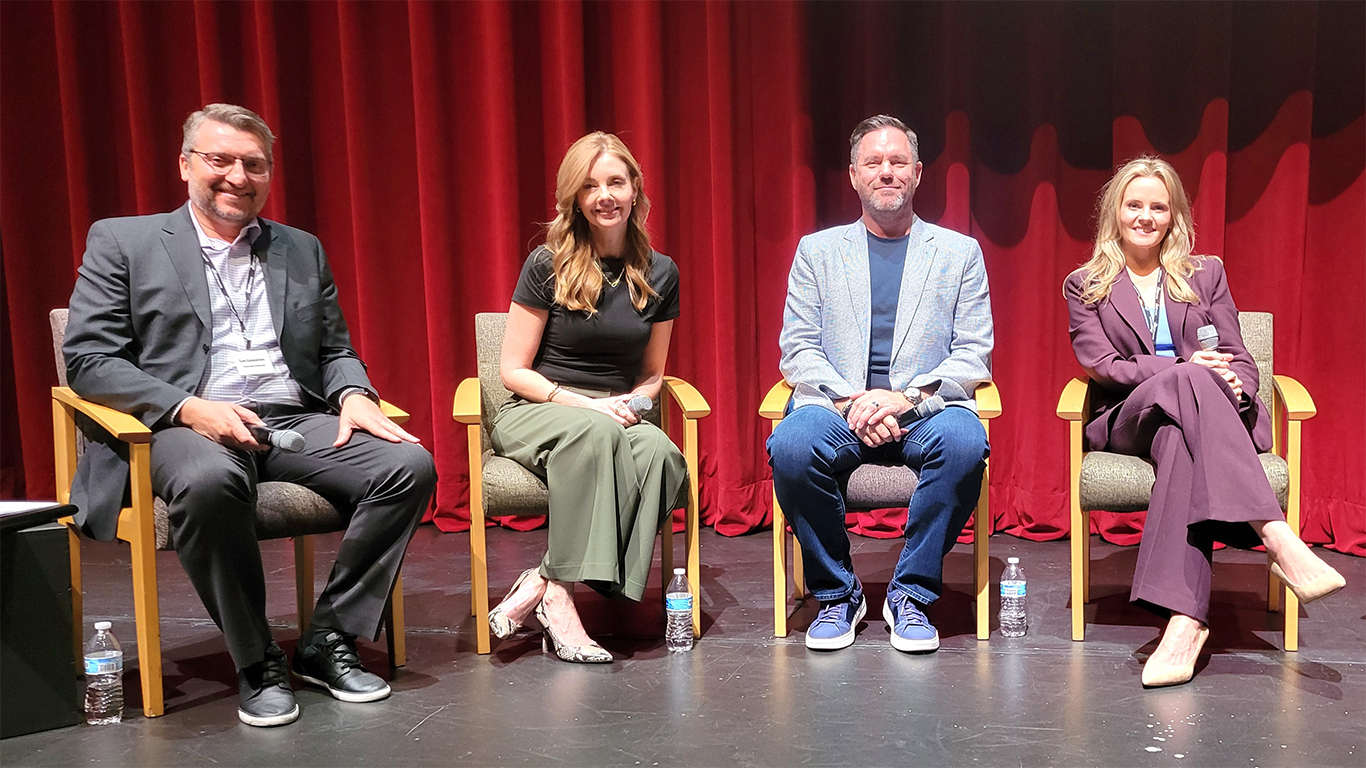
AI is essential for the East Valley’s future. That was the shared view among stakeholders at the PHX East Valley Partnership’s annual meeting at Mesa Community College’s Performing Arts Center on May 14.
MCC President Dr. Richard Daniel opened the event by highlighting the region’s changing workforce needs. The renewal of the college’s accreditation, the introduction of new bachelor’s degrees, and the growing workforce corridor will all depend on AI. The college’s new programs in data analytics and programming signal this shift.
However, the more significant story lies in the hands-on, human-focused programs, such as welding, construction, and behavioral health simulation, which prepare students for jobs that AI cannot take over. “We truly believe in the community we serve,” Daniel said, noting MCC’s $1.7 billion economic impact and the 20,000 jobs it helps support.
DEEPER DIVE: Abandoned North Phoenix project gets new life as $190 million sports complex
INDUSTRY INSIGHTS: Want more news like this? Get our free newsletter here
He said MCC is training students to view AI as a tool rather than a threat, especially in skilled trades, caregiving, and practical problem-solving. Former Mesa Mayor John Giles redirected the discussion to the beginning of the talent pipeline: early childhood development.
Representing First Things First, he warned that the state’s early-learning system, funded by tobacco taxes, is shrinking as smoking rates decline.
“People are smoking a lot less than they used to,” he explained, noting that revenue has dropped from about $180 million to roughly half that amount.
In an AI-driven economy where cognitive development and early learning are crucial for future flexibility, this funding gap becomes more than just a social issue. It becomes a workforce crisis.
The final presentation of the morning highlighted the AI theme. Kirk Adams, managing partner of Mayo Global’s Sunny Day Sports, shared his vision for the $5 billion Palo District, which will redevelop the former Fiesta Mall site.
His remarks began with memories of Bobby McGee’s, O’Sullivan’s cookies, and the mall’s past as one of Arizona’s top sales tax contributors.

The new project aims to create an AI-ready urban district, featuring a domed 25,000-seat stadium, a four-star hotel, a sportsbook venue, a retail center similar to Kierland, and high-density housing. Adams pointed out that the site is “literally 20 minutes from everywhere.”
“You’ll be hard-pressed to find an 80-acre urban infill project with as much potential as this one.”
A panel led by AZ Big Media editor-in-chief Michael Gossie thoroughly examined AI, including Alison Brooks from Visit Mesa, Leo Goncalves from the University of Phoenix, Emily Ward from Fennemore Craig, and Korey Wilkes from Butler Design Group.
Ward shared that her firm partnered with OpenAI to create a secure, closed system for client data. Her first real test came during a weekend emergency.
“I had to do an emergency TRO [temporary restraining order], and I thought, ‘I really want to spend time with my kids. Let me just play around with it.’”
AI prepared the document in 5 minutes, compared to the three hours it would have taken her.
“I was hooked from then on.” Wilkes agreed, stating that AI isn’t replacing jobs; it’s eliminating tedious tasks. “We’re creating closed AI systems to handle some mundane tasks,” from coding research to automating timecards.
The firm has grown by 25% in the past year. “We’re not using AI to replace people. We’re using it to assist them.”
In hospitality, Brooks explained that her CEO pushed for AI adoption early. “It’s either you sink or swim, and you’ve got to get on the boat.”
Her team formed an internal “Avengers” group to test tools and lead implementation. She noted that AI will help smaller destinations compete with larger ones: “It’s going to let smaller places compete with bigger ones because content doesn’t have to be expensive.” Goncalves, representing higher education, offered a more complex viewpoint. “It can widen or close opportunity gaps; it depends on how it’s designed.”
He mentioned that workers want structure — not just hype — and leaders must “set the expectations” for responsible use. The panel discussed risks as well.
Ward cautioned that lawyers must check AI-generated content for accuracy. “It looks amazing, but you really do have to check the accuracy.”
Wilkes warned against too much reliance on AI: “It’s like how we used to remember phone numbers — now we don’t remember any.” Then came the bold predictions. Goncalves forecasted that only a few universities will truly transform and stand out.
Brooks predicted AI-powered personal assistants becoming part of everyday life. Wilkes thought that everyone would have their own personal AI assistant, not just top executives.
Ward delivered the most thought-provoking line of the morning: “I think the billable hour is going to be abolished.”