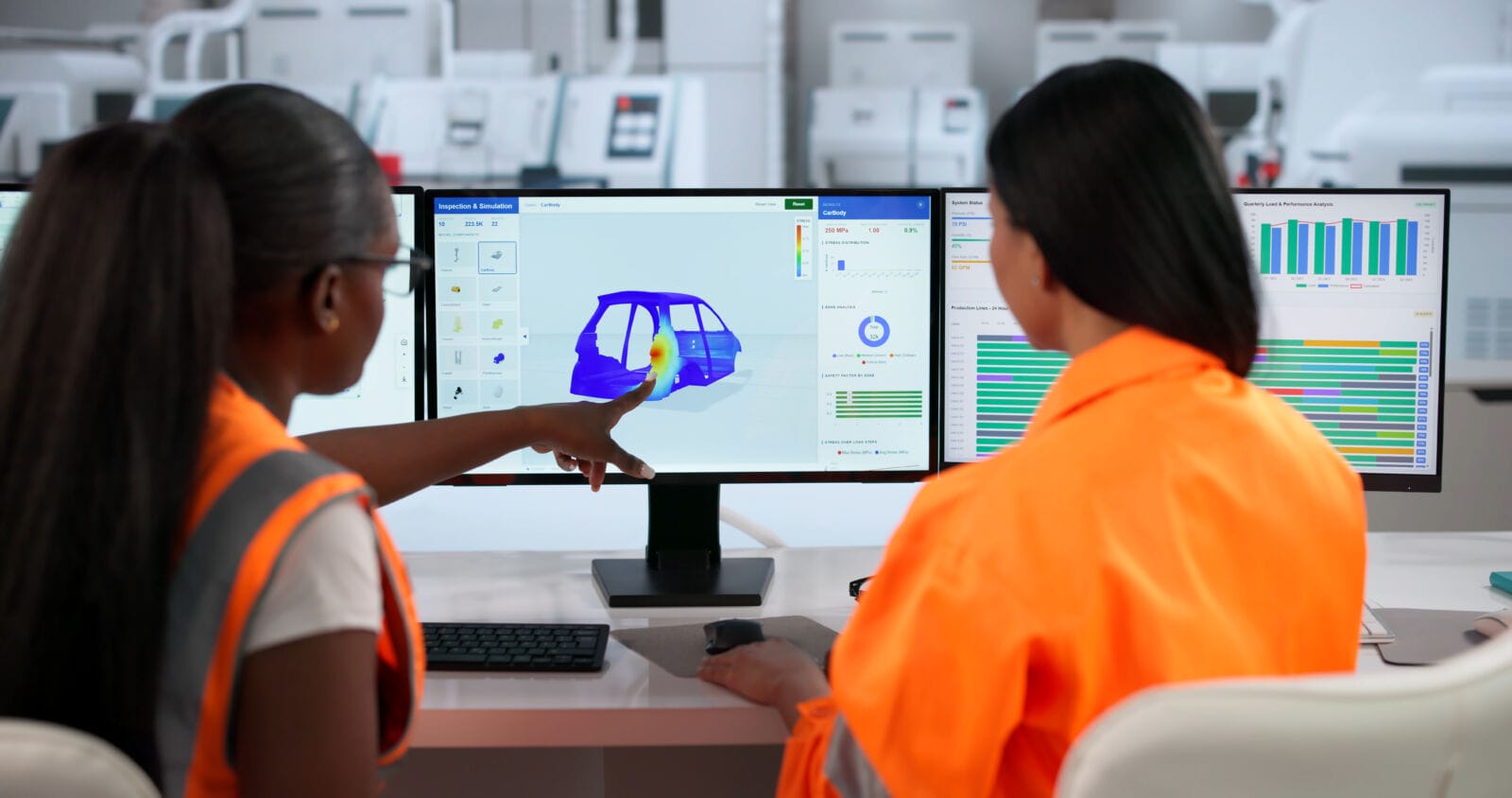
Most design offices reach for FEA late. The model gets built once geometry is locked and the schedule is already compressed. At that stage, analysis runs as a formal check before submission, with no upstream effect on decisions already made. This article walks through the six workflow stages where FEA software produces value, the effect each stage delivers, and why pushing simulation to the end remains the most expensive source of rework.
Where FEA Becomes a Bottleneck
Late verification always costs more than early verification. When the first complete FEA iteration starts after geometry and connections are locked, any code-check failure forces a step back: cross-sections revisited, weld calculations redone, drawings amended. On a complex assembly, a single iteration runs anywhere from thirty minutes to several hours on a modern workstation. Independent reviews of engineering practice put the typical team at three iterations before the deadline, five at most, after which whatever version is “good enough” gets shipped.
Strategic use of simulation produces measurable business outcomes. Joint research by McKinsey and NAFEMS, presented at the ASSESS Summit, reports a 20–30% reduction in time-to-market and a 5–30% improvement in product performance when simulation is embedded across every development stage. The implication is direct: FEA decoupled from design loses most of its value.
Concept Stage: Catching Geometry Errors Early
At the concept stage, geometry is still flexible. Cross-sections, material selection, analytical scheme, load path. Each choice here locks everything downstream. Hand calculations rely on simplified models and absorb uncertainty through inflated safety factors, which leads to oversized steel or, conversely, to stress concentrations that never get captured.
A coarse FEA model with simplified boundary conditions can evaluate several layout options within a few hours. Local stress peaks, inefficient load paths and stability risks surface before geometry gets fixed in drawings. A Tech-Clarity survey of 230 engineers found that organizations with the strongest product metrics are 75% more likely to apply simulation at the concept phase. Among companies using FEA to test ideas at the start, 99% confirm the practice pays off.
Detailed Design: A Parallel CAD-FEA Process
During detailed design, geometry and analysis evolve together. Every CAD change triggers a new analysis run. FEA fidelity climbs in parallel: coarse mesh and simplified loads give way to detailed constraint distributions, contact definitions, and material assignments. The split between geometry and calculation, where each stage lives in isolation, disappears.
Parametric studies vary several variables at once: plate thickness, stiffener spacing, fillet radius and weld type. Without automation, the number of required runs grows combinatorially. Surrogate modeling cuts direct FEA runs in an optimization task from 500–1,000 down to 50–100, preserving the quality of design-space exploration.
A peer-reviewed study by Cinar et al. (Applied Sciences, 2025) shows that an integrated CAD-FEA automation platform reduced housing mass by 18.42% while keeping the safety factor at or above 3,948 and maximum deformation at 0.012 mm. The authors note that the system also shortens design time and reduces the rate of operator error.
Code Compliance Inside the Design Loop
The common pattern: analysis converges, the report is assembled, and code compliance is checked separately. The engineer calculates utilization ratios by hand, cross-references Eurocode 3, AISC 360, or DNV formulas, and types tables in Excel. On larger structures, where elements and load combinations run into the thousands, this approach breaks for two reasons. Some load combinations never get checked. Any model change invalidates the static tables, and the spreadsheets are not always rebuilt.
Modern FEA software for structural verification closes that gap. Element recognition runs automatically. Collinear beam elements get assembled into members. Shell fields between stiffeners get identified as panels. Connection nodes get flagged as welds. Code formulas are then applied to each element, and utilization ratios are computed across every load combination. When geometry or boundary conditions change, results update with the model rather than being rebuilt by hand.
This integration matters most on projects governed by several standards at once. For example, an FPSO requires DNV-OS-C101, NORSOK N-004, and Eurocode 3 for the steel topsides. A fixed offshore platform combines API RP 2A, ISO 19902, and DNV-RP-C203 for fatigue. When each standard runs in a separate tool, reconciling results becomes a job in itself. An FEA environment that covers multiple codes inside one workflow saves time precisely by removing those handoffs.
Optimization: Below the Code-Check Ceiling
Passing code is the floor. Once every utilization ratio sits below 1.0, the next question opens up: can the structure pass with less mass and lower cost? Optimization algorithms iterate through cross-sections, plate thicknesses, and weld types, keeping ratios below their limits while minimizing weight or material cost.
Topology optimization paired with FEA produces parts 20–40% lighter than conventionally designed equivalents under the same strength and stability requirements. On heavy structures such as cranes, offshore modules, and wind turbine supports, every saved ton of steel feeds into material cost, transport, and foundation loading. On projects where platform payload or crane mass shape the entire design, an optimization loop inside FEA produces ROI comparable to savings from reporting as the Final Step of Analysis.
A structural design report carries the status of a legal document. Classification societies (DNV, ABS, Lloyd’s Register, RMRS) require traceability for intermediate calculations: input loads, applied code formulas with clause references, and final utilization ratios. Assembling such a package by hand means screenshots, table exports, and copying values across documents.
Automated reporting reduces labor at this stage by 50–70% compared to manual assembly. The decisive factor here is the live link to analysis. The report binds to the current state of the model. Any geometry change triggers regeneration without engineer involvement. That connection eliminates the risk of sending the client documents built on a stale analysis, which, on projects with long approval cycles, remains the single largest source of conflict.
After Delivery: Reusing the FEA Model
The FEA model’s life does not end at certification. A validated model becomes the reference for Structural Health Monitoring (SHM), residual life assessment, and inspection planning. Sensor data from the physical asset operates as a parallel observation layer, and the FEA model stays the interpretive baseline for those measurements.
The digital twin concept rests on this continuity: the same physical-mathematical model carries through concept, verification, operation, and inspection. The 2026 Deloitte Engineering and Construction Outlook records that adoption of BIM, digital twins, and AI-based analytics reduces project timelines by up to 20%. For offshore platforms and wind turbines, where downtime costs run into hundreds of thousands of dollars per day, reusing the analysis model during operations becomes direct protection of the capital investment.
The complete design workflow ties together six interconnected stages that share one analysis model. Concept, detailed design, verification, optimization, reporting, and monitoring. When the model carries through all six stages without breaks, the effects compound: fewer reworks at the start, tighter optimization in the middle, cleaner certification at the finish, and longer asset life after handover.