
Hiring a bank CEO or fintech CFO isn’t a “post and pray” exercise. Packages reach seven figures, and a bad pick can invite regulatory fines or hammer the stock.
That risk is why boards pay retained-search fees (about one-third of the leader’s first-year cash compensation, plus expenses) for a rigorous, confidential process, according to a Korn Ferry 2024 SEC filing.
Insiders still often win. Spencer Stuart’s 2025 CEO transitions data show that 90 percent of new S&P 1500 financial-services CEOs were first-time chief executives, and financial-services companies promoted insiders at a higher rate than the index average.
This guide distills five firms into “best-for” lanes so you can match your mandate to the right partner and keep the process transparent from kickoff to signed offer.
SPMB: best for fintech and technology-led financial services

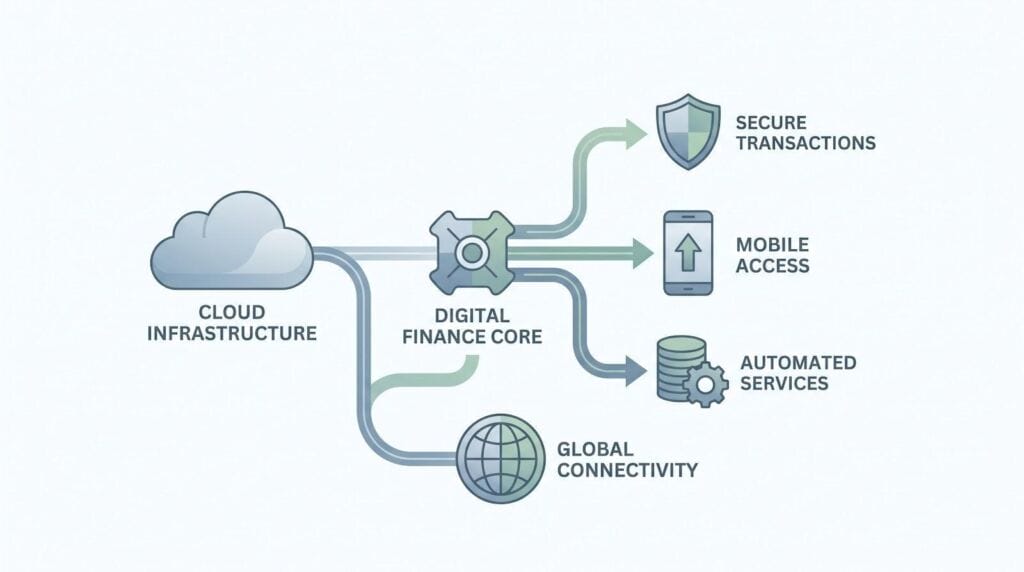
For fintechs and digital-first banks craving proven West-Coast connectivity, SPMB tops the shortlist. Its financial services executive recruiter practice page cites more than 45 years of placing executive talent at financial services companies across fintech, banking, investment management, insurance, and real estate.
The firm grew out of Silicon Valley more than 40 years ago, and that network still delivers. Its fintech and financial services client list includes BlueVine, Credit Karma, Chime, Stripe, Affirm, Robinhood, and Goldman Sachs.
Why it matters to boards
- Eight named partners cover fintech, financial services, insurance, and real estate, so a C-suite search stays in senior hands, not an associate queue.
- Current compensation data. SPMB gives clients market pay data and candidate expectations, which helps boards make offers that are hard to refuse.
- Partner continuity. The average SPMB partner has been with the firm for 10 years.
Commercial terms
Expect a classic retained fee of about one-third of first-year cash compensation, plus documented expenses and any “uptick” clause tied to a higher final offer. Ask for recent bank or insurer case studies if your mandate leans toward OCC-regulated territory; most of SPMB’s marquee evidence still skews fintech.
Bottom line
When the brief reads “Find us a payments-savvy CTO who can clear FedWire audits,” SPMB is the call to make.
Korn Ferry: best for global scale and integrated assessment
When your bank spans borders, you need more than a recruiter. You need pay benchmarks across regions, leadership assessment, and a succession plan that satisfies regulators. Korn Ferry brings all three, earning its place in the global-scale lane.

Korn Ferry finance recruiters page
Forbes ranked the firm No. 1 on its 2026 list of America’s Best Executive Recruiters, the ninth time in ten years it has taken the top spot. The firm’s fiscal 2026 10-K shows $924.1 million in executive-search fee revenue, up about nine percent year over year.
Integration is the edge. Assessment scientists, rewards consultants, and org-design specialists all draw from the same leadership database, so the shortlist already bakes in market pay and bench depth.
Commercial terms
SEC filings state that search fees are generally one-third of estimated first-year cash compensation, plus expenses and an uptick if the final package rises above the estimate. Ask for that uptick math in writing before the search starts.
Net result: one vendor can map the market, model succession risk, price the package, and coach the hire through the first 100 days. You get a single point of accountability when a multi-jurisdictional mandate threatens to sprawl.
Spencer Stuart: best for CEO succession and board-level mandates
Boards call Spencer Stuart when the question is not “Who’s available?” but “Who should lead us for the next decade?” The firm’s research arm tracks every S&P 1500 CEO change. Its 2025 data found that 90 percent of new financial-services CEOs were first-time chief executives. That kind of data helps boards weigh inside talent against the outside market instead of sidelining it.
Spencer Stuart CEO succession planning page
Confidentiality matters here. Many assignments involve replacing an incumbent, so ask how the partner team limits who sees the brief before a finalist emerges.
Depth over breadth defines the model. Ask, “What does an asset-management CEO earn in London versus New York?” and expect data, not guesses.
Commercial terms
Expect the market norm of about one-third of estimated first-year cash compensation, plus expenses. Ask whether leadership assessment or onboarding support is billed separately. Korn Ferry may bring scale, but for succession, board refresh, or a discreet top-seat overhaul, Spencer Stuart is planner, assessor, and trusted phone-caller in one.
Russell Reynolds Associates: best for transformation, governance and leadership-risk advisory
Some searches start with a résumé wish list; Russell Reynolds starts with a risk brief. Its Global CEO Turnover Index recorded 234 CEO exits in 2025, an eight-year high. When boards care less about “fit” and more about “failure modes,” that real-time lens makes RRA the safe counsel.

Russell Reynolds Associates Board & CEO Advisory page
Financial-services clients cite two strengths.
- Governance depth. The same partners who place CEOs advise audit committees on culture, succession, and stakeholder signaling.
- Transformation insight. RRA links high CEO turnover to market volatility and closer scrutiny from boards and activist investors, so ask how candidates are tested for adaptability and crisis record.
Deliverables feel more like a board pack than a recruiter’s slide deck. They are evidence rich, benchmarked, and calibrated to risk appetite.
Commercial terms
Fees follow retained norms: roughly one-third of estimated first-year cash compensation, plus expenses. Clarify which advisory modules (culture mapping, coaching, compensation diagnostics) are bundled versus billed separately before you sign.
When transformation is non-negotiable and the board needs hard data, not hope, to pick its next steward, RRA is the call to make.
Heidrick & Struggles: best for global banking and capital-markets searches
Complex stakeholder map? Cross-border pay mix of base, bonus, deferred equity, and carried interest? Heidrick & Struggles speaks that language.
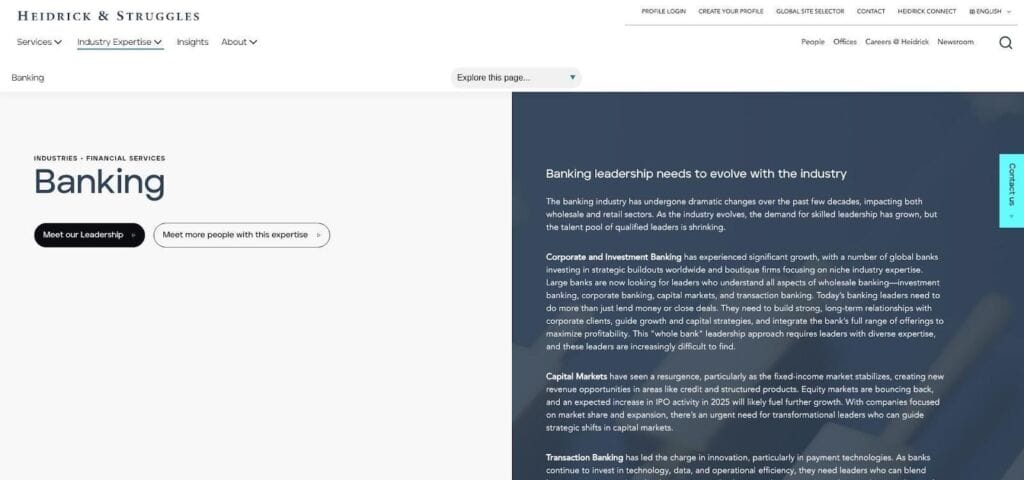
Heidrick & Struggles banking practice page
Its financial services practice covers banking, including corporate and investment banking, capital markets, and transaction banking. Sector sub-teams for banking, capital markets, insurance, and private equity collaborate rather than compete, giving each mandate specialist focus and global reach.
Data is the quiet differentiator. The firm’s annual US Global Markets Compensation Survey tracks pay for sales, trading, and research professionals, giving search committees real benchmarks before they craft an offer. That insight matters when a finalist’s bonus-deferral schedule or carried-interest vesting dates could derail timing.
Commercial terms
Heidrick is typically paid a retainer equal to about one-third of the estimated first-year compensation, billed in thirds over three months, plus one-third of the excess if the final package runs higher. Nail down that uplift formula in writing, and confirm relocation, tax-gross-up, and clawback language up front.
Because Heidrick operates in nearly every financial center, off-limits conflicts can shrink the candidate pool. Ask for a written conflict map before signing, then use the firm’s global database to cross-check reputational flags in each jurisdiction.
When the brief spans New York, London, Singapore, and São Paulo, and compensation must satisfy four regulators, Heidrick & Struggles brings the playbook you need.
Compare the five firms at a glance
Need a cheat sheet for an RFP appendix? Use the matrix below to see each firm’s proof points, natural habitat, and the question you should ask before signing a retainer.
| Firm | Category winner | Stand-out evidence | Geographic sweet spot | Fee signal | Must-ask diligence question |
| SPMB | Fintech & tech-led FS | Fintech client list (BlueVine, Credit Karma, Chime); eight FS partners | U.S. tech hubs | Market benchmark (about one-third of first-year cash) | “Show us a recent bank-or-insurer CEO/CRO search you led.” |
| Korn Ferry | Global scale & integrated assessment | Forbes No. 1 ranking; $924.1 million executive-search revenue FY 2026 | Truly global | One-third plus expenses and any “uptick” clause | “What share of our target market is off-limits because of current clients?” |
| Spencer Stuart | CEO succession & boards | 2025 CEO-transition data (90 percent of new FS CEOs first-timers) | Global | Benchmark range; assessment often billed separately | “How will you benchmark our internal candidates against the external market?” |
| Russell Reynolds | Transformation & governance risk | Global CEO Turnover Index (234 exits in 2025, an eight-year high) | Global | Benchmark range; advisory modules à la carte | “Which advisory pieces are included and which trigger extra fees?” |
| Heidrick & Struggles | Global banking & capital markets | Dedicated banking practice; 2025 US Global Markets pay survey | Global finance centers | One-third, billed in thirds | “Provide an off-limits map covering our top 25 competitors.” |
Which search model fits your mandate?
Retained search is not the only way to hire an executive, yet in regulated financial services it is often the safest. Boards still ask why they should pay a six-figure retainer when contingency recruiters or in-house teams look cheaper.
Think of the three options as service tiers, not just price points.
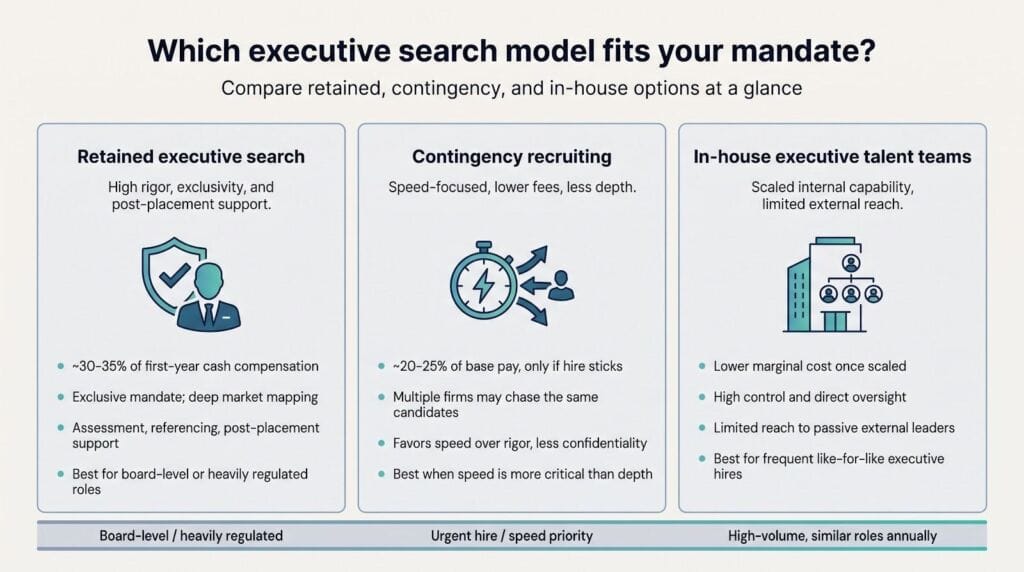
Retained executive search. A concierge model. You pay about one-third of first-year cash compensation in scheduled installments, as the large firms’ SEC filings describe. In return, you get exclusivity, deep market mapping, assessment, referencing, and post-placement support. The fee buys the process, not just a hire, which is why serious firms publish replacement guarantees.
Contingency recruiting. Payment, commonly 20 to 25 percent of first-year pay, comes only when a candidate is hired. The model favors speed over rigor; multiple firms may chase the same candidates, and confidentiality or off-limits rules can slip.
In-house executive talent teams. Lower marginal cost once scaled, plus direct control. Blind spots include limited reach to passive leaders and conflicts when benchmarking internal successors against external talent.
A rapid checklist:
- Is the role board-level or heavily regulated? Retained wins.
- Is speed more critical than depth? Contingency can work.
- Do we fill multiple like-for-like executives each year? Build in-house muscle.
Match the model to the mandate, and you avoid overpaying for shallow coverage or under-investing when the stakes demand full due diligence.
Conclusion: 12 questions to ask before you sign the retainer
Smart boards never outsource accountability, and you should not either. Even the best brand needs scrutiny; these questions separate a slick pitch from a solid engagement letter.
- Who is the lead partner, and how much of their time is committed? A marquee name on the slide deck is useless if that partner appears only at kickoff and close.
- What are the partner’s ten most comparable searches from the past three years? Same sector, scale, and geography, or you fund their learning curve.
- Which target companies or executives are off-limits, and for how long? Ask for the written conflict map early.
- What share of the candidate universe is blocked by those conflicts? A hard number lets you judge real reach.
- What is the timeline for each milestone (spec, market map, first candidate, shortlist, signed offer)? “Soon” is not a schedule.
- What are your completion and 12-/24-month retention rates in financial-services searches? If they refuse to share, assume you will become the case study.
- How will you assess internal candidates alongside external prospects? Financial-services companies promoted insiders at a higher rate than average in 2025. Ignoring the bench is a mistake.
- Spell out every fee, expense, and “uptick” formula in writing. No surprise invoices for flights, psychometrics, or pay deltas.
- What restart or replacement guarantee applies if the hire leaves? Define “for cause,” voluntary exit, and role change scenarios now.
- Describe your diversity-sourcing and bias-reduction process under current EEOC guidance. March 2025 EEOC and DOJ guidance warns that DEI practices that base job decisions on race or sex can violate Title VII.
- Which stages use AI tools, and where does candidate data go? Privacy optics matter almost as much as bias testing.
- What onboarding, coaching, and stakeholder-alignment support is included? A search ends only when the leader is delivering, not on signing day.