Suppose scientists find a genetic change that appears often in people with a serious disease. They also identify a drug that might block its effects. Why not give the drug to patients and see what happens?
Because “might work” is not enough when people could be harmed. Researchers first need to know whether the change affects cells, whether a drug can reverse that effect, and whether the result can be repeated.
For diseases linked to DNA, those answers may begin with cells grown in a laboratory. These cells cannot reproduce an entire human body, but they can help scientists study one change at a time before an unproven treatment reaches patients.
Why a Disease-Linked Gene Is Only the First Clue
DNA contains instructions that help cells make proteins and control everyday functions. A change in those instructions may alter a protein, change how much of it is produced, or affect when it becomes active.
Finding such a change is only the beginning. For example, a variant may appear more often in people with a heart condition, but that pattern alone does not prove it caused the disease. The variant could be harmless or matter only when combined with other genes. Age and health conditions may also influence the result.
Scientists therefore need a controlled comparison. Ideally, they want two groups of cells that are almost identical except for the suspected genetic change. When the cells share the same background, differences in their behavior are more likely to be connected to that variant.
How Precise Gene Editing Re-creates Disease in Cells
Creating this comparison requires placing the right DNA sequence in the right location. Researchers can use CRISPR knockin to introduce a specific mutation or gene sequence at a chosen site in the genome.
A guide RNA helps the editing system find the target, while a donor DNA template carries the sequence researchers want to insert. After editing, scientists isolate individual cell clones and use PCR and DNA sequencing to confirm that the intended change is present.
Picture two groups of cells growing side by side. They are almost like twins. One carries the suspected disease-related mutation, while the other keeps the original sequence.
If only the edited cells behave abnormally, researchers have stronger evidence that the mutation matters. The cells might grow more slowly, produce a damaged protein, or react poorly to stress.
The cell type also matters. A variant linked to heart function may reveal more in heart-like cells than in skin cells. A mutation connected to a neurological condition may need to be studied in neurons or related cells.
A useful disease model must do more than contain the right DNA sequence. It must also produce a measurable response relevant to the condition.
Why Add a Mutation Instead of Removing a Gene?
Gene editing is often described as turning a gene off. That approach, called gene knockout, can show what happens when a gene stops working completely.
However, not every disease is caused by a missing gene. Some conditions develop because a protein behaves differently, becomes active at the wrong time, or interacts incorrectly with other molecules.
Deleting the entire gene may therefore create an effect that does not resemble the disease seen in patients. It would be like removing an engine to investigate one faulty component. The result shows that the engine matters, but not what the damaged part is doing.
Researchers may instead add one specific mutation to healthy cells and compare them with cells carrying the normal sequence. Scientists may also correct a disease-related mutation to see whether normal behavior returns.
Knock-in editing can also add a small tag that makes a protein easier to follow or insert a reporter that shows when a gene becomes active.
The next question is whether the edit creates a meaningful difference. Does the protein move to the wrong part of the cell? Do the cells die more easily or respond differently to stress?
An edited cell becomes a useful disease model only when the genetic change produces a clear and relevant response.
How Do Researchers Know the Model Is Reliable?
DNA editing does not always go as planned. The new sequence might appear in the wrong location, part of it could be missing, or only some cells might carry the change.
Researchers therefore verify the model before using it to test a drug. PCR and Sanger sequencing can confirm that the intended sequence was inserted correctly. Scientists must also examine how the cells behave by measuring protein production, growth, survival, or another disease-related response.
Researchers may test several independently edited clones. If the same result appears in each one, it is less likely to be caused by chance. Matching unedited cells from the same original cell line are kept as controls.
These checks matter because a faulty model can make an ineffective drug look promising or cause researchers to reject a treatment that might work.
How Knock-In Cell Models Help Test a Possible Drug
Once the model has been validated, researchers can add a potential treatment. They want to know whether it improves the problem caused by the mutation.
Validated knock in cell lines, including models developed through services such as those provided by Ubigene, allow researchers to compare normal and disease-like responses under closely matched conditions before moving to more complex studies.
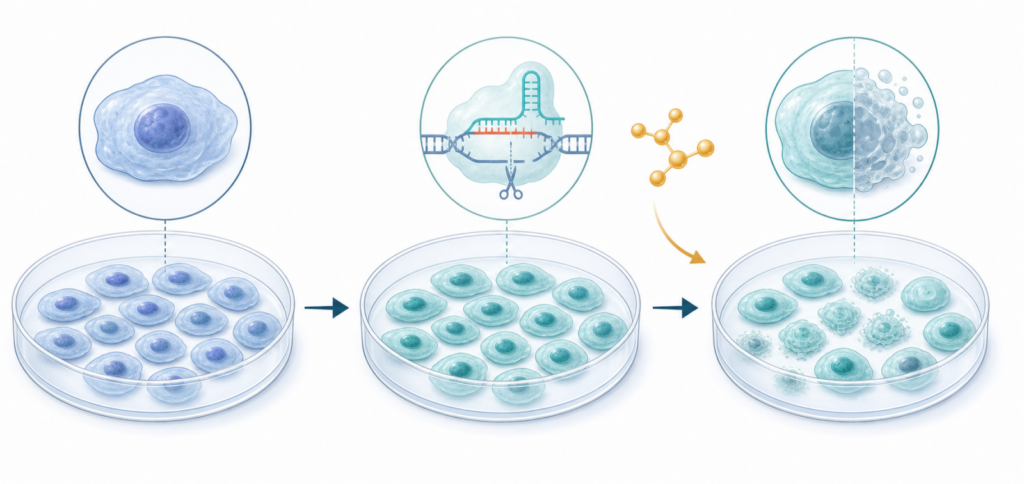
Suppose the edited cells produce an abnormal protein and die more easily under stress. After adding the drug, scientists can check whether the protein behaves more normally and whether more cells survive.
If nothing improves, the drug may target the wrong process, the dose may be too low, or the original theory may be incomplete. This result can stop a weak idea from moving into a larger, more expensive study.
If the cells improve, the drug has passed an important early test. Researchers may also discover that it works only in cells carrying a particular mutation. That finding could help later studies focus on the patients most likely to respond.
Success in cells does not prove that a drug will work in people, but it can show that the idea is worth investigating further.
Where Cell Models Fit in the Drug-Testing Process
A dish of cells is much simpler than a person. It lacks a complete immune system, blood circulation, and several organs working together. It cannot fully show how the body will absorb, break down, or remove a drug.
That is why new treatments pass through several stages of research. Cell models can show whether a genetic change affects cell behavior and whether a drug influences that effect. More complex models and animal studies may then examine dosage, delivery, and safety. Clinical trials are still needed to learn whether a treatment is safe and effective in people.
Modeling disease in cells is not a shortcut around these stages. It is an early filter. By comparing closely matched cells, scientists can reject weak ideas, improve promising ones, and move forward with clearer evidence before asking patients to accept the risk.