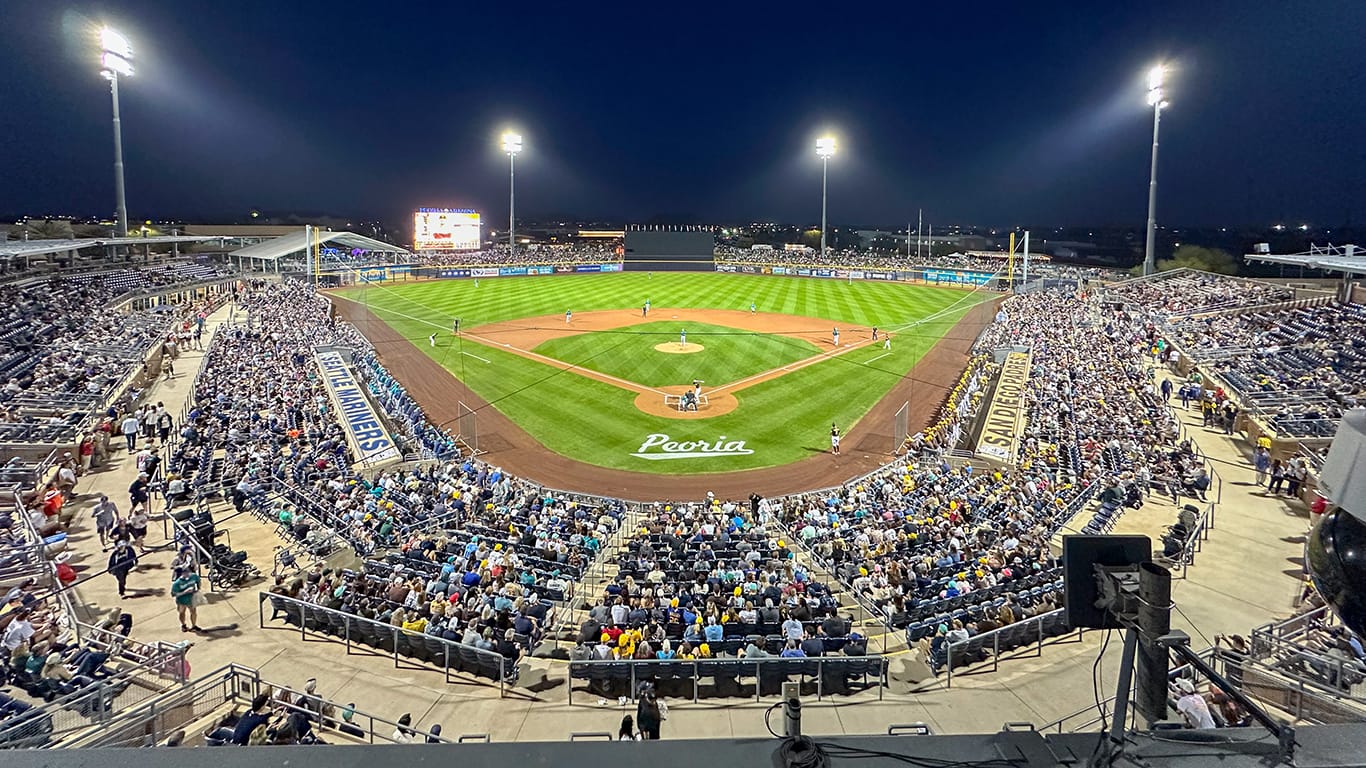
The 2026 Cactus League season generated $495.8 million for Arizona’s Gross Domestic Product (GDP), according to an economic impact study by the Seidman Research Institute at Arizona State University’s W.P. Carey School of Business.
Overall, the 2026 season generated $806.9 million in total economic activity or gross output.
“With teams based in all four continental U.S. time zones, the Cactus League has developed an unmatched following of passionate fans,” said Alix Skelpsa Ridgway, Arizona Office of Tourism director and Cactus League executive board member.
“For hundreds of thousands of visitors, spring training is the magnet that draws them to Arizona. But while they’re here, they take the opportunity to explore our beautiful state. The positive financial impacts of spring training extend far beyond the Cactus League’s footprint.”
The Gross Domestic Product and gross output are the highest since economists began measuring spring training’s financial impact more than 20 years ago.
DEEPER DIVE: Here are Arizona’s Most Admired Companies of 2026
To gauge the impact of Arizona’s oldest annual mega event, researchers conducted face-to-face surveys with 3,999 out-of-state visitors who came to Arizona for games at all 10 Cactus League ballparks and measured only new dollars that flowed into the state due to spring training.
“The Cactus League is a critical tourism driver for Arizona’s economy – an annual mega event that pours hundreds of millions into the state’s coffers and creates thousands of well-paying jobs,” Gov. Katie Hobbs said.
“Generations of baseball fans from across the country and the world have fallen in love with Arizona, and Arizona is thrilled to welcome them back for baseball in the sunshine each spring. I congratulate the Cactus League and its stakeholders on this impressive economic impact report.”
The study found that spending by Cactus League visitors created 5,500 jobs in 2026, paying $297.2 million in 2026. Spring training also directly generated a total of $43.9 million in taxes for the state ($22.2 million), Maricopa County ($4.4 million) and local governments ($16.2 million). The figure includes $1.1 million in rental car surcharges.
“The Cactus League’s economic impact is as enduring as baseball itself,” said Bridget Binsbacher, Cactus League executive director.
“The numbers don’t lie: 2026 was another banner season for spring training in Arizona. We are grateful to Major League Baseball and the host communities for their partnership and to the Arizona Sports and Tourism Authority for providing grant funding for ballpark construction and renovation.”
Founded with two teams in 1947, the Cactus League has grown to 15 Major League Baseball teams training at 10 facilities in eight municipalities and a tribal community across Maricopa County.
The robust economic impact figures are a result of another strong season at the gate. The Cactus League drew a total of 1,753,849 to 237 games, or 7,400 per game. Attendance in 2026 climbed for the fifth consecutive season despite a record heat wave during the season’s final week. Six out of 10 Cactus League attendees come from out of state, according to the report, and two out of three attendees called spring training the “sole or primary reason” for visiting Arizona.
“Baseball is defined by numbers,” said Joe Garagiola Jr., the Arizona Diamondbacks special advisor and former general manager.
“Baseball is defined by numbers. But instead of runs, hits and errors, the numbers in the ASU study reflect tourism dollars, jobs and tax revenue for state, county and local governments. And the numbers don’t lie: the Cactus League is a power hitter in Arizona’s economy.”
The survey found that spring training benefits areas beyond Maricopa County; 20.3% of fans said that they would visit another part of Arizona during their trip. The two most popular destinations were North Central Arizona (including Sedona, Prescott, Payson and Globe) and Northern Arizona (including the Grand Canyon, Flagstaff and Monument Valley).
The median Cactus League travel party attends three games, spends four nights in Arizona and spends $385.71 per day, according to the study.
“This outstanding report shows the dividends of strong community investment in spring training ballpark construction and renovation — by the host municipalities, the tribal community, the clubs and the Arizona Sports and Tourism Authority,” Scarlett Spring, AZSTA board chair.
“Spring training is more than a game. It’s a competitive industry, and we must always protect our investment and the legacy that has been built here in Arizona.”
The volunteers and stakeholders are consistently delivering on the promise made to Maricopa County voters when they approved Prop. 302, Spring added.
Kim Grace Sabow, Arizona Lodging & Tourism Association’s president and chief executive officer, called spring training “an important driver for Arizona’s tourism industry.”
“Its impact is especially strong in the lodging sector,” Sabow said. “Year in and year out, the Cactus League is an all-star attraction for visitors from all four U.S. time zones. Baseball lovers of all ages can attest: Arizona is the place to be in the spring.”
ASU researchers have called the Cactus League a mega event – but one that occurs every spring, lasts a month and touches every corner of Maricopa County. The latest study captures the strength of an enduring force in Arizona’s economy, according to the study’s author, Dr. Anthony Evans, center director at ASU’s Seidman Research Institute.
“The Cactus League remains a consistent driver for tourism and hospitality,” Evans said.
“We estimate that out-of-state visitors alone directly spent $374 million on lodging, in bars and restaurants, on retail and in-state transit, and on other local forms of entertainment. Very few events deliver that amount of new dollars into the state’s economy.”
Danny Seiden, the Arizona Chamber of Commerce and Industry’s president and chief executive officer, is proud of spring training performance.
“The Cactus League has once again performed like an all-star for the state’s economy,” Seiden said.
“Attracting hundreds of thousands of fans from across the country and the world each year, spring training baseball is a proven economic powerhouse in Arizona. Congratulations to the Cactus League and all the stakeholders who make spring training a point of pride for all Arizonans.”