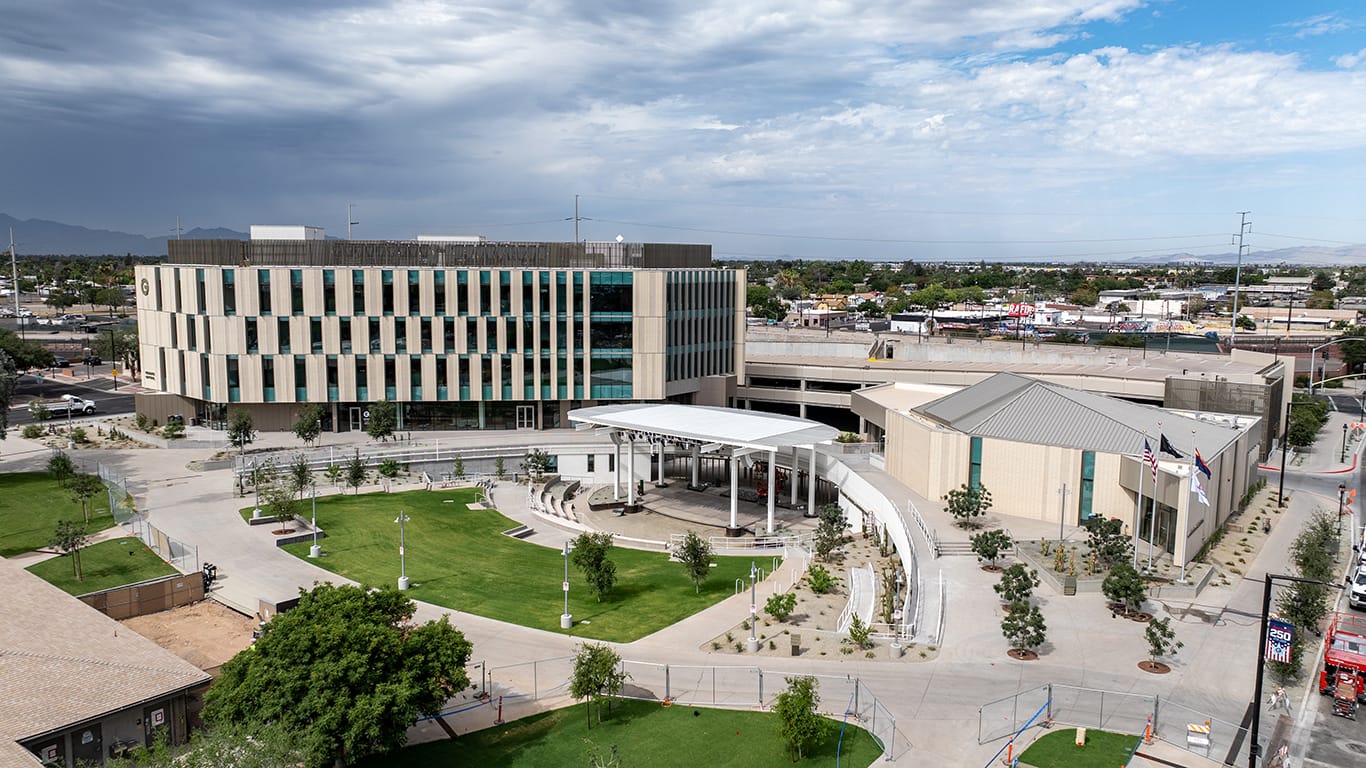
Patrick Banger, Glendale’s new city manager, says he’s proud to lead the community into its next chapter. During the week of June 15, the City of Glendale will unveil the results of the nearly $100 million Downtown Campus Reinvestment Project, anchored by a reimagined city hall, council chambers and E. Lowell Rogers Amphitheater. The 113-year-old Murphy Park, preserved, takes center stage.
The project is more than cosmetic; it’s strategic. The move helps city officials and residents connect seamlessly and puts a brighter spotlight on Glendale. The economic upside is straightforward — increase visitor spending, up the number of ancillary events, and retain more tax revenue at home.
The project is set among more than $3 billion in surrounding private investment.
DEEPER DIVE: Read all the Ranking Arizona Top 10 lists here
INDUSTRY INSIGHTS: Want more news like this? Get our free newsletter here
Banger said the timing is meaningful.
“It’s not often a city gets to open a new civic campus and welcome a new city manager in the same breath,” he said. “It really does feel like the start of a new chapter.”
He said the new city hall was designed to change how residents experience their government.
“You walk in, and it feels open, it feels bright, it feels like you belong there,” he said. “That matters. People should feel welcome in their own city building.”
The Garden Level — the one-stop shop for permitting, development services and utilities — is central to that philosophy.
“You shouldn’t have to wander around a building to get answers,” Banger said. “We wanted to make it intuitive, efficient and human.”
He said the amphitheater is just as intentional. “It’s not just a stage,” he said. “It’s a place where government and community meet. We’re going to program it constantly — music, theater, festivals, civic events. It’s meant to be alive.”
Banger said Glendale’s economic story is unusual in the Valley.
“Our residential growth has largely peaked, but our commercial potential is enormous,” he said. “We have more than 60 million square feet of light industrial land along the Loop 303. We have hundreds of acres in [Glendale’s] Sports & Entertainment District. Most cities would kill for that.”
The district boasts State Farm Stadium; Desert Diamond Arena; Camelback Ranch, the Spring Training home of the Los Angeles Dodgers and Chicago White Sox; VAI Resort and the Mattel Adventure Park.
“This is the kind of cluster normally found in cities three times Glendale’s size,” he said. “We can capitalize on that even more.”
He said Glendale’s national profile is already established. “When Taylor Swift launches a tour here, when Ed Sheeran launches a tour here, when the Super Bowl comes here — that’s not luck,” he said.
“That’s because Glendale is a national brand.”
He said residents sometimes forget the magnitude of what’s in their backyard.
“Shohei Ohtani plays right here in Glendale,” he said. “The Dodgers have been world champions. The Cardinals are the oldest team in the NFL. These are things cities three times our size doesn’t have.”
The VAI Resort, he said, will amplify that visibility.
“When it’s all said and done, it’ll be the single largest resort outside of Las Vegas,” he said. “Resorts like to cluster. That’s what happened in Scottsdale. We’re going to see the same thing here — but with a different style, a different energy.”
He said the city is already preparing for the next wave of major events.
“We’re kicking off a master transportation impact analysis for the entire entertainment district,” he said.
“When you have the stadium, the arena, the resort and multiple events happening at once, you have to plan for that now — not after everything is built.”
He said the goal is to understand congestion, circulation and parking before the next round of development breaks ground.
“You know what it’s like on a Cardinals game day,” he said. “You build that into your schedule. But when you layer multiple events on top of each other, you need a plan. That’s what we’re doing.”
The city is also working with property owners to understand their timelines and interest in bringing parcels to market.
“We want to be proactive,” Banger said. “We want to market Glendale to the right companies, the right operators, the right entertainment brands. We want them to see what we see.”
But while the entertainment district drives national visibility, Banger said Glendale’s historic downtown is part of the city’s long-term vision — and its most underleveraged economic asset.
“That has been the core of the city since its founding,” he said. “Downtowns ebb and flow with the development of the community and the local economy. This gives us an opportunity to revitalize it and get it back to that place it once was and will be again — the living room for our community.”
He said the bones are exceptional. “We have buildings you can’t recreate today,” he said. “Red brick, narrow alleys, historic storefronts. Those alleys are culturally significant if you do them right — patio dining, lighting, artwork. They become magical.”
The city, he said, is approaching the work with intention.
“We’re doing traffic studies, parking studies, redevelopment tools, stakeholder engagement — all of it,” he said. “This isn’t a check-the-box exercise. It’s a foundation.”
He said the goal is to create an 18-hour downtown.
“You want breakfast crowds. You want lunch crowds. You want dinner crowds. You want festivals. You want people living there,” he said. “That’s when a downtown thrives.”
He emphasized that downtown is not competing with the Westgate Entertainment District or the Arrowhead Towne Center.
“It’s a value add,” he said. “If you’re here for a game or a concert or the resort, you’re ten minutes from a historic district where the owner is in the kitchen cooking your food. That’s special.”
Banger said the city plans to reestablish a redevelopment district to give Glendale more tools to work with.
“We had one at one time,” he said. “It expired about 20 years ago. Statutes give us more tools now. We want to use them.”
Soon, he explained, the city will launch a robust stakeholder engagement process.
“We want to hear from everyone — property owners, entrepreneurs, Catlin Court [Historic District], restaurants, retailers,” he said. “We want all those voices in the room.”
The city owns several parcels downtown and will evaluate how to activate them.
“We want to bring in the right partners,” he said. “In Gilbert, we had early investors like Joe Johnston and Greg DeMarco. Those people changed the trajectory of the district. We want to find the Glendale version of that.”
The amphitheater will play a major role in reactivating the area.
“We’re going to program the heck out of it,” he said. “Plays, musicals, concerts, festivals. You want vibrancy. You want energy. You want reasons for people to come downtown.”
He said the library is also under evaluation.
“It’s old. We’re looking at redevelopment opportunities. We want learning, arts, theater, education — all of it — in the downtown.”
He said the city is also exploring a collegiate presence. “You want students downtown. You want that energy. You want that activity.”
Banger said Glendale’s identity is becoming clearer.
“We’re not trying to be Phoenix. We’re not trying to be Scottsdale,” he said. “We’re just Glendale, Arizona. And that’s enough. You can get anywhere quickly and easily, and you still have all the same amenities.”
He said the city’s sports assets, Luke Air Force Base, and entertainment cluster give Glendale a national profile that most cities its size don’t have.
“You can’t understate the importance of Luke Air Force Base,” he said. “You can’t understate the Dodgers playing right here. You can’t understate the Cardinals’ history. These things matter. They shape who we are.”
The June 20 celebration of America’s 250th birthday will be the first major event on the new civic campus. Banger said the timing is perfect.
“It’s a chance to show people what this space can be,” he said. “It’s a chance to say, ‘This is your city. This is your place.’”
The event — with music, drones, food, family activities, and the amphitheater activated for the first time — is meant to feel like a community reunion. “It’s not just a party,” he said. “It’s a statement.”
For Banger, the convergence of projects, investments and civic energy is not accidental. It’s the beginning of a new era.
“We’re stepping into our moment,” he said. “And we’re doing it together.”