We all know the story of “Goldilocks and the Three Bears.” One bear’s bed is too big, another too small and then there’s the bed that’s just right. In some ways, the Arizona workforce mirrors this age-old story. The Arizona workforce is large and growing, while skilled talent struggles to keep up with demand, leaving many wondering what comes next.
DEEPER DIVE: Here are Arizona’s Most Admired Companies of 2026
The workforce is growing, but talent gaps remain
How fast is the Arizona workforce expanding? According to the Arizona Office of Economic Opportunity (OEO), the state is projected to add more than 700,000 jobs by 2030 in high-tech manufacturing, healthcare and other high-growth sectors.
Arizona’s semiconductor boom is no longer new, but neither is the challenge of finding enough skilled workers to support it. The Arizona Commerce Authority (ACA) reports that the state has attracted more than 60 industry expansions and over $210 billion in investments since 2020. With that said, economic organizations and educators understand that demand for skilled labor continues to grow exponentially.
“Arizona is exceptionally well-positioned for long-term economic growth, particularly in semiconductor manufacturing, where demand spans from highly skilled engineers to specialized technicians,” says Brian Mueller, president at Grand Canyon University (GCU).
Of the roughly 115,000 new semiconductor jobs anticipated by 2030, the Arizona Technology Council reports that more than half will go unfilled at the current hiring rate.
Arizona’s construction industry faces a similar workforce dilemma as the semiconductor space. As another rapidly growing industry, a wide range of employment skills is needed to keep up with workforce demand,
“Construction is facing workforce shortages across nearly all major skilled trades, including electrical, plumbing, HVAC, mechanical, carpentry and equipment operators,” says Eric Fields, senior vice president at McCarthy Building Companies.
Healthcare is another area in desperate need of workers across the board. In 2025, Maricopa Community Colleges (MCC) provided a deeper dive into healthcare workforce deficits. By 2032, Arizona is projected to be short 4,679 registered nurses, 412 nurse practitioners and 4,131 physicians.
“Workers remain in demand in nursing and other direct healthcare roles,” says Kristin Pozen, practice leader at Duffy Group, “as well as in the nonprofit industry, but employers have limited resources to recruit and hire top talent. As a result, in some cases, employers are getting squeezed out of hiring the best people.”
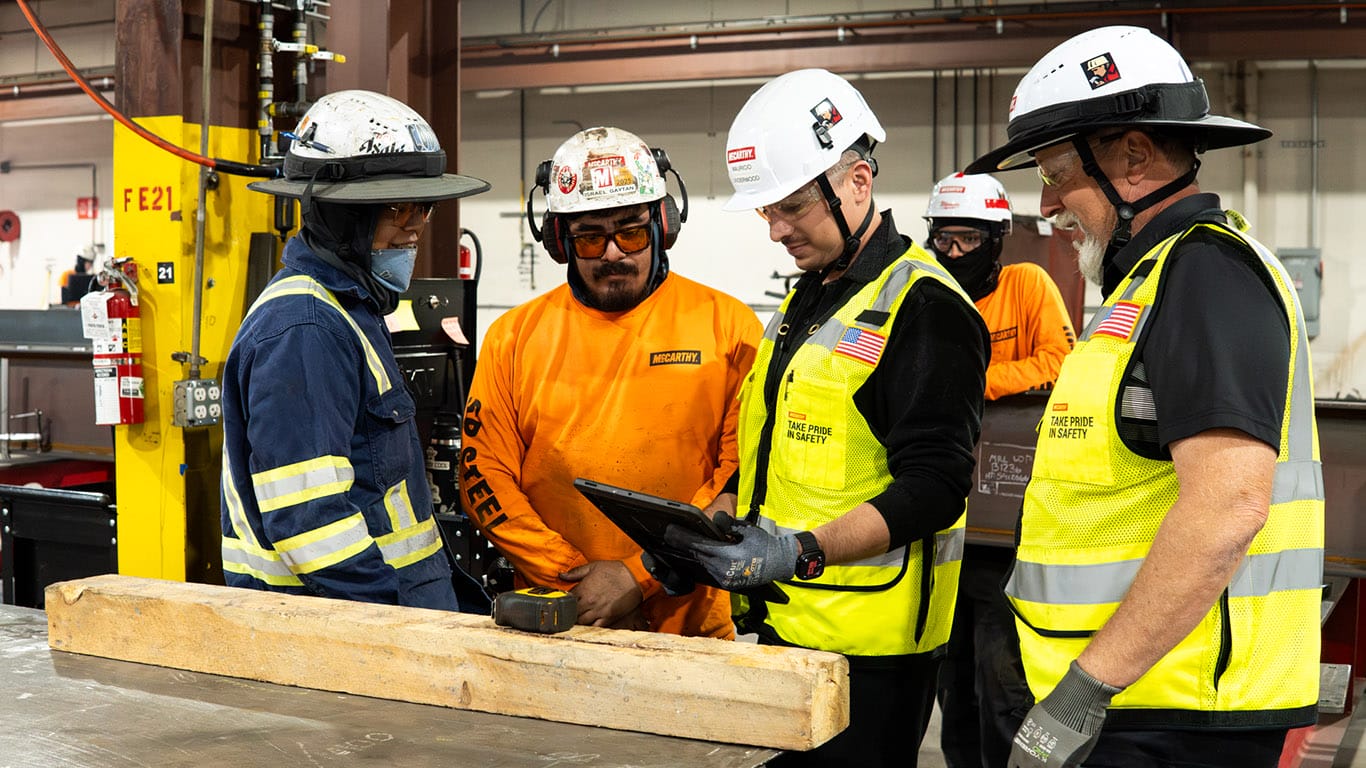
McCarthy Building Companies’ Innovation and Craft Workforce Center (ICWC) is a dedicated facility that focuses on providing training and career development for skilled trade professionals and the firm’s prefabrication operations. (Photo provided by McCarthy Building Companies)
What is causing gaps in Arizona’s workforce
Gaps in Arizona’s workforce mirror several national challenges. Workers are nearing retirement age, with healthcare and construction laborers in particular, exacerbating an existing shortfall. By 2060, retirement-age residents (65+) will grow to 30% of Arizona’s population (up from 23% in 2026), according to EOE.
“As experienced leaders retire and competition for talent remains strong, organizations that identify future leaders early and provide mentoring, stretch assignments and leadership development opportunities will have a significant advantage,” explains Travis Laird, senior regional director with talent solutions and business consulting firm Robert Half.
Broad federal economic uncertainty, inflation and elevated interest rates have slowed hiring new talent. A recent article published by the Economic and Business Research Center at the Eller College of Management (EBRC) adds to increased tariffs, reduced international migration, rising deportations and high energy costs to the list of contributors widening workforce gaps in Arizona.
“Demand is growing faster than the available supply of trained craft professionals,” Fields says. “Although the industry has made meaningful progress in rebuilding interest in the trades and expanding workforce development efforts, shortages remain a real challenge.”
Is AI reshaping jobs or replacing them?
The impacts of AI in the modern workforce are cavernous, conjuring wildly different appraisals and opinions. One thing that can’t be denied, no matter where you fall on the pro or negative AI scale, is that it has significantly changed the workforce landscape.
Phoenix ranks among the nation’s leading cities for business AI adoption. A LendingTree study found that 28.4% of Phoenix businesses reported using AI, trailing only Seattle and Denver, according to Jennifer Yee, a partner in Snell & Wilmer’s employment and labor law group.
Then there’s the question on everyone’s mind: Is AI taking over Arizona jobs, and if so, how is that contributing to gaps in the workforce?
Forrester reports that initial projections of 29% of U.S. jobs lost to automation coming from generative AI will rise to 50% by 2030. On the flip side, the same report reflects that AI currently influences 20% of jobs more than replacing them.
“What we’re seeing is not mass displacement,” says Ian Roark, provost and executive vice chancellor of Academic Affairs and Workforce Development at Pima Community College (PCC). “What we’re seeing is actually a shifting of skills, lower-level skills that usually were done by people being shifted to AI, which allows for a higher-level skill set.”
Mueller adds, “Digital literacy is no longer optional. It is foundational across every industry and affects all of us every day. At GCU, we are integrating rigorous, human-centered AI training throughout our academic programs to ensure graduates understand not only how to use these tools but also how to apply them responsibly and effectively.”
AI in the hiring process
How AI is used in vetting and hiring job candidates appears to be more of a concern over job displacement, raising new ethical and legal questions.
Another challenge employers are faced with is that candidate resumes and cover letters are starting to look the same, making it more difficult to identify truly qualified applicants.
“The widespread use of generative AI has led to higher application volumes and resumes that often look increasingly similar,” Laird says. “Nearly half of professionals (46%) say AI-generated applications have made it harder to stand out.”
Pozen explains that employers and recruiters are using “skillfishing” to identify talent with versatile skills to ensure candidates are not overstating their qualifications.
As AI becomes more commonplace in the hiring process, legal experts are faced with a new landscape of AI legalities and evolving employment laws.
Employers are increasingly using AI to streamline hiring, promotions and other HR functions, but outsourcing those decisions to technology doesn’t eliminate legal responsibility.
Existing employment laws prohibiting discrimination based on factors such as age, disability and protected characteristics still apply, meaning companies remain accountable if AI-driven decisions produce discriminatory outcomes.
“The laws that exist are broad enough where they’re still going to apply, even if an AI tool is used,” says Josh Woodard, partner at Snell & Wilmer.
Yee adds that the regulatory landscape is also evolving. While Arizona has not adopted AI-specific employment disclosure requirements, five state and local jurisdictions have already enacted laws requiring employers to disclose when AI influences hiring or employment decisions.
“That disclosure is going to fuel more employment claims and a closer look by employers at compliance,” she says. “It will be readily apparent to applicants or employees that AI was used in the hiring process.”
Solving the talent equation takes partnership
It took Goldilocks time to find a situation that’s “just right,” and it will take Arizona a while to reinforce a pipeline to sustain the state’s workforce. Many educational and business partnership measures are already in place, with future plans to solidify more.
“Workforce has become one of the most important factors for companies evaluating expansion opportunities in new markets,” says Christine Mackay, president & CEO, Greater Phoenix Economic Council (GPEC).
Mackay points out that Greater Phoenix has key advantages headlined by the strength and size of the region’s educational institutions. Arizona State University (ASU), University of Arizona (U of A), MCC and GCU all collaborate closely with industry partners, helping to set curriculum that prepares students for productive roles in the workforce immediately upon graduation.
“Strong partnerships between employers and universities are essential to building a workforce that meets real-time economic needs,” Mueller says. “We have established 22 advisory boards comprising more than 800 industry leaders across Arizona.”
It’s these partners, Mueller explains, that play a critical role in identifying workforce gaps, shaping curriculum to align with current industry demands, and providing internships and employment opportunities for students.
PCC has a dedicated workforce development team to address industries in need of highly skilled and trained professionals.
Roark provides the partnership example of PCC and American Medical Response (AMR).
“AMR hires individuals who aren’t yet trained as EMTs and pays for them to complete our EMT and paramedic program,” he says.
Roark adds, “We have an amazing partnership with Raytheon and IT cybersecurity where typically they require a four-year bachelor’s degree, but when they saw how robust our program was in two years, they partnered with us to offer an apprenticeship.”
McCarthy’s Innovation and Craft Workforce Center (ICWC) is a dedicated facility that focuses on providing training and career development for skilled trade professionals and the firm’s prefabrication operations. ICWC houses McCarthy’s apprenticeship programs, provides hands-on learning and instruction in emerging technologies, as well as safety practices. It also offers leadership training and mentorship for craft professionals interested in advancing into roles such as crew leader or superintendent.
“Working directly with companies, our universities and community colleges can develop curriculum to best suit what is needed in Greater Phoenix but not being taught anywhere else in the country,” Mackay says.
How can employers prepare and navigate gaps in the workforce?
As discussed, educational institutions, business partnerships and training programs are doing their part to strengthen Arizona’s workforce pipeline. In the meantime, employers seek ways to protect themselves from human resources legal complications, while also figuring out the best way to compete for talent.
“Arizona employers should be paying close attention to succession planning,” Laird says. “As experienced leaders retire and competition for talent remains strong, organizations that identify future leaders early and provide mentoring, stretch assignments and leadership development opportunities will have a significant advantage.”
Roark says one of the best ways employers can prepare for workforce shortages is by becoming active partners in workforce development rather than passive consumers of talent. At PCC, every academic program is developed alongside business and industry partners to ensure students graduate with the skills employers are seeking.
“We want to have a workplace connection to every program at the college,” he says.
Arizona may not have found its “just right” workforce balance yet, but employers, educators and policymakers agree that strengthening partnerships today will help shape the talent pipeline the state’s growing economy will depend on tomorrow.