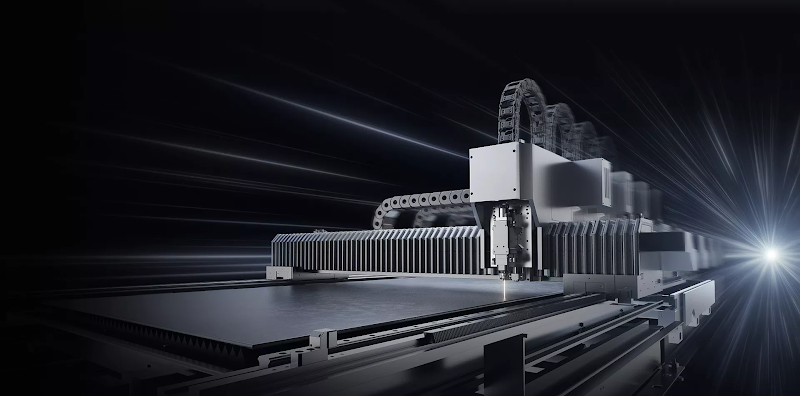
For a metal fabrication business, buying a fiber laser cutting machine is not simply an equipment upgrade. It is a capacity, staffing and cash-flow decision that can influence quoting speed, production scheduling and profitability for years.
The purchase price is easy to identify. The return on investment is more difficult to calculate.
A machine with a lower initial price may become expensive if it produces inconsistent edges, consumes excessive gas or experiences long periods of downtime. A high-power system may look impressive during a demonstration but deliver a slow financial return if the shop does not have enough suitable work to keep it productive.
A useful ROI analysis therefore looks beyond laser power and advertised cutting speed. It measures how the complete production system affects throughput, material utilization, labor, secondary processing, delivery reliability and the shop’s ability to accept more profitable work.
Start with the current production baseline
Before comparing machines, a fabricator should document how work is completed today. This creates a baseline against which a proposed investment can be measured.
The review should cover at least 12 months of representative production rather than relying on one unusually busy or quiet period. Useful information includes:
- Monthly sheet and plate volume
- Materials and thicknesses processed most frequently
- Hours spent cutting, loading and unloading
- Current outsourcing expenses
- Labor used for cutting and secondary finishing
- Scrap and rejected-part costs
- Maintenance and consumable expenses
- Average delivery time
- Orders declined because of limited capacity
- Revenue affected by production delays
Outsourcing costs should include more than the supplier’s invoice. Freight, minimum order quantities, communication, inspection, rejected parts and waiting time can all affect the real cost.
The same principle applies to an older cutting process. Its operating cost should include energy, labor, consumables, maintenance and downstream work such as grinding, drilling or oxide removal.
Without this baseline, an ROI estimate can easily become a comparison between an accurate machine quotation and an incomplete picture of current costs.
Measure productive hours instead of maximum speed
Cutting speed is important, but it does not represent the output of the entire fabrication process.
A machine may achieve a high speed on a straight cut through a specific material. During normal production, however, the cycle also includes loading, positioning, piercing, cornering, unloading, sorting and moving finished parts.
Productive capacity can be limited by:
- Frequent material changes
- Long sheet-loading times
- Manual part removal
- Inefficient nesting
- Delays while locating drawings or material
- Nozzle inspection and replacement
- Unstable gas pressure
- Insufficient extraction
- Programming bottlenecks
- Unplanned maintenance
- Waiting for downstream operations
This is why maximum cutting speed should not be used as the primary ROI figure.
A more useful measure is the number of acceptable parts produced during an ordinary shift. For job shops, productive hours should also account for frequent changeovers and a varied order mix. A high-volume manufacturer may be more concerned with continuous cutting, automated material handling and consistent cycle times.
Buyers should ask suppliers to demonstrate the machine using realistic parts rather than a single long contour designed to produce an impressive speed figure.
Calculate the complete installed investment
The machine price is only one part of the capital required to begin production.
When comparing industrial fiber laser cutting machines, buyers should evaluate the complete installed system and the infrastructure required to operate it.
The total investment may include:
- Machine and selected laser source
- Cutting head and control system
- Exchange table or single platform
- Freight and transport insurance
- Import duties and taxes
- Unloading and positioning
- Foundation or floor preparation
- Electrical installation and grounding
- Voltage stabilization where required
- Chiller and cooling connections
- Fume extraction and ductwork
- Oxygen, nitrogen or compressed-air systems
- Air compressor, dryer, filters and storage tank
- Software and nesting licenses
- Operator and maintenance training
- Initial consumables and spare parts
- Automatic loading and unloading equipment
- Material storage and handling systems
These costs should be confirmed before approval rather than added after the machine arrives.
Factory readiness also affects the time between delivery and productive operation. A machine that remains idle because electrical capacity, gas supply or extraction was not prepared is consuming capital without generating revenue.
For that reason, ROI calculations should begin when the total investment starts—not only when cutting finally begins.
MORE NEWS: Arizona earns 19 Michelin Guide selections in inaugural Southwest Guide
Match power to the profitable thickness mix
More laser power can increase cutting speed and extend thickness capacity, but the highest available power is not automatically the most profitable choice.
A shop should first identify its profitable thickness mix: the materials and thicknesses that represent most recurring revenue.
The analysis should separate three categories:
- Daily work that must run efficiently
- Occasional thick-material orders
- Work the company hopes to win in the future
Buying a machine around an occasional maximum thickness can lead to unnecessary capital and operating costs. On the other hand, selecting insufficient power for everyday work can restrict throughput and force the machine to operate near its limits.
The decision should also reflect edge-quality requirements. Oxygen may support efficient cutting of carbon steel, but it leaves an oxidized edge. Nitrogen may produce cleaner results on stainless steel and aluminum, but its consumption can significantly affect the cost per part.
Manufacturers such as GWEIKE offer different power levels, working areas, enclosures and automation options. Buyers should match these configurations to their actual order mix instead of treating kilowatts as a complete measure of machine capability.
Include material utilization in the calculation
For many fabrication businesses, raw material represents a larger annual expense than electricity or routine consumables. Even a small improvement in sheet utilization can therefore have a meaningful financial effect.
Nesting software influences how many parts fit on each sheet, how remnants are managed and how much material becomes scrap. The financial benefit depends on:
- Part geometry
- Quantity per order
- Common-line cutting opportunities
- Kerf and part-spacing requirements
- Sheet dimensions
- Grain-direction restrictions
- Remnant identification and reuse
- Production scheduling
A demonstration should use the buyer’s actual DXF files whenever possible. Comparing nesting results from the same part library provides more useful information than reviewing a supplier-selected sample.
Material savings should be calculated using actual purchase prices. The value of saving 2% of an expensive stainless steel or aluminum sheet can be very different from saving the same percentage on a lower-cost material.
Rejected sheets should also be included. A single failed thick plate may cost more than several hours of electricity, gas and labor combined.
Calculate secondary-processing savings
Laser cutting can affect more than the cutting department.
If a machine produces consistent holes, accurate contours and a suitable edge, it may reduce the need for grinding, drilling, reaming or other secondary work. However, these savings should be verified for the company’s actual parts.
The evaluation should consider:
- Burr and dross removal
- Oxide removal before painting
- Edge preparation before welding
- Hole correction
- Part straightening
- Manual marking
- Rework caused by dimensional variation
- Handling between separate processes
Gas selection plays an important role. Cutting carbon steel with oxygen may support a particular production objective, but the oxidized edge may require cleaning before coating. Nitrogen may reduce some downstream work while increasing gas cost.
The correct comparison is not simply the cost of completing the cut. It is the cost of producing a part that is ready for the next operation.
Evaluate labor savings realistically
Automation can reduce manual handling, but it rarely eliminates labor completely.
An exchange table may allow a new sheet to be prepared while another sheet is being cut. Automatic loading can reduce crane or forklift activity. Unloading systems can improve continuity during repeat production.
Operators may still be required to:
- Prepare and verify programs
- Confirm material
- Inspect the first part
- Monitor process conditions
- Replace nozzles and protective windows
- Separate and identify components
- Remove scrap
- Perform quality checks
- Respond to alarms
- Maintain the machine and work area
Automation usually creates the strongest return when demand is stable enough to keep it working. A job shop running short, unpredictable orders may need a different level of automation than a factory producing the same components across multiple shifts.
Buyers should calculate labor changes by task. A general claim that a system “saves one operator” is not sufficiently precise unless the affected activities and shift pattern are identified.
Account for gas, energy and consumables
Operating costs vary according to power, material, thickness, gas strategy and local utility prices.
The analysis should include electricity used by:
- The laser source
- Motion system
- Chiller
- Extraction equipment
- Air compressor
- Loading and unloading systems
- Other supporting equipment
Assist-gas costs require separate attention. Nitrogen consumption can become a major expense in stainless steel production. Compressed air may lower purchased-gas costs in suitable applications, but the compressor, dryer, filtration, maintenance and electricity are not free.
Consumables commonly include:
- Nozzles
- Protective windows
- Ceramic rings
- Filters
- Lubricants
- Cleaning materials
- Wear components
Each supplier should provide enough information to estimate these expenses for the buyer’s production mix. The result should be calculated per productive hour or per acceptable part, not simply as an annual lump sum.
Include maintenance and downtime risk
ROI estimates often assume that every scheduled hour will be productive. Real factories experience maintenance, process interruptions and unexpected faults.
Downtime has two costs:
- The direct expense of service and replacement parts
- The contribution margin lost while orders cannot be produced
A shop with tight delivery schedules may also face overtime, expedited outsourcing or damaged customer relationships when equipment is unavailable.
Before purchasing, buyers should ask:
- Which maintenance tasks are required daily, weekly and annually?
- Which components are considered consumables?
- What spare parts should be kept locally?
- Is remote diagnosis available?
- Where are service technicians located?
- What response times are realistic?
- What does the warranty include and exclude?
- Who trains operators and maintenance employees?
- How is production restored after a control or software problem?
The lowest purchase price can quickly lose its advantage if a critical replacement part has a long delivery time.
Build three ROI scenarios
A single optimistic forecast is not enough for a major capital decision. A better approach is to calculate conservative, expected and growth scenarios.
Conservative scenario
Use lower machine utilization, limited sales growth and realistic startup inefficiencies. This scenario shows how the investment performs if demand is weaker than expected.
Expected scenario
Use the current order book, normal production hours and savings that can be supported by existing data. This should be the main planning case.
Growth scenario
Include an additional shift, new customers or work currently declined because of capacity limitations. Growth revenue should only be counted when there is a credible sales plan.
A simplified annual-benefit calculation can be expressed as:
Annual net benefit =
outsourcing savings
+ contribution from additional production
+ labor savings
+ material savings
+ secondary processing savings
– additional operating costs
– additional maintenance costs
The simple payback period is:
Simple payback period =
total installed investment ÷ annual net benefit
This calculation does not account for financing, taxes or the time value of money. Larger investments should also be evaluated using cash-flow analysis, net present value or internal rate of return with assistance from a qualified financial professional.
Verify assumptions with a representative cutting test
A supplier demonstration should confirm the assumptions used in the ROI model.
The buyer should provide:
- Actual material grades
- Common and maximum thicknesses
- Representative DXF files
- Small holes and detailed contours
- Typical production quantities
- Required edge quality
- Tolerance expectations
- Downstream process requirements
During the test, record:
- Nesting yield
- Total cycle time
- Piercing time
- Assist gas and pressure
- Loading and unloading time
- Edge quality
- Burr or dross
- Hole quality
- Number of rejected parts
- Secondary work required
A practical fiber laser cutter selection and configuration guide can help buyers organize questions about power, bed size, utilities, automation and factory preparation before conducting a test.
The demonstration should produce evidence that can be inserted into the financial model. It should not be treated only as a visual sales presentation.
Look beyond the payback period
A short payback period is attractive, but it is not the only measure of a good investment.
A fiber laser may also improve:
- Quotation responsiveness
- Control over delivery dates
- Ability to process urgent orders
- Repeatability between batches
- Access to new materials or thicknesses
- Customer confidence
- Production scheduling
- Capacity for future automation
Some of these benefits are difficult to convert into an exact dollar amount. They should still be documented and considered alongside the financial calculation.
The equipment should also fit the company’s longer-term strategy. A machine that provides excellent ROI for the current workload may become restrictive if the business plans to enter large-format plate processing or automated high-volume production.
Conversely, paying for future capacity that may never be used can weaken cash flow and delay the return.
Final thoughts
The true ROI of a fiber laser cutting machine cannot be determined from purchase price, power or maximum cutting speed alone.
A reliable evaluation begins with the shop’s current production baseline. It then measures realistic throughput, installed cost, material utilization, labor, gas, energy, secondary processing, maintenance and downtime.
The most useful question is not, “How fast is this machine?”
It is:
How much additional value can this complete production system generate from the work our business actually performs?
By using representative drawings, real material costs and multiple demand scenarios, metal fabricators can replace optimistic assumptions with a defensible investment case. The result is a machine selected for profitable production—not simply for the most impressive specification sheet.