State Route 30, the Tres Rios Freeway, is poised to play a pivotal role in the West Valley’s growth, influencing transportation efficiency, development patterns, and long-term economic competitiveness across the Buckeye-Phoenix corridor.
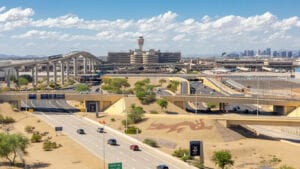
SR 30 will be parallel to I-10 about 5 miles to the south.
“There’s going to be a tremendous number of additional vehicles from just the population growth we’re seeing all over the West Valley, but specifically in Buckeye,” says Buckeye Mayor Eric Orsborn.
“We’re going from 125,000 in population today to 300,000 by 2040. In the next 15 years, we’re almost tripling in population, which is a staggering amount of growth, on our way to somewhere between 1 million and 1.5 million when we ultimately grow out.”
Construction of the central segment — from Loop 303 to Loop 202 — is slated to begin in 2027, with six lanes planned.
LEARN MORE: The 15 best public and private high schools in Metro Phoenix
FOOD NEWS: 25 places for great patio dining in Arizona
ADOT is driving land acquisition for the freeway, stitching together right-of-way along the planned corridor and locking in key parcels well before construction begins. ADOT expects to wrap up the $28 billion project in 2035.
SR 30 will be a significant benefit to the city of Buckeye, as the segment from Loop 303 to SR 85 falls within the city. The project is expected to attract jobs to the area, allowing residents to “stay close to home,” Orsborn says.
“The majority of the population travels east for work, up Miller Road or up Watson or one of the other arterial roadways, hops on I-10 and goes to work farther in town.”
With a secondary freeway project, Orsborn says he can split the difference. People who live close to the I-10 are likely to take that freeway anyway, but other folks would take SR 30 to local employers.
Aiding that is the nearly 25 million square feet of industrial projects that are in some phase of development, “with much, much more to come,” Orsborn says.
SR 30 ties into Buckeye’s Downtown Specific Area Plan, which lays out the framework for the area.
“I think, across the board, we’ve all said we want something vibrant that serves as a destination for people to visit small businesses and arts and culture venues, and to celebrate Buckeye’s heritage and history,” he says.
There, underground improvements are needed before city officials and stakeholders can celebrate the finished project. The changing of property ownership is enhancing Downtown Buckeye, as well.
“This feeds not only the residential that is coming that way, but also the retail and services that are there,” he says.
With the passage of Prop 479, Orsborn says stakeholders are trying to expedite the project without high cost.
“I think all of the options are on the table,” he says. “But it’s trying to figure out how we deliver these projects in a much more efficient manner so relief can come to the folks who live in the area.”
But the buck doesn’t stop with SR 30. Development is brisk elsewhere in the West Valley.
Development savvy
Peoria Economic Development Director Maria Laughner says the city directs its destiny, as staff have developed a “very close relationship with the State Land Department” to create intergovernmental agreements for the North Peoria Gateway and the Peoria Innovation Core.
That creates a mutually beneficial agreement for Peoria to help achieve its vision, “what the city can look like in terms of making sure that we have jobs, amenities and different housing available for all of our residents,” she says.
“All while allowing the state to be true to its statutory goal of selling at the highest price to fund Arizona education.”
The agreements allow Peoria to move through the zoning process ahead of State Land Department auctions, work closely with stakeholders and residents, and shape land uses and zoning that will allow for smart residential and employment growth — while committing the funding needed to plan and build the supporting infrastructure.
Driving the surge in development is a combination of abundant, relatively affordable land and the arrival of major semiconductor players such as TSMC and Amkor. Their presence has accelerated industrial growth along the Loop 303 corridor, where more than 25 million square feet of industrial space is under construction.
“State Land is the most pristine desert in the Valley,” Laughner says. “However, without any infrastructure in the ground, it makes it more difficult for a large user to come in and go through the lengthy auction process to buy 20, 30, or 100 acres because they have to do all of the basic public infrastructure work as well. Peoria has taken away that risk by purchasing the 834 acres in our Peoria Innovation Core and constructing all of the necessary road and utility infrastructure.
“We’re bringing the water,” she adds. “We’re working with Cox every day to ensure fiber is available. We’re doing all of that to make the sites — seriously — shovel-ready so employers can come in and build their facilities.”
Amkor is one of the state’s largest projects, bringing jobs as well as hotels, restaurants and retail to the area.
Local jobs are still needed, however. With an average age of 41, Peoria’s population skews mature and educated, with slightly less than half of residents earning a bachelor’s degree or higher, she says.
“Because of the accessibility — particularly in North Peoria, through the [Loop] 303 and then off the [Loop] 101 and [SR] 74 — we have access to 1.5 million workers within a 30-minute drive.
“All of these things are coming together to help Peoria really grow our economic base, which is something we haven’t had. Quite honestly, we know that 90% of Peoria residents have to travel outside of their community to work because we just didn’t have the jobs here.
“It has been a really big focus of our council to try to bring more jobs into the city, so our residents have a better quality of life and less windshield time.”
Bringing jobs to the community means increased tax revenue, indirectly, because “people are around more. They’re able to spend more time in the city.” Peoria staff is ensuring there is a means to the end.
“I’ve read that we’ve grown 9% since 2020. We need some place for our residents to also have fun. The city put a lot of work into that, such as with our Trailhead project, the Main Street project planned for FIVE NORTH, and our downtown revitalization, which is underway with Caldwell County BBQ and Jefferson House.”
Retail is increasing in Peoria. Laughner says the city hired Brian Carpenter, deputy economic development services director, to lead the retail effort.
“He has made various inroads to developers and brokers,” she says. “He is working on four letters of intent right now, related to destination retail projects all over the city — not just North Peoria. He is focusing on Downtown, Park West and P83, trying to improve the retail that already exists, to fill big boxes with new users, and to add new retail options, particularly in the north where they don’t have enough amenities for the number of households there.”
Park West has several pads available for a hotel, additional retail and restaurants.
“There’s a lot happening and just so much on the horizon and so much optimism,” Laughner says. “I could say that for the whole Valley, though, the whole state. I’ve seen the excitement in a lot of statewide and regional efforts because of Amkor and the semiconductor industry.
Healthcare is another priority for Peoria, as Laughner calls it a “medical care desert.” Earlier this month, HonorHealth opened a facility that marries concierge medical care and urgent care.
“You could just go there, and they will tell you if you need urgent care or the emergency room,” she says. “The same if you think it’s not a big issue but you do have a medical emergency. There are emergency room doctors in the facility who can do a CT scan and run labs.”
Another piece of the puzzle is workforce development with West-MEC. With the bond passing in November, West-MEC has two Peoria campuses being planned. City staff is working with the school on its site plan and permitting. Laughner calls this a win for Peoria, as the city has the largest number of students in the West-MEC programs.
The campuses have not yet determined the exact programs, but Peoria is looking for several healthcare-related programs as well as advanced manufacturing and construction programs.
“It’s going to be fantastic: The connection being made between school programs and career training that our residents can experience all in their hometown. And that is what employers are looking for: a pipeline of talent. With everything that Peoria is working on, 2026 is going to be amazing.”
‘Buc-ing’ the trend
Goodyear economic development director Wendy Bridges pulls up a spreadsheet to track the sheer volume of activity flowing through her department.
However, one word sums it up: Buc-ee’s.
Texas-born Buc-ee’s is a massive travel center known for “spotless restrooms, endless fuel pumps, fresh food, quirky merchandise, and its beaver mascot.”
“A lot of people have been talking about this and are excited about it,” Bridges says, adding the juggernaut is expected to open in Q2.
“When we started working with them, I was planning a trip out of state. I stopped and visited one, and it is every bit as amazing as promised. So many people in Arizona are fans, and this is the first one in Arizona. This will bring millions of people right to our doorstep.”
Using Buc-ee’s and spring training as a foundation, the City of Goodyear recently launched a tourism initiative, Visit Goodyear, to inform and attract visitors.
Through preseason baseball, “we learned that not only do we have a strong weekday market for hotels, but there is a lot of opportunities to really beef up our weekend overnight stays. We’re concentrating on tourism this year.”
Goodyear is landing industrial projects as well. In December, United Sports Brands opened. Meanwhile, Abrazo just completed a new medical building adjacent to its Goodyear campus.
“Abrazo has added a lot,” she says. “They have the da Vinci 5 system for specialty surgeries. They have added high-tech operating and radiology suites.”
The expansive City of Hope is dedicated to cancer care for locals — and beyond. At City of Hope, formerly known as Cancer Treatment Centers of America, patients can see specialists and learn about the types, causes, symptoms, risk factors, and prevention of cancer.
“It’s very important that people do not need to travel to get state-of-the-art cancer care treatment. City of Hope is an incredible asset to have in our community,” Bridges says.
“TGen is the foundational arm of City of Hope. All the research that TGen is doing benefits not just City of Hope patients, but cancer patients everywhere.”
Bridges says entertainment has been a priority for residents. The Rush Funplex, which features miniature golf, bowling, food and other experiences, is coming.
“In fact, we survey our residents every two years to ask them what they would like to see,” she says. “Entertainment options are very high on the list.”
The city doesn’t lack for entertainment. GSQ (Goodyear Civic Square) is Goodyear’s walkable downtown district, at McDowell Road and 150th Drive. The mixed-use development is the community hub, featuring the new city hall, library, park, offices, and a variety of retail and dining options, and includes the Harkins Theatres with CINÉ XL.
The Stillery, a Nashville-inspired restaurant and music venue, moved into GSQ in September 2024. It combines Southern comfort food with a high-energy nightlife atmosphere, featuring live music nightly.
“They fly in acts from Nashville every weekend, so you get to see new and different people each time,” she says.
Trader Joe’s, First Watch, and Firebirds Wood Fired Grill are poised to elevate GSQ’s dining scene, adding a mix of beloved staples and polished, sit‑down options. Their arrival follows the debut of BJ’s Brewhouse, which shattered the company’s record for highest opening‑weekend sales — a sign that the district’s momentum is only accelerating. “It’s very rare that you get to see a community being created and it’s even more rare to be a part of that,” Bridges says.
“It’s definitely one of the highlights in my career — if not the highlight — to really have an impact on how our city is growing and shaping.
“We’re actively recruiting the amenities our residents are asking for. We have a dedicated team that is still focused on our core work, which is strengthening our business community and making sure that there are good quality jobs for our residents.”
The Goodyear Auto Mall underwent a facelift. Yates Mitsubishi is currently under construction. Rodeo Ford added an Elite Pro truck service and JFN Mechanical is due to open their new building soon.
“We’re seeing different industries taking off,” she says. “Going back to Goodyear’s catalyst, which really started driving all this growth,
“The majority of the development started at the 303 with the Sub-Zero and Wolf Appliances building. They were the first ones to take advantage of a Foreign Trade Zone designation.”
Fairlife, Ferrero Rocher, Daimler, Dick’s Sporting Goods and REI soon followed. With the I-10 “just a few steps away,” trucks can get in and out of the facilities easily and continue their journey to other parts of the country.
“Loop 303 has developed, seemingly, overnight,” Bridges says. “But it’s been growing and developing for about 20-ish years. It’s nice for a lot of reasons.
“First, it brings jobs to the community. Second, that 303 area can’t be used for too many other things because it’s in the flight path of Luke Air Force Base. We definitely can do industrial, but you wouldn’t want to build a school or homes there.”
Bridges says residents will not see companies with smokestacks, as they are not a good fit for the community. Manufacturing today, she added, has “come so far;” it’s much cleaner and efficient.
“The best fits are on the lighter side of industrial uses, she adds. “There’s so much opportunity for tech-industrial, especially given Goodyear’s proximity to TSMC.”