
A perpetual futures platform is judged on four things before anything else — its fees, its maximum leverage, the markets it lists, and how it settles trades — and on the widest of those, market range, EVEDEX lists 52 perpetual contracts covering crypto, US stocks, an index, commodities, foreign exchange and two pre-IPO markets, all margined in USDT. The other four venues in this comparison — Hyperliquid, dYdX, GMX and Aster — concentrate on crypto with narrower additions. Fees, leverage and custody, covered below, separate them further than that headline suggests.
Key takeaways
● On major crypto, EVEDEX and Hyperliquid share the same order-book rate, 0.015% maker and 0.045% taker; dYdX charges 0.010% / 0.050%, and Aster charges 0% maker with 0.040% taker.
● Maximum leverage spans a wide range: dYdX up to 20x, Hyperliquid up to 40x, GMX up to 100x, EVEDEX up to 200x on BTC, ETH and SOL, and Aster up to 1001x on BTC.
● EVEDEX lists the broadest market set here — 52 perpetuals across six asset classes — while the others are crypto-first.
● None of the five requires traditional account KYC to trade; funds settle on-chain, and EVEDEX runs on-chain AML screening on deposits.
● Higher leverage shortens the distance to liquidation: near 100x, a roughly 1% adverse move can close a position; near 1001x, roughly 0.1%.
● ESMA’s product-intervention analysis found 74–89% of retail CFD accounts lose money — context that applies to any leveraged instrument.
| Parameter | EVEDEX | Hyperliquid | dYdX | GMX | Aster |
| Markets | 52 perps: crypto, US stocks, SPY, commodities, FX, pre-IPO | 100+ crypto perps | Crypto perps | Crypto, commodity & index perps | Crypto & stock perps |
| Max leverage | Up to 200x (BTC, ETH, SOL) | Up to 40x | Up to 20x (BTC, ETH) | Up to 100x | Up to 1001x (BTC) |
| Fees (maker / taker) | 0.015% / 0.045% | 0.015% / 0.045% | 0.010% / 0.050% | 0.04% / 0.06% open+close | 0% / 0.040% |
| Onboarding | Wallet; on-chain AML | Wallet | Wallet | Wallet | Wallet or email |
| Settlement | Off-chain matching, on-chain settlement | On-chain order book | Off-chain matching, on-chain settlement | Liquidity pool, oracle pricing | Order book + liquidity pool |
| Network | Arbitrum (L2) | Hyperliquid L1 | dYdX Chain (L1) | Arbitrum, Avalanche, MegaETH | BNB Chain, Arbitrum, Ethereum, Solana |
Fees, leverage, markets, settlement and network: each venue’s own documentation, read 21 September 2026. EVEDEX figures verified 16–18 September 2026.
How perpetual futures actually work
A perpetual future is a contract that tracks an asset’s price with no expiry date, held in line with spot by a funding payment that longs and shorts exchange at regular intervals. Because there is no settlement date, the mechanism that matters is leverage: margin posted as collateral controls a larger notional position, and the ratio between them sets how far the price can move against the position before it is liquidated. That single relationship — leverage in, liquidation distance out — drives most of the risk, whatever the venue.
Where platforms differ is the machinery behind the order. EVEDEX is a hybrid perpetual futures exchange: it matches orders off-chain in its order book and settles them on-chain on Arbitrum, so execution runs at order-book speed while positions settle to a public chain. dYdX uses a comparable split on its own Cosmos-based chain; Hyperliquid runs a fully on-chain order book on its Layer 1; GMX prices trades against liquidity pools using Chainlink oracles rather than an order book; and Aster combines an order book with a pool.
Fees: what you actually pay
For active crypto trading, the order-book venues sit close together, and the pool model is a different shape. EVEDEX and Hyperliquid both charge 0.015% maker and 0.045% taker at base (Hyperliquid fee documentation; EVEDEX Trading Fees, verified 16 September 2026), dYdX charges 0.010% maker and 0.050% taker (dYdX documentation), and Aster charges 0% maker with 0.040% taker on its general crypto pairs (Aster documentation). GMX does not split maker and taker: it applies a position fee of 0.04% or 0.06% of size on each open and close, plus borrowing and funding, depending on whether the trade balances open interest.
A round trip makes the order-book rates concrete: at EVEDEX’s 0.045% taker, opening and closing a $10,000 position costs about $9 before funding. EVEDEX’s rates are fixed rather than tiered, and its cashback returns part of the fee already paid — up to 35% of a trader’s own fees, which at the maximum brings the effective taker rate to about 0.02925%.
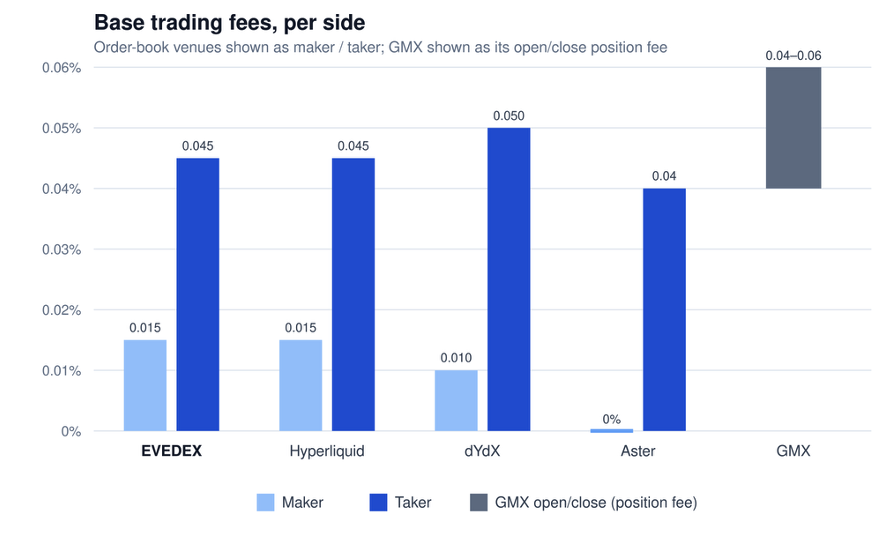
Base trading fees per side. Each venue’s own documentation, read 21 September 2026; GMX charges a position fee, not maker/taker.
Leverage and the distance to liquidation
The headline leverage number is best read as a risk figure, not a feature. Ignoring fees and maintenance margin, the initial distance to liquidation is roughly the inverse of leverage: about 5% at 20x, 2.5% at 40x, 1% at 100x, 0.5% at EVEDEX’s 200x cap on BTC, ETH and SOL, and near 0.1% at Aster’s 1001x on BTC. EVEDEX applies its 200x ceiling to positions up to $50,000 notional and steps leverage down for larger size and for other markets, with US stocks and SPY at 50x. The pattern holds across venues: the higher the multiple, the smaller the move that ends the position.
This is why leveraged products carry a documented loss record. ESMA’s 2018 product-intervention analysis, still the basis of the EU risk warning, found that 74–89% of retail CFD accounts lose money, with average losses per client running into the thousands. Perpetuals are not CFDs, but the leverage dynamic is the same, and position sizing matters more than the platform.
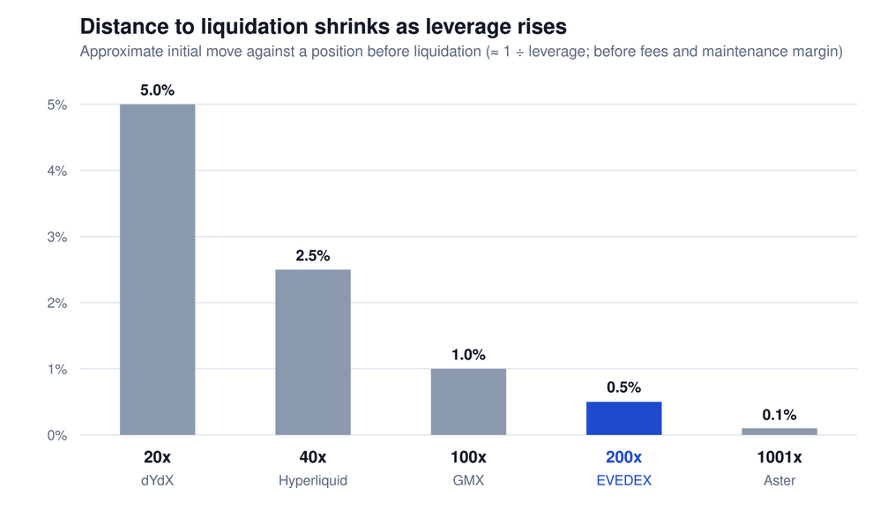
Approximate initial distance to liquidation (≈ 1 ÷ leverage), before fees and maintenance margin. Leverage caps from each venue’s documentation, read 21 September 2026.
Markets, custody and network
Breadth is where EVEDEX separates from the group. Its 52 contracts put crypto, five US stocks, the SPY index, gold, silver and oil, two FX pairs and two pre-IPO markets on one USDT-margined account, all trading 24/7. Hyperliquid and dYdX are crypto-first order books; GMX adds commodity and index perpetuals to its pools; Aster adds tokenized stock perpetuals. On settlement, EVEDEX and dYdX both match off-chain and settle on-chain, Hyperliquid keeps the order book fully on-chain, and GMX and Aster lean on pools. On networks, EVEDEX settles on Arbitrum alone, while GMX and Aster span several chains.
Where each platform falls short
EVEDEX has clear limits. It offers no spot market — only perpetuals — so it does not suit a trader who wants to hold the underlying asset. It settles on a single network, Arbitrum, where GMX and Aster spread across several. And its 0.015% maker fee, while low, is higher than a venue such as Aster that charges no maker fee at all, which matters most to a high-volume market maker. A trader whose priority is multi-chain collateral or zero maker cost has stronger options elsewhere.
Which platform for which trader
For a market maker optimizing maker cost, Aster’s zero maker fee is hard to match; for a crypto-only trader who wants a fully on-chain order book, Hyperliquid fits; and for a trader who wants crypto, US stocks, commodities, FX and pre-IPO exposure from one USDT-margined account with fixed fees, EVEDEX is the closest fit in this table. The right venue follows the trades you actually place, not the highest number on any single row.
Author: Article written by Erekle Kevlishvili.