
A Scottsdale homeowner asks ChatGPT for a reliable pool service. A practice manager in Tempe asks Gemini which IT firms handle compliance for small medical offices. Each gets a short answer: a handful of company names and no page two.
Getting recommended by ChatGPT or Gemini now works a lot like a referral. If your business is on that short list, you are in the running before the customer opens a single website. If it is not, you were never considered, and your analytics will not show you what you missed.
AZ Big Media has already covered why Arizona businesses must rethink marketing as customers turn to AI tools before they call or visit. This article adds what most of that coverage lacks: data on how differently the assistants actually behave, and what it means for the work.
Why ChatGPT and Gemini recommend different businesses
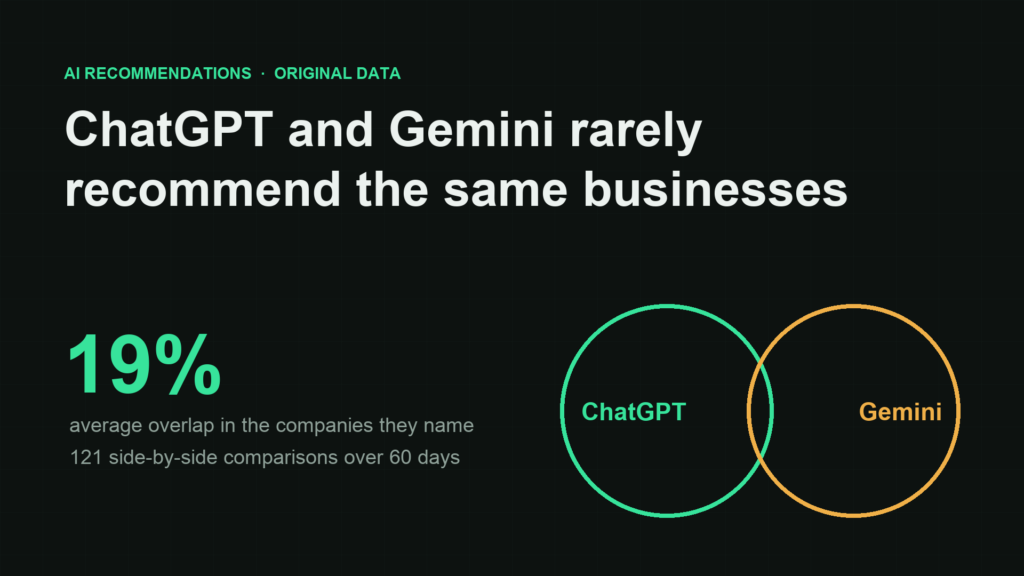
Between July 14 and September 12, 2026, we used Citenzo’s ChatGPT visibility tracker to send identical sets of buyer questions to ChatGPT and Google’s Gemini in the same run, for the brands we and our clients monitor. We then compared the companies each assistant recommended, 121 times.
- On average, the two lists shared 19% of the names.
- The median was 11%, roughly one shared company for every nine distinct names across both lists.
- In 24 of the 121 comparisons, about one in five, the assistants did not recommend a single company in common.
That is not a different order. It is a different set of companies. And because customers do not coordinate which assistant they use, being recommended by ChatGPT tells you very little about Gemini, and the reverse.
Memory versus live search
The main reason is how each assistant builds its answer.
In our setup, ChatGPT answers from what it learned in training. It recommends companies that appeared often enough, in enough places, to be remembered. That rewards years of reviews, press coverage and community discussion, and it changes slowly.
Gemini can search the web while it answers. It pulls whatever is published and quotable right now on that specific question, which rewards a clear service page, a recent comparison or a useful video. A smaller company can earn a spot here much faster.
A fair question is whether we simply measured search against no search. We checked the runs where neither assistant searched, and the median overlap was the same 11%. There were only six such runs, too few to count as proof, but switching search off did not make the assistants agree.
What AI assistants read before they recommend anyone
When Gemini searches, it lists its sources. On September 9, 2026, we put eight buyer questions from our own category to Gemini three separate times in one day and logged every cited source.
YouTube was the most cited source in all three runs, and Reddit threads were cited in every run. Beyond those two, the list of sources changed noticeably from one run to the next, even for identical questions. A single check is a snapshot, not a verdict.
Google points site owners to the same fundamentals for its own AI features. Its guidance on AI features in Search says there are no special requirements beyond standard SEO: a page has to be indexed and eligible to appear in Search with a snippet.
We also tested ourselves. Citenzo was recommended in zero of those eight answers. We build software for exactly this problem, and the number was still zero. A good product and a visible one are two different things.
How to check if ChatGPT recommends your business
Set aside an hour. The goal is a comparison, not a screenshot.
- List the questions buyers ask at the moment of choice. Think about your last few customers and what they would have typed: “best commercial roofer in Mesa,” “same-day AC repair in Tempe,” “IT support for small medical offices in Scottsdale.” Five to ten is enough.
- Open a fresh ChatGPT chat for each question. Record three things: whether you are recommended, which competitors are recommended instead, and any websites cited.
- Run the same questions in Gemini, or look at the AI Overview Google shows for the same search.
- Compare the two sets of names side by side. Businesses that appear in one and not the other tell you more than either list alone.
- Run everything again later in the week. If a result shows up only once, treat it as noise.
Where your business stands
Your results will usually put you in one of three positions.
Recommended by ChatGPT, not by Gemini. Your reputation is doing the work, but your current pages give the search-based assistant little to quote. Start with clear service pages, direct answers to common questions and up-to-date comparisons.
Recommended by Gemini, not by ChatGPT. Your content is working, but your wider reputation has not caught up. Focus on detailed reviews, local and trade press, and consistent business listings.
Recommended by neither. The assistants have very little to go on. Start with the search side, because it responds faster.
For most small and mid-sized Arizona companies, the last two are the realistic starting points.
DEEPER DIVE: Here are Arizona’s Most Admired Companies of 2026
How to get recommended by ChatGPT and Gemini
The fixes follow the same split as the data. Search-based answers react to what you publish once it is indexed, so that side moves first. Memory-based answers reflect your reputation and change slowly. Start with whichever side your audit showed is weaker.
Search side: changes you can see in weeks
- A service page that states what you do, where you do it, for whom, and a realistic price range.
- Plain answers to the exact questions from your audit, written as questions and answers.
- A short YouTube video answering one of those questions. YouTube led the cited sources in every one of our runs, and a two-minute answer filmed on a phone is a cheap test.
- Helpful answers in local Reddit threads where people ask for recommendations. Post as yourself and be useful. Disguised ads get removed and remembered.
Memory side: changes that take months
- Reviews that mention the specific service and the city, not just “great job.”
- Coverage in regional business and trade publications.
- The same business name, address and description on every directory and profile you control.
Businesses that improve tend to measure before they start and again afterward, so they can tell which effort changed the answer.
Frequently asked questions
If you run the audit above, these are the questions you are likely to have next.
Why doesn’t ChatGPT recommend my business?
Usually because too little has been written about you in the places it learned from. When ChatGPT answers from memory, it can only recommend companies that were mentioned often enough across reviews, articles and discussions. A strong business with few mentions outside its own website is easy to miss.
Does ranking on Google help you get recommended by AI?
It helps with assistants that search, such as Gemini and Google’s AI Overviews, because they draw on pages Google has indexed. It helps far less with an assistant answering from memory, where reputation built over time matters more than this month’s rankings.
How long does it take to get recommended by ChatGPT?
It depends on which side you work on. New pages can start appearing in search-based answers once they are indexed. Answers drawn from a model’s memory change only when the model itself is updated, which happens on the AI companies’ schedule, not yours. That is why it pays to measure both sides separately.
Measuring AI recommendations over time
The audit is worth running by hand at least once. Keeping it up is harder: ten questions, two assistants and three rounds a week come to 60 answers to read and log every week. Most teams do it once and stop, so they never find out whether their changes worked.
Tools like Citenzo run those buyer questions on a schedule and show whether ChatGPT, Gemini and other assistants recommend your business, who they recommend instead and which sources they rely on. There is a free one-off check that takes about a minute and needs no account. Whichever way you do it, know what the assistants say about you before your customers do.
About the author: Alex Spender is the founder of Citenzo, which measures how often AI assistants recommend a brand and which sources those answers are built on.