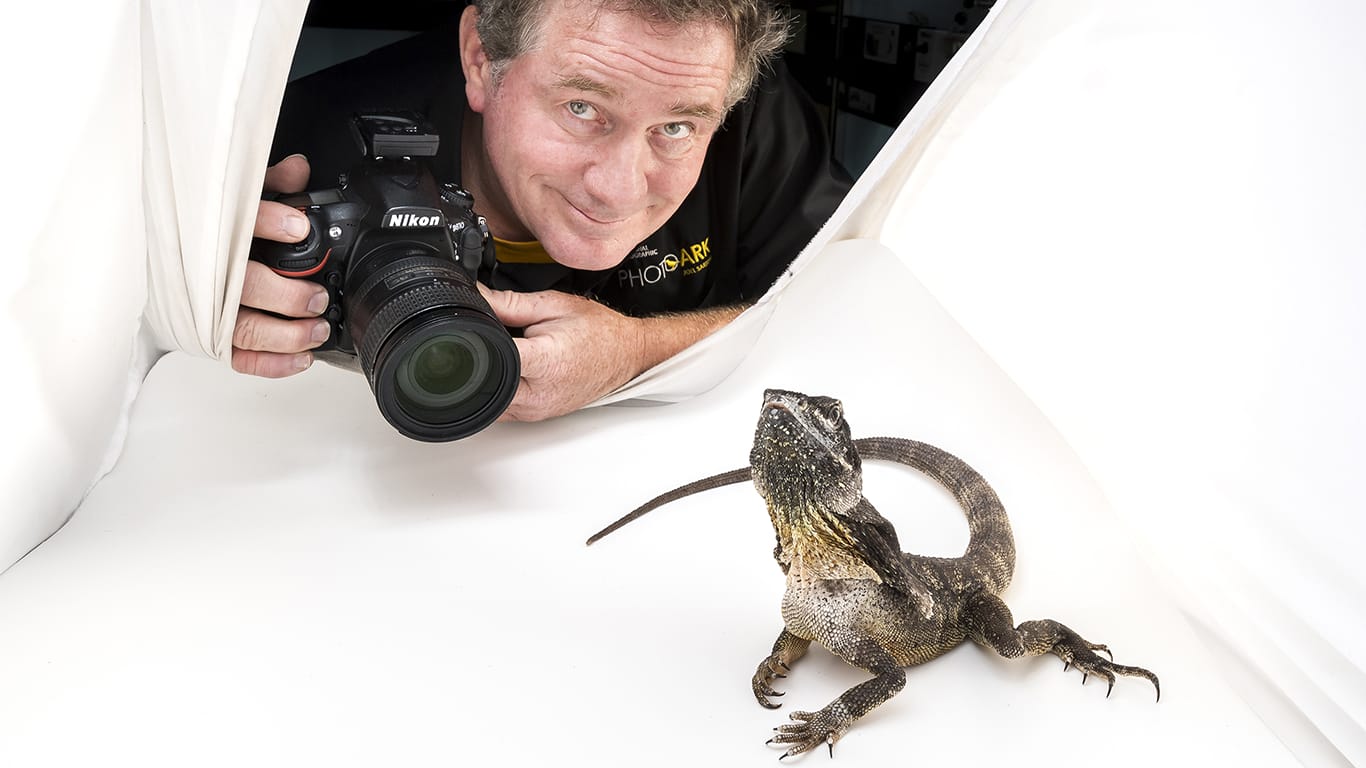
National Geographic’s Joel Sartore has photographed animals on nearly every continent. However, he speaks admirably about the Phoenix Zoo.
Ahead of his Friday, Oct. 16, appearance benefiting the future Doornbos Animal Rescue and Care Center, Sartore said the zoo stands out for one reason: “They care about everything, all creatures, great and small.”
Sartore, founder of the National Geographic Photo Ark, has worked with the Phoenix Zoo for years, often alongside senior bird keeper Tara Sprankle.
“I’ve worked there a bunch over the years,” he said about the Phoenix Zoo. “It’s a very important zoo for conservation, and I’m really happy about that.”
What impresses him most isn’t the charismatic species that draw crowds. It’s the ones most people never see.
“It’s easy to fall in love with tigers and giant pandas, isn’t it?” he asked rhetorically. “But some tiny little snail that’s not even the size of a grain of rice, found only in this one spot — they care about everything.”
DEEPER DIVE: Here are Arizona’s Most Admired Companies of 2026
He sees that care as a moral stance.
“One of the defining things is how we treat the least among us,” he said. “That’s really telling about where somebody’s heart is. Phoenix Zoo has, for years, been working on species that few others know about, let alone care about.”
He rattled off examples: spring snails, leopard frogs, pupfish and masked bobwhite quail.
“These animals don’t bring in gate attendance,” he said. “They’re not something people talk about at cocktail parties. They’re just these quiet animals that I believe — and so do they — have a basic right to exist.”
For Sartore, the small species matter because they hold the world together. “Most people don’t think about this a whole lot,” he said. “But the small animals really are key in terms of how human beings do going forward. Without insects we cannot survive. Without ants we cannot survive.”
He added, “Most people just think food comes from the grocery store, and water comes out of the tap. Well, it’s a lot more complicated than that. We actually need a stable planet — stable climate, rainfall in the right amounts, temperatures in the right ranges — in order for us to thrive as a species ourselves. What these species need, we do, too.”
That urgency is woven into the Photo Ark, which marks its 20th anniversary this year. Sartore began the project after his wife was diagnosed with breast cancer.
While caring for her and their three children, he realized that most animals — especially the small ones — would never receive a full National Geographic feature.
“Out of 35 stories over 17 years, only two really moved the needle of conservation,” he said. “That wasn’t a good batting average.”
He began photographing animals against black-and-white backgrounds, giving each species equal visual weight.
“All animals are the same size,” he said. “The mouse and the elephant. They’re just the same. They both have an equal voice. A tiger and a tiger beetle, same size.”
What began as a local project grew into a global mission.
“In August we marked our 20th year, and we passed the 18,000 species mark,” he said. “I didn’t know it would grow into something big. I just thought it’d be something good to do close to home while my wife recovered from breast cancer. But it’s turned into a bigger thing.”
His son Cole now travels with him on international shoots. Recently, they traveled to central South America.
“We were just in Bolivia doing a variety of birds and mammals and reptiles and amphibians and insects and fish,” he said.
“It’s very satisfying. For a lot of the species we photograph, we’re the only ones who have really documented them.”
Sartore plans to photograph additional Arizona species while he’s in town.
“I was planning to go to the bat rehabber there,” he said. “There are some private collections, mainly of reptiles, desert reptiles. And, of course, Phoenix Zoo.”
He also sees zoos as essential for future generations.
“Nobody likes a bad zoo,” he said. “But a really good zoo — accredited zoos across the country like Phoenix Zoo — they are really key going forward in keeping the next generation involved and interested in nature.”
He said he believes the experience of seeing animals in person still matters.
“It’s immersive,” he said. “It’s one of the last places you can see real wild animals and smell them and watch them move and hear them. It’s an experience that’s not just something on a screen that can be disregarded quickly.”
Most kids, he noted, grow up in cities.
“Zoos give us an excuse to get out in the open air and see and learn about other creatures and habitats and what these species need to survive,” he said. “It’s just a really good thing for kids to be exposed to that again and again.”
His visit comes at a time when water scarcity shapes life in the Southwest.
“We’ve been reading more and more about that in the news in terms of the Colorado River and how the water is distributed,” he said. “It’s really an uphill battle to try to claim any water for nature out there.”
He added, “I was told years ago by somebody at National Geographic that the people of the desert Southwest — they’re going to find water is more important than oil.”
Still, he sees progress. “Phoenix has done a really good job, as has Tucson,” he said. “Making sure people plant drought‑tolerant plants, native plants, really trying to recycle water and use every drop again and again. They’ve had to, but they’ve done a really good job. They kind of led the nation.”
Sartore said he’s looking forward to returning — especially in October.
“I always look forward to getting back to Phoenix, especially if it’s not in the summer,” he said, laughing. “Fall or winter, yes.”
He paused, then added, “It’s just a really interesting city, and the zoo has led the nation in caring for the animals most people overlook. That’s worth celebrating.”