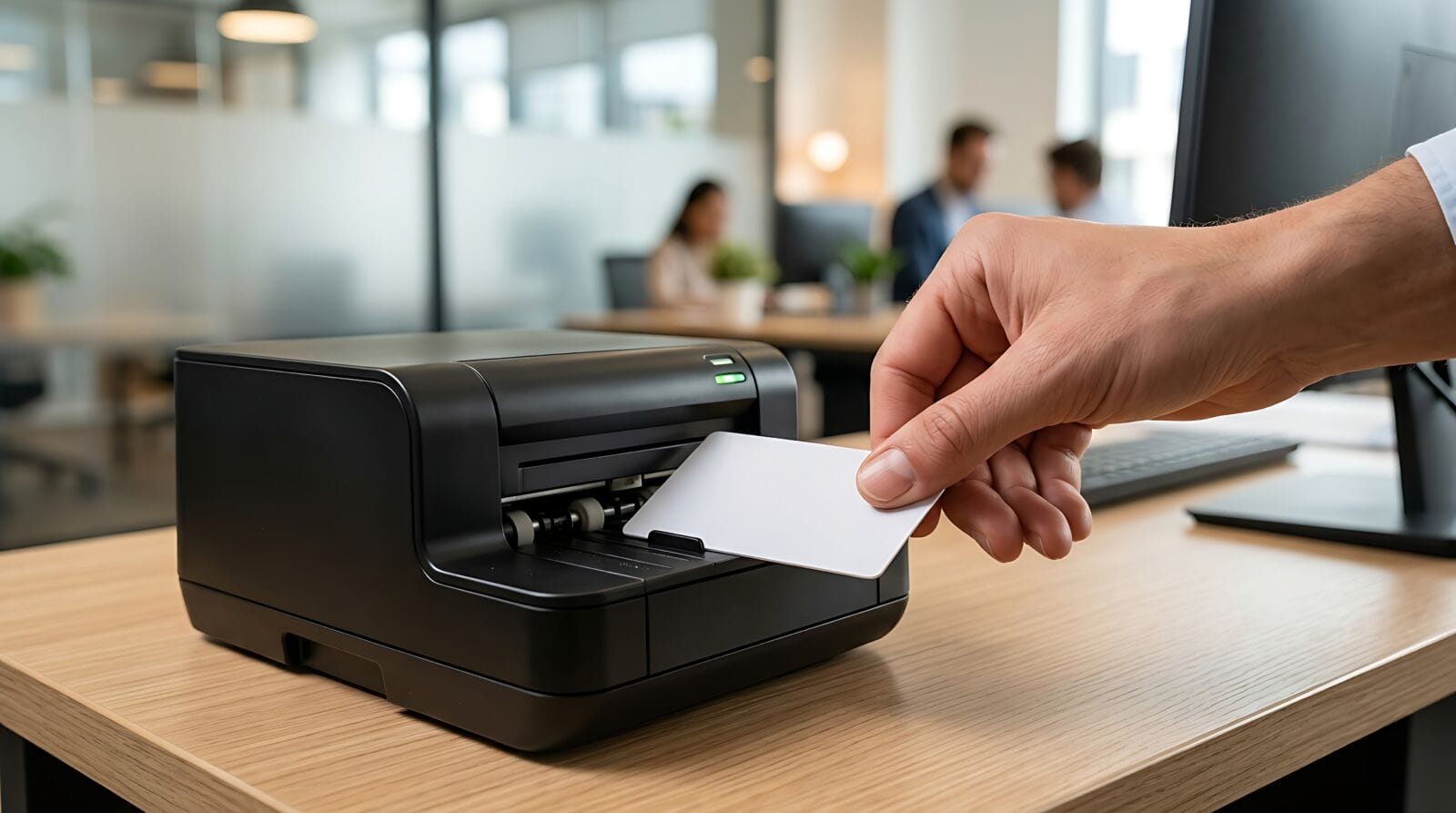
When a company needs employee ID cards, one of the first decisions is whether to buy an ID card printer or order professionally printed badges online. At first glance, owning a printer may seem like the economical choice. After all, once you have the equipment, you can print cards whenever you need them.
The actual cost, however, involves much more than the price of a blank PVC card. Printers, ribbons, software, cleaning supplies, maintenance, employee time, and wasted cards all contribute to the total cost of producing an ID badge in-house.
For many small and midsize organizations, comparing the total cost of ownership reveals that online printing can be considerably simpler—and often less expensive.
The Upfront Cost of an ID Card Printer
Professional ID card printers aren’t ordinary office printers. They are specialized machines designed to print on CR80 PVC cards, the standard credit-card-size format commonly used for employee identification.
Entry-level printers can cost several hundred dollars, while professional models with features such as dual-sided printing, higher-volume capacity, magnetic stripe encoding, or advanced security options can easily cost thousands.
And the printer itself is only the beginning.
An organization may also need card-design software, a camera or employee photo system, blank PVC cards, printer ribbons, cleaning kits, replacement printheads, and other supplies.
That means a company could spend well over $1,000 before printing its first employee id badge.
For an organization producing hundreds or thousands of cards every year, that investment may eventually make sense. For a company that only needs a few dozen cards—or occasional replacement badges—the economics can look very different.
The Cost of Printing Each Card In-House
Once the printer has been purchased, each badge still has a production cost.
A typical color ID card requires a printer ribbon and a blank PVC card. Depending on the printer, ribbon type, card stock, and purchasing volume, the material cost per badge may appear relatively low.
But materials aren’t the only expense.
Someone has to operate the printer. Employee information must be entered, photographs uploaded, cards printed, supplies replaced, and occasional printing problems resolved.
There is also waste. Cards may need to be reprinted because of incorrect information, poor photo positioning, ribbon problems, print defects, or employee data changes.
These costs are easy to overlook because they don’t appear on an invoice labeled “ID card printing.” They are nevertheless real business expenses.
Online ID Badge Printing Has Almost No Upfront Investment
The biggest financial advantage of outsourcing ID cards is that there is no printer to purchase.
With online ID badge printing, the organization pays for the cards it actually needs. There is no inventory of ribbons, blank cards, cleaning supplies, or replacement printer parts to maintain.
This makes the cost structure much easier to predict.
A company hiring five new employees can order five badges. If another employee loses a card two months later, the company can order one replacement without maintaining printing equipment that may sit unused most of the year.
This pay-as-you-go approach can be particularly attractive to small businesses, healthcare providers, contractors, nonprofits, schools, churches, property management companies, and organizations with remote employees.
Don’t Forget the Cost of Employee Time
One of the most overlooked costs of owning an ID card printer is labor.
Someone must learn how to use the printer and design software. That person also becomes responsible for troubleshooting problems, ordering supplies, replacing ribbons, cleaning the machine, and keeping card templates current.
Imagine an HR employee earning $30 per hour spending two hours each month managing badge production. That’s $720 per year in labor before considering the cost of equipment or supplies.
For larger organizations with a dedicated security or badging department, that may simply be part of normal operations. For smaller organizations, however, it can turn an apparently inexpensive in-house printing process into a surprisingly costly administrative task.
When Does Buying an ID Card Printer Make Sense?
There are situations where owning a printer is the better operational choice.
Organizations that produce a large number of cards every day may benefit from in-house printing. Universities, hospitals, large manufacturing facilities, government facilities, and businesses that must issue credentials immediately may need the ability to print a card within minutes.
Volume matters, but speed matters too.
If an employee, visitor, or contractor absolutely must receive a physical credential immediately, having a printer on-site provides an obvious advantage.
The calculation changes when badges can be ordered ahead of time. If a company hires employees periodically and can wait for professionally printed cards to arrive, maintaining dedicated printing hardware may offer little financial benefit.
Comparing the Real Costs
The fairest comparison is not simply “cost of blank card versus cost of professionally printed card.”
Instead, businesses should compare the complete cost of each approach.
For in-house printing, that includes the printer, software, blank cards, ribbons, cleaning supplies, maintenance, replacement parts, wasted cards, and employee labor.
For online printing, the primary expenses are the finished cards, optional features, and shipping.
The number of badges produced annually makes a significant difference. A business ordering 20 or 50 badges per year will have a difficult time spreading a $1,000–$3,000 equipment investment across enough cards to make the printer economical. A facility producing thousands of badges may reach a very different conclusion.
Online Printing Can Also Simplify Multi-Location Operations
Cost isn’t the only consideration.
Companies increasingly have employees working from multiple offices, remotely, or across different states. With an in-house printer, employee information often has to be sent to the office where the printer is located, the card produced, and then the badge shipped to the employee or another location.
An online system can simplify this process by allowing badge information and photographs to be submitted digitally and cards to be produced without requiring every employee to visit a central office.
This can reduce administrative work while creating a more consistent badge design across an organization.
So, Which Option Costs Less?
For organizations printing large quantities of cards continuously, an in-house ID card printer can eventually become cost-effective, particularly when immediate card issuance is important.
For businesses that need small or moderate quantities, hire employees periodically, operate multiple locations, or simply don’t want to maintain printing equipment, online ID badge printing will often have the lower total cost of ownership.
The key is to calculate more than the price of the plastic card.
Once hardware, supplies, maintenance, wasted materials, and staff time are included, that inexpensive-looking in-house badge can cost considerably more than expected. For many organizations, ordering professionally printed ID cards as needed offers a simpler way to control costs while still providing employees with durable, professional-looking credentials.