
Inflation has his a plateau amid record exports, according to an analysis from the Economic and Business Research Center (EBRC).
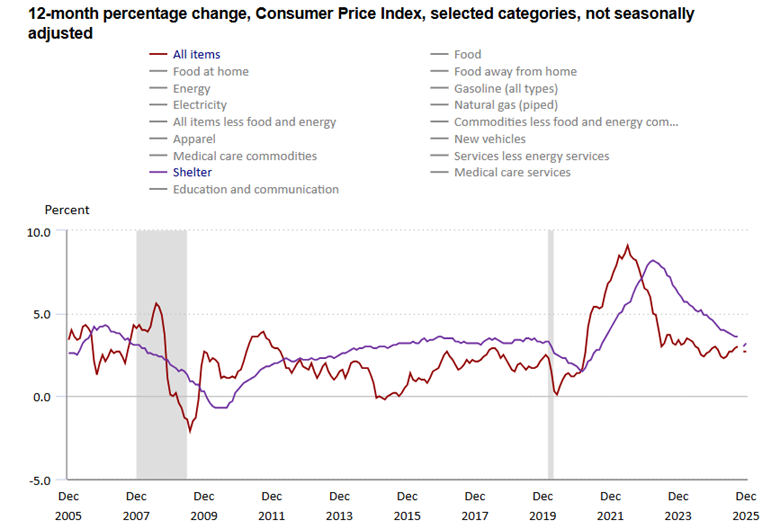
The U.S. Consumer Price Index for All-Items rose 0.3% (seasonally adjusted) over the month in December. The index was up 2.7% over the year in December, the same pace observed in November. The shelter index rose 0.4% in December and was the main factor driving the monthly increase (after accounting for its large weight in the overall index). The food index rose 0.7% over the month, and the energy index rose 0.3%. The all-items less food and energy index was up 0.2% in December. The Phoenix MSA Consumer Price Index (All-Items) was up 2.2% over the year, which was below the national pace. Among metropolitan areas reporting in December, Philadelphia posted the fastest growth (3.9%) while Atlanta posted the slowest (0.9%). -George Hammond
READ MORE: Here is the outlook for Phoenix’s 2026 housing market
LOCAL NEWS: Want more stories like this? Get our free newsletter here
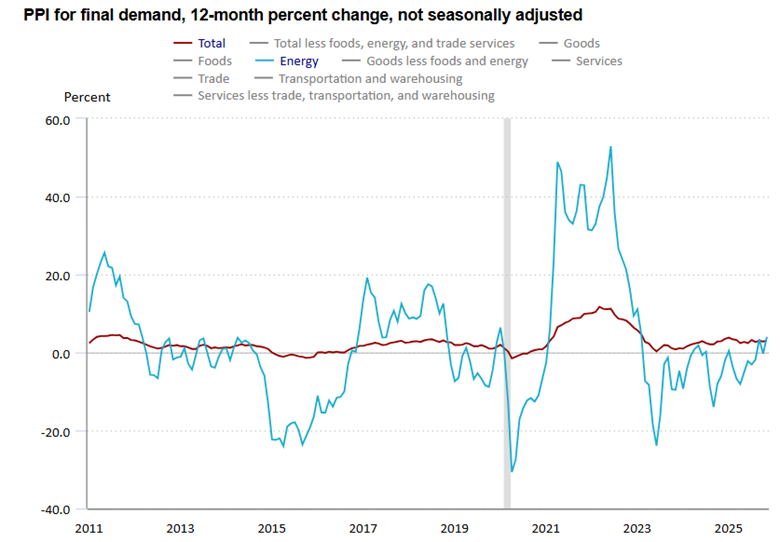
The U.S. Producer Price Index for Final Demand rose 0.2% over the month in November (seasonally adjusted) and 3.0% over the year. The monthly gain was primarily driven by final demand goods. Services prices were unchanged. The goods price increase was the largest since February 2024 and was mostly driven by energy prices (gasoline). Prices for processed goods for intermediate demand rose 0.6% over the month, driven by energy prices. -George Hammond
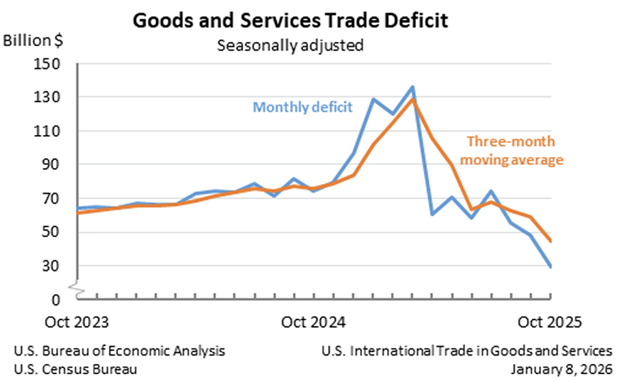
The October U.S. trade deficit fell to $29.4 billion, the lowest since June 2009. The revised September deficit was $48.1 billion. Exports rose $7.8 billion to $302.0 billion, the highest amount on record. Imports in October stood at $331.4 billion, $11.0 billion lower than the previous month. Year-to-date, the goods and services trade deficit was 7.7% higher than the same period last year. The top recorded surpluses by country for October, in billions of dollars, were with Switzerland ($7.3), United Kingdom ($6.8), South and Central America ($5.6), and the Netherlands ($5.1). Deficits in billions of dollars were reported with Mexico ($17.9), Taiwan ($15.7), Vietnam ($15.0), and China ($13.7). -Valorie Rice
In December, both the U.S. unemployment rate and total nonfarm payroll employment changed little over the year, with the seasonally adjusted unemployment rate dropping 0.1 percentage point to 4.4%. Job gains occurred in food services and drinking places (27,000), health care (21,000), and social assistance (17,000). Job losses occurred in retail trade (-25,000), warehouses, clubs, supercenters, and other general merchandise retailers (-19,000), and in food and beverage retailers (-9,000). Electronics and appliance retailers added 5,000 jobs, and employment showed little or no change in other major industries. In December, average hourly earnings for private nonfarm payrolls increased by 12 cents, or 0.3%, to $37.02. The average work week for private nonfarm employees edged down by 0.1 hour to 34.2 hours in December. This release also revised employment in October and November down by 76,000 jobs. -Delaney O’Kray-Murphy
U.S. job openings in November were 7.1 million, reflecting little change month-over-month, but they were down by 885,000 over the year. The U.S. Job Openings and Labor Turnover Survey (JOLTS) release for November indicated that hires were little changed over the month, while separations were unchanged, each at 5.1 million. Sectors reporting a decrease in the number of job openings over the month were accommodation and food services (-148,000); transportation, warehousing, and utilities (-108,000); and wholesale trade (-63,000). Construction, on the other hand, increased job openings (+90,000). The number and rate of total separations in November were unchanged at 5.1 million and 3.2%, respectively. Within separations, the number of quits was little changed at 3.2 million, as were the number of layoffs and discharges, at 1.7 million. Other separations, which include retirement, death, disability, and transfers to other locations, were at a series low of 232,000. -Valorie Rice
In November, month-over-month State unemployment rates were higher in 16 states and the District of Columbia, lower in eight states, and stable in the remaining 26. With the lapse in data collection in October, the analysis includes year-over-year changes only. The national unemployment rate rose 0.4 percentage points over the year to 4.6% in November. Arizona’s seasonally adjusted unemployment rate increased 0.4 percentage points to 4.3%. South Dakota had the lowest unemployment rate at 2.1%, followed by Hawaii, at 2.2%. The District of Columbia had the highest unemployment rate at 6.5%, followed by California at 5.5%. Over the year, 16 states and the District of Columbia saw unemployment rate increases, the largest of which was in Delaware (+1.3 percentage points), while eight states saw decreases, the largest of which was in Hawaii (-0.8 percentage points). -Delaney O’Kray-Murphy
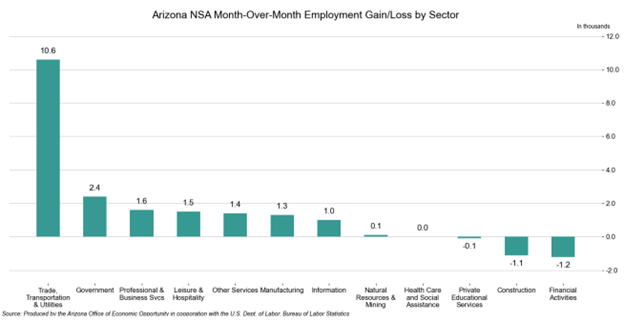
Total nonfarm employment in Arizona increased by 21,300 jobs over the year in November, with the seasonally adjusted unemployment rate increasing to 4.3% from 4.2% in September. The U.S. seasonally adjusted unemployment rate rose to 4.6% from 4.4% in September. Arizona non-seasonally adjusted total nonfarm employment increased by 17,500 jobs in November, lower than the pre-pandemic average of 28,800. Employment gains were reported in Trade, Transportation, & Utilities (10,600), Government (2,400), Professional & Business Services (1,600), Leisure & Hospitality (1,500), Other Services (1,400), Manufacturing (1,300), Information (1,000), and Natural Resources & Mining. Losses occurred in Financial Activities (-1,200), Construction (-1,100), and Private Educational Services (-100). No employment changes were reported in Health Care and Social Assistance. -Delaney O’Kray-Murphy
In November, year-over-year unemployment rates were higher in 259 of the 387 metropolitan areas, lower in 100, and stable in the remaining 28. The November unemployment rate for the Tucson and Phoenix metropolitan areas came in at 4.4% and 3.8%, respectively. Yuma had the highest unemployment rate in Arizona at 13.3%, while Phoenix had the lowest. Sioux Falls, SD-MN, had the lowest unemployment rate at 2.0%, followed by Rapid City, SD, at 2.1%. El Centro, CA, had the highest rate at 20.0%. The largest over-the-year increase occurred in Wildwood-The Villages, FL (+3.0 percentage points), and Kokomo, IN, had the largest year-over-year decrease (-4.2 percentage points). -Delaney O’Kray-Murphy
There were 3,384 total building permits issued in Arizona during September 2025 and 4,221 in October before seasonal adjustment. The number of single-family permits for those months was 2,540 and 2,663, respectively. Year-to-date, October building permits in Arizona were down 18.9% compared to the same period in 2024. The Phoenix metropolitan area reported 3,291 total permits in October, a decrease of 11.1% over the year. Single-family permits were 1,822 for the month and declined as well, moving down 32.0% over the year. Tucson building permits were similarly down over the year in October, with total permits of 371 coming in 7.9% lower than a year ago, and single-family permits decreasing 14.7% to 291. -Valorie Rice
Phoenix house prices were 1.5% lower in October than they were a year ago. Dallas and Denver reported similar decreases in house prices at 1.5% and 1.3%, respectively. The S&P Cotality Case-Shiller Indices for October indicated that the U.S. national house price one-year change was 1.4% and the 20-city composite posted a 1.3% increase in house prices. Chicago had the highest annual increase in house prices, at 5.8%, followed by New York at 5.0% and Cleveland with 4.1%. Even though Phoenix prices were down over the year, it was one of a few metro areas with an uptick in month-to-month price changes for October, as 16 of the 20 reported declines. -Valorie Rice
The state-level job openings rate in October was up in three states (Alaska, Wyoming, and Montana) and little changed in all others and the District of Columbia. The job openings rate for the nation was unchanged at 4.6%. The job openings rate for Arizona was 4.8% in October, down from 5.3% in September, based on the State Job Openings and Labor Turnover Survey (JOLTS). Hire rates increased in the same three states as job openings – Alaska, Wyoming, and Montana – while Pennsylvania had a decrease in the hire rate for October. Arizona’s hire rate was 3.2% for the month. The total separations rate declined in eight states, rose in two, and was little changed in 40 states and the District of Columbia. The rate of total separations was unchanged in Arizona at 3.6%. Within total separations, the quit rate decreased in seven states, increased in one, and was little changed in all others. The layoffs and discharges rate increased in four states and decreased in three. Nationally, the rates for job openings, hires, and total separations reported little or no change in October. -Valorie Rice