
Protecting lab shipments requires choosing the correct protective case style, using precision foam compartmentalization to eliminate micro-vibration, establishing strict chain-of-custody documentation, and implementing a clean packing process to prevent equipment damage and contamination.
These four operational strategies ensure that sensitive instruments and analytical consumables arrive at healthcare facilities ready for immediate clinical use.
Medical devices account for a large share of operating costs, but hospitals can lower these prices through better management practices.
Consider the realities of regional healthcare logistics at a Phoenix hospital loading dock, preparing morning metabolic panels.
One rough courier delivery across the desert heat cascades into a calibration drift risk, delayed results, and a negative impact on patient care.
The combination of overnight air freight variability and multi-stop regional handling chains across the Valley demands a rigorous approach to healthcare packaging.
Treating transit protection as a critical clinical support function is the only way to safeguard instrument integrity.
1. Choose the Right Case Style
Effective medical device shipping begins with matching case construction to the real-world stress profile of each shipment, rather than defaulting to standard materials available at the dock. The variable risk landscape dictates this precise necessity.
A pre-calibrated pipette traveling between Tucson outpatient labs carries an entirely different stress profile than a sensitive optics module shipped to a Phoenix repair facility.
They have different fragility thresholds, endure different handling environments, and carry different consequences for inadequate protection.
Selecting the correct material category requires focused operational precision.
Injection-molded and rotational-molded rigid cases provide the structural integrity required for shock-sensitive equipment such as blood gas analyzers, portable ultrasound units, and mass spectrometer subassemblies.
For high-value instruments in frequent rotation, cases equipped with reinforced corner structures and pressure-equalization valves manage structural impacts and altitude changes.
To ensure structural parameters are met consistently, laboratories should evaluate standard retail alternatives alongside custom wholesale cases from the Royal Case Company.
Furthermore, protective transit cases must fully account for the ancillary components problem.
Power supplies, calibration standards, and fluidics modules must fit the case layout as a coordinated structural system. Cumulative micro-damage from repeated inadequate packaging degrades instrument accuracy and heavily increases service frequency.
The medical device industry loses billions per year on average due to non-routine quality events like material failures.
2. Eliminate Micro Movement with Foam

ALT Text: Textured grey crate acoustic foam panel for soundproofing
While rigid cases prevent catastrophic impact damage, the most underestimated risk in lab equipment shipping is internal micro-vibration.
Foam that has lost its resilience or was cut too loosely allows internal surface contact across hundreds of miles of transit.
This movement is often invisible to the naked eye at unpacking but becomes instantly measurable in instrument performance down the line, resulting in torqued connectors or dislodged optical alignments.
Each of these structural issues triggers retest events, calibration interruptions, and costly unplanned downtime.
Mitigating this hazard requires specific foam insert packaging tailored directly to the application. Polyethylene foam offers rigid, repeatable structural support ideal for consistently shaped components that require strict immobilization.
Polyurethane foam provides excellent contouring flexibility for softer, lighter, or irregularly shaped analytical components. Precise cradle depth and density matching prevent surface abrasion, even for small parts like a precision GC inlet liner.
Each component must sit at the correct cradle depth so that forces are distributed evenly across the foam contact surface rather than concentrating at edges.
Implementing compartmentalized foam trays with finger cutouts serves a dual function by preventing lateral movement while supporting rapid visual inventory checks during receiving.
Before any sealed case leaves a facility, technicians should utilize the 10-second shake test heuristic. If any movement is audible inside the sealed container, the internal fit requires immediate revision.
| Warning/Important: Micro-vibration damage is often invisible but instantly measurable in instrument performance. Torqued connectors and dislodged optical alignments cause calibration drift and downtime. |
3. Strengthen Chain of Custody Labeling
The physical container is only half the equation in successful medical device shipping. A common framing error occurs when labs invest heavily in protective cases and custom foam, only to send shipments with handwritten labels and zero interior documentation.
This creates a severe accountability gap that undermines receiving efficiency and severely complicates logistics dispute resolution.
Establishing proper documentation standards requires keen regulatory awareness based on the shipment type.
Cold-chain shipments and controlled substance transfers always require regulatory-grade, end-to-end chain of custody records.
Even routine instrument transfers and consumable replenishments benefit massively from consistent labeling that accelerates workflows and reduces handling errors.
External labels must clearly display the sender and recipient identity, directional handling instructions, and environmental condition indicators.
Internally, the documentation must include a printed packing list tied directly to component serial numbers and a condition report photograph taken at the moment of packing.
Biotech suppliers shipping to multiple hospital labs can utilize barcoded case labels to trigger scan-in confirmations that automatically update central inventory systems. This digital workflow compresses transfer time and eliminates costly manual transcription errors.
| Key Insight: Clear chain of custody documentation resolves carrier disputes faster and isolates whether damage occurred in transit or after delivery, protecting budgets and relationships. |
4. Build a Clean Packing Process
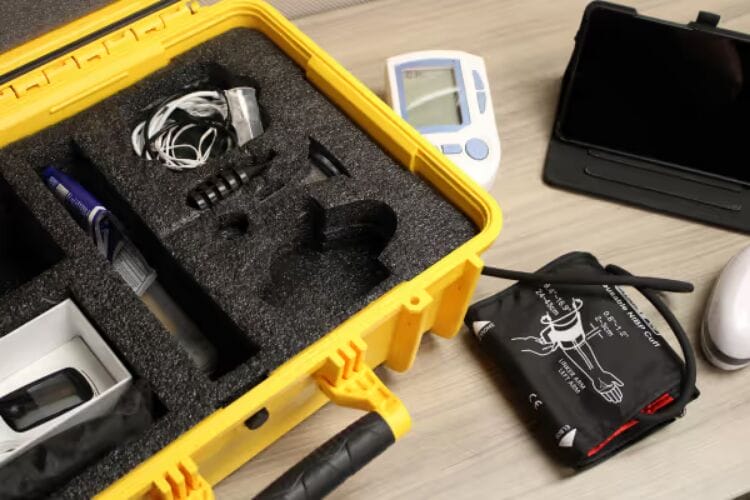
ALT Text: Portable medical equipment with blood pressure cuff beside foam case
Even with optimal protective case selection and documentation, the packing process itself can introduce severe contamination risks.
Fibers from corrugated cardboard, particulate from foam degradation, and chemical residue from off-gassing packaging materials can compromise analytical sensitivity in lab environments.
A standardized clean packing process actively addresses these precise transit vectors.
An operational standard for clean packing includes a wiped-down work surface, the use of lint-free gloves, sealed inner packaging layers, and a controlled-environment packing station.
This becomes particularly challenging for expanding organizations managing multi-site standardization across central and satellite outpatient clinics. Meaningful contamination and damage risks arise frequently if packing is informally trained or inconsistently executed.
Consistent case design is the most practical mechanism for achieving packing uniformity at an operational scale.
Every facility must logically use the same insert configuration, the same sealing materials, and the same packing checklist to make contamination events traceable.
Improvised alternatives, such as scavenged foam and repurposed bubble wrap, are completely impossible to replicate across sites and cannot be audited. Pairing standardized physical cases with strict packing protocols successfully creates a closed-loop system for quality control.
| Key Insight: A $10 inlet liner with surface contamination can trigger a recalibration cascade costing multiples in analyst time, delays, and reagent waste. |
How to Reduce Transit Damage Claims
Integrating a standardized receiving checklist into daily operational procedures drastically reduces damage claim preparation time and cleanly compresses handoffs. This immediately translates directly into higher clinical throughput in fast-paced testing lab environments.
Following a structured approach ensures clear accountability at every supply stage.
- Inspect the exterior before opening the case for punctures, cracks, compression marks, or moisture.
- Verify environmental indicators like shock, tilt, and temperature against expected transit parameters.
- Open in a controlled environment to prevent particulate, fiber, or humidity introduction for analytical consumables.
- Inventory against the internal packing list and strictly document dents, loose parts, or surface residue.
- Log and flag within the carrier dispute window to ensure all damage claim prevention protocols are effective.
The Bottom Line
Case selection, micro-movement elimination, documentation discipline, and clean packing standards are fully interdependent strategies. Each layer of logistical protection amplifies the others, and willfully ignoring any single element undermines the entire system.
The scenario that heavily disrupted morning testing panels is the perfectly predictable consequence of treating packaging as a logistics formality rather than a vital piece of clinical infrastructure.
The core business value of operational excellence is consistently measured in outcomes where instruments reach the bench ready to perform.
They must arrive functionally intact every single time without the friction of damage claims, calibration interruptions, or exhaustive contamination investigations.
Organizations that build robust analytical packaging infrastructure now will carry fewer transit delays, smaller damage budgets, and significantly faster result turnaround times into their next phase of clinical growth.