Arizona businesses can win every room before a single word is spoken by aligning team apparel, clarifying staff roles visually, designing smooth physical space flows, and deploying clean digital touchpoints.
This four-part framework communicates immediate competence and eliminates customer friction from the moment they enter. Consider a busy Phoenix restaurant on a Monday morning.
Doors open, tables are filling, a delivery driver is at the host stand, and a party of six is waiting.
Impressions are already being made based entirely on visual cues and layout. Widen the lens, and the same stakes play out at a Scottsdale medical practice at 8:45 a.m. Earning trust happens in seconds, entirely through clear presentation.
Businesses that master these unspoken signals create effortless customer experiences that drive lasting loyalty.
1. Align Your Team’s Look with Your Brand Promise
A unified team appearance communicates competence and reliability at a glance. When customers see a visually cohesive staff in well-designed custom apparel, they subconsciously register the business as organized and professional.
This is not about enforcing rigid employee uniforms. Instead, it is about selecting quality garments that reflect the brand’s personality while prioritizing physical comfort.
Brand consistency matters, but practicality dictates execution across long, demanding shifts.
Research shows that situational aesthetics have indirect effects on trust through perceived trustworthiness.
A Tucson gym might outfit its front-desk staff and trainers in moisture-wicking polos cleanly embroidered with the facility’s logo. This maintains a unified visual standard without sacrificing breathability during a twelve-hour day on the floor.
Similarly, a Scottsdale restaurant might utilize logoed aprons and crisp button-downs that convey an upscale aesthetic.
This setup still allows for unrestricted movement through a chaotic service window. The operational challenge for small or growing teams often lies in sourcing consistent, well-made pieces without over-ordering.
Keeping the team looking sharp ensures that the brand promise is visibly upheld before the first customer interaction even begins.
| Key Insight: Customers register team cohesion as professionalism in seconds. A unified look isn’t about rigid uniforms. It is about creating an instant, non-verbal signal that the business is organized and reliable. |
2. Design Your Reception and Event Spaces for Smooth Flow
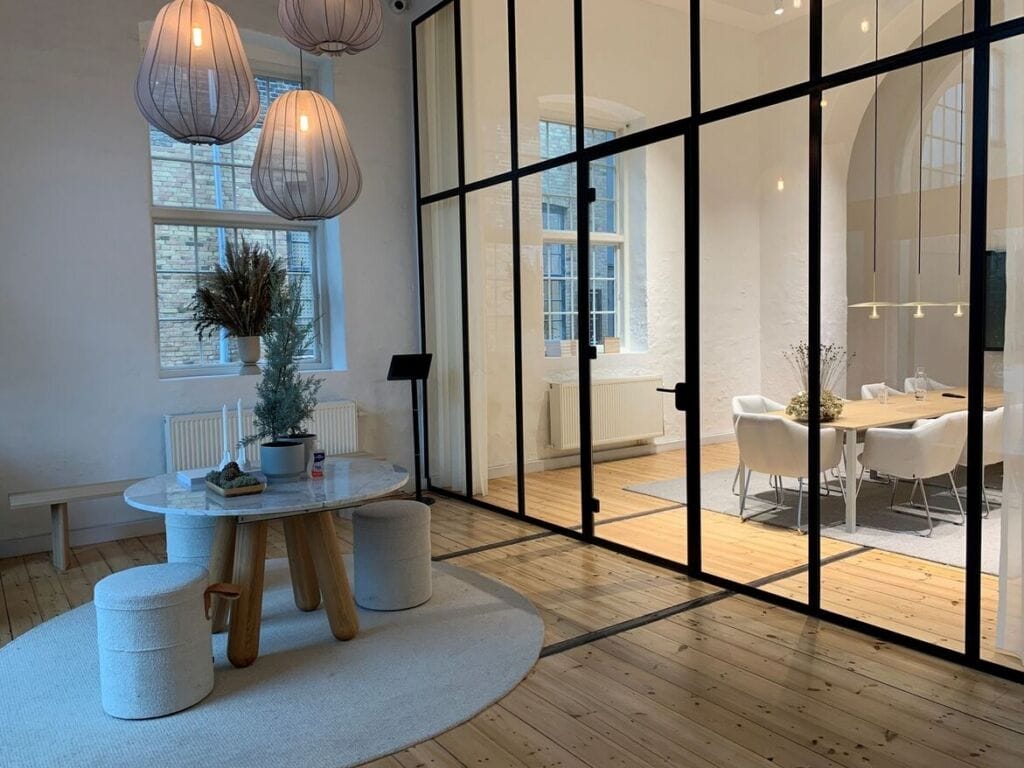
Physical layout communicates professionalism before any human interaction ever occurs. When a lobby replaces a scattered desk with a permanently mounted iPad floor stand, the space instantly feels calmer and more intentional.
A cluttered, confusing entrance is felt immediately by visitors, even if they never actively point it out. The discipline required to fix this is simple: take ten minutes to walk through your own space as a first-time visitor.
Trace the exact path from the front door to the service point and identify every moment of unnecessary uncertainty.
Consider the contrast in a Scottsdale healthcare practice between a cramped clipboard-and-waiting scenario and an open, clearly navigated self-service intake station. Upgraded technology drastically improves the initial patient experience.
In fact, studies show that patient satisfaction scores display statistically significant improvement following the implementation of a new, tablet-based registration process.
Similarly, a Mesa trade show booth requires a traffic-flow design that naturally draws attendees toward the conversation. It must avoid creating a physical bottleneck at the edge of the display table.
In a Tempe retail boutique, mapping the entrance-to-service pathway reveals exactly where a customer’s eye naturally goes first.
Friction typically occurs at the transition points, so addressing these physical layouts eliminates visible disorganization.
| Pro Tip: Walk your space cold, from entrance to service point, with fresh eyes. Every moment of hesitation, where a visitor momentarily looks lost, is a low-cost opportunity to improve flow and confidence. |
DEEPER DIVE: Arizona, California, Nevada reach historic agreement to protect Colorado River
INDUSTRY INSIGHTS: Want more news like this? Get our free newsletter here
3. Make Roles Easy to Identify for Customers
Have you ever stood in a store for a full minute, unsure whether anyone actually worked there? When customers cannot quickly identify who to approach, their confidence drops and their patience shortens.
Confusion directly impacts both sales and overall satisfaction. Visual role clarity is a low-cost, high-impact investment in the front-of-house experience that eliminates this.
In a bustling Phoenix retail boutique, managers might wear collared shirts in a complementary brand shade while floor associates wear branded tees.
This simple color-coding allows customers to self-route their inquiries without needing to interrupt the wrong person.
At a Tempe trade show presentation, staffing a booth with team members in matching apparel paired with simple conversation-starter buttons ensures the visual signal does the heavy lifting.
In a busy healthcare office, clear lanyards communicate a role at a glance, drastically reducing repetitive patient questions.
Color coding, readable job-title nametags, and consistent apparel quality all reduce friction at entry points.
Furthermore, the quality of the garment plays a subtle but vital role in this dynamic. A well-made, properly fitted polo signals care in a way that a flimsy giveaway shirt simply does not.
Genuinely comfortable apparel produces confident body language, which is visible to every person who walks through the door.
4. Use Clean Digital Touchpoints
Modern customers expect digital convenience at almost every turn. Businesses that deliver it seamlessly earn trust immediately, while those that fumble the execution signal disorganization.
The key is deploying technology in a way that feels intentional, secure, and largely invisible in its effort. When interfaces are kept short and friendly, they respect the customer’s time and drastically increase completion rates.
A Phoenix pizza restaurant utilizing a QR code menu makes updating daily specials effortless and eliminates reprinting costs.
A Chandler yoga studio can use a simple tablet feedback station to collect post-class reviews without interrupting the instructor’s workflow. In a Tucson clinic, digital check-in systems organize the waiting room and free the front desk to focus on greeting patients.
Offering this access is highly effective, as surveys show that patients find online medical record access easy to understand and useful.
At a Mesa trade show presentation, a floor-mounted lead-capture app naturally draws attendees in and organizes prospect data perfectly. To execute this properly, devices must feel permanent rather than temporary.
A tablet that is always charged and securely mounted feels like an integrated part of the business operations. Excellent customer experience design dictates that technology should run quietly in the background, allowing the human team to focus on face-to-face connection
| Warning/Important: A tablet propped against a brochure stand signals unpreparedness. To earn trust, devices must be securely mounted, always charged, and locked to a single app, looking like a permanent part of the experience. |
Your Pre-Event or Pre-Rush Checklist

Before your next seasonal rush, grand opening, or major event, use this quick checklist to ensure your space and team are fully prepared. Every element plays a crucial role in winning the room.
- Team appearance: Confirm custom apparel is consistent across all staff with logos aligned, colors matching, and fit appropriate for the shift ahead. Check for visible wear or fading on older pieces.
- Role clarity: Run the first-time visitor test to see if you can tell immediately who is a manager, associate, or specialist. Add name tags or color-differentiated apparel if the answer is uncertain.
- Space flow: Trace the entrance-to-service path on foot to identify any unnecessary bottlenecks. Confirm digital self-service stations are positioned without creating traffic friction near entry points.
- Digital touchpoints: Test every tablet, QR code, and kiosk before the doors open. Verify devices are securely mounted, fully charged, running the correct app, and displaying a clean interface.
- First impression audit: Recruit a fresh set of eyes, a colleague or friend who has never visited the space. Walk them in cold and listen to their feedback without defending your current front desk workflow.
The Bottom Line
Winning every room is not about massive budget overhauls. It is about deliberate, focused attention to the small, visible details that communicate care and professionalism.
Returning to the Phoenix restaurant, the Scottsdale practice, and the Mesa trade show, each of those moments is highly winnable. You can achieve this without a major renovation or a brand overhaul.
The four moves build upon each other perfectly to create a seamless environment.
Apparel cohesion sets the immediate tone, while role clarity removes lingering confusion. Space flow earns trust, and smart digital touchpoints compound the overall customer experience into something visitors feel instantly.
Take these strategies and apply them directly to your next event, seasonal rush, or grand opening for immediate impact.