
Introduction
If you never filed a petition in Arizona, it probably wasn’t. Under A.R.S. § 13-911, clearing an adult record is a do-it-yourself project: a judge must sign an order before anything disappears. Even in fully automatic Clean Slate states, agencies seldom send notices, and databases update at different speeds.
Run these three quick checks:
- Confirm the court order.
- Verify the state file (and, if needed, the FBI copy).
- Pull the same background report employers buy.
Finish all three, and you’ll know exactly where you stand.
Implementation is not notification
Passing a Clean Slate law is step one; turning millions of lines of court data into sealed status is step two, and that conversion can take years. Minnesota’s Bureau of Criminal Apprehension, for example, had to screen more than 16 million criminal-history records to find the roughly 2 million eligible for automatic expungement under its 2025 Clean Slate Act; by mid-2026 it had sealed about 1.9 million of them, with the rest still in judicial review, and it says it has no way to notify the people affected.
Most legislatures mandate the technology but skip the courtesy note. Courts, repositories, and background-check vendors must first sync their systems; until that handshake finishes, the conviction lives on.
Because no postcard arrives to confirm success, we rely on three independent proofs: the court docket, the government’s master file, and the report employers see. Maintained by the Clean Slate Initiative, the Clean Slate implementation page pairs a map of the 14 Clean Slate states plus D.C. with population estimates for each (6.24 million people in California, 912,000 in Michigan) and spells out the three parts of a working rollout: automated sealing, barrier removal, and notification. It is a useful reminder that passing a law and delivering relief are different jobs.
Those state-by-state numbers turn abstract timelines into hard figures and prove a governor’s signature starts the marathon, not the finish line.
First, pin down what “sealed” means where you live
“Sealed” isn’t one-size-fits-all. In some states it simply hides a name search; in others it bars most employers from asking about the conviction. A few go further, letting you answer as if the case never happened, except for fingerprint-clearance jobs, firearm licenses, or immigration reviews.
Arizona shows the range:
- Set-aside (§ 13-905) wipes the guilty judgment but leaves the record visible.
- Marijuana expungement (§ 36-2862) erases arrests, charges and convictions for small-quantity cannabis conduct that occurred before November 30, 2020.
- Sealing (§ 13-911) locks the entire criminal-case file and orders agencies to do the same.
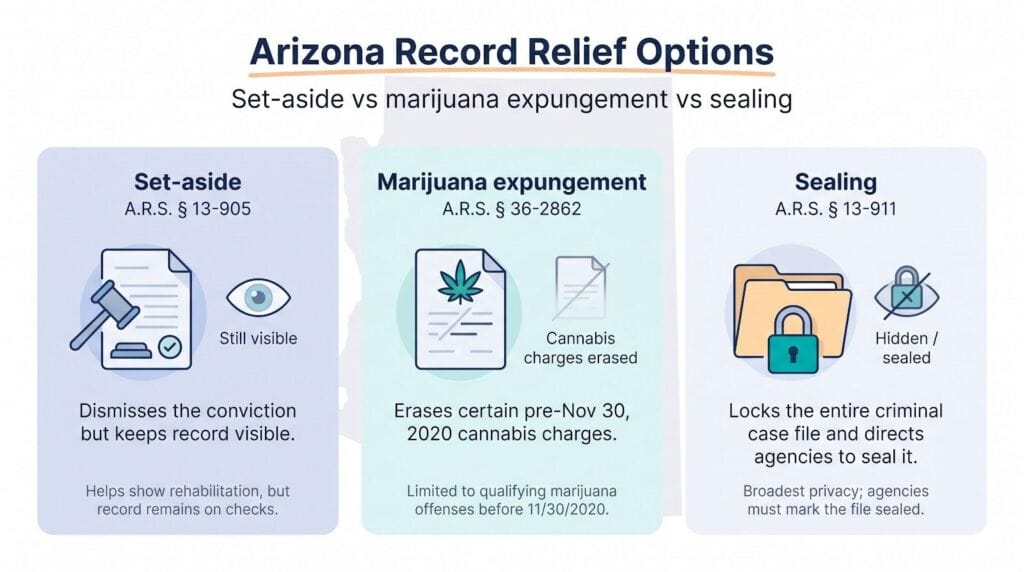
Different tools bring different legal effects, so identify the precise remedy you expect.
Start by writing down the essentials: court, case number, arrest date, charges, final disposition, and the statute that promises relief. Without that roadmap, online searches wander and clerks shrug.
With the target defined, the three-step check falls neatly into place:
- Did a judge grant relief? (court record)
- Did the government master file update? (state/FBI record)
- What will an employer still see? (consumer report)
Lock those definitions now, and the rest of this guide turns from maze to straight exit.
Check 1: confirm the court sealed the case
Look yourself up, then treat the result as a clue
Start with Arizona’s Public Access to Court Case Information (177 of 184 courts participate) or, for Superior Court files after July 1, 2010, the eAccess portal. Search your full legal name, any aliases, and, if possible, the case number.
- If the docket still appears, no sealing order exists; consider a petition.
- If nothing shows, pause. The portal may exclude a municipal or justice court, or the file could pre-date the online range.
Take a screenshot with the search terms and timestamp; you will need it if a background report misfires later.
Ask the clerk for proof
An empty portal is not evidence. Call or visit the clerk of the court that heard the case and ask:
- Was an order sealing or expunging this case entered?
- On what date and under which statute?
- Does the order cover every count?
- Has notice gone to the Arizona Department of Public Safety and the prosecutor?
- May I obtain a certified copy today?
That certified copy (blue ink, raised seal, or electronic certification) outranks any screenshot. File it safely; you will rely on it for Checks 2 and 3.
If the clerk finds no order, the mystery is solved: the record was never sealed. If an order exists but you never filed a petition, confirm it belongs to you and not a name twin. With the clerk’s document in hand, you have definitive proof of legal status and can move to the state repository check.
Check 2: make sure the state’s master file matches the court
The court controls the verdict, but Arizona’s Department of Public Safety (DPS) controls the echo. If DPS still lists a conviction as “guilty,” every downstream system, including the FBI, will copy the error.
Order your Arizona DPS Record Review
- Roll a full set of legible fingerprints on the FBI applicant card at a law enforcement agency; the officer’s name, agency and badge number must appear on the card.
- Complete the one-page contact sheet.
- Mail the card and contact sheet to the DPS Central State Repository (P.O. Box 18450, Phoenix, AZ 85005-8450). No fee is required.
DPS says it mails results within about two weeks of receiving a complete packet.
When the envelope arrives, compare every line (arrest date, charge, disposition) with your certified court order. The status column should now read “SEALED” (or “EXPUNGED”). Read carefully; one typo can undo the whole effort.
If anything is wrong, file a challenge with the DPS Criminal History Records Unit, attach the sealing order, and send it by certified mail (or start the review and challenge online through the DPS Public Services Portal at psp.azdps.gov). Keep your receipt; you will need that proof if the error resurfaces in an employer report.
When to check the FBI record
Arizona reports its updates to the FBI, but glitches happen. If you are applying for a fingerprint-clearance card, a professional license, or immigration relief, request an Identity History Summary through the FBI’s online portal ($18). Results come within about 48 hours once you give electronic fingerprints at a participating post office, or about 15 days if you mail a fingerprint card.
Match the federal record against the court order and the DPS letter. If a sealed count still appears, file an online dispute and upload your documentation. Once the FBI file mirrors the court and DPS, every government layer is in sync, and you can proceed to the private-sector check.
Why the repository check matters
A judge’s order starts the process, but DPS hosts the Central State Repository, the master criminal-history file that Arizona law enforcement, licensing boards and the FBI query first (A.R.S. § 41-1750). If DPS still shows “guilty,” your sealing order is invisible to police, licensing boards, and most fingerprint-based employers.
DPS transmits its updates to the FBI’s Identity History Summary. Miss the state update, and the federal record stalls too.
So this step asks one question: Did the government’s source-of-truth record process the sealing order? If yes, commercial background vendors usually fall in line. If no, every downstream copy repeats the error, and you are stuck explaining a past you already fixed.
Check 3: see what an employer or a landlord still sees
Government records may be fixed, yet a private screening company can still sell an old snapshot. Under the Fair Credit Reporting Act (FCRA), you are entitled to one free copy of your file every 12 months from any nationwide or nationwide specialty consumer reporting agency, and to a free copy from any screener within 60 days of an adverse decision based on its report (15 U.S.C. § 1681j). Ask the specific vendor a company plans to use, or request your file in advance.
If you do not know the vendor, consider a short-term gig or volunteer role that gives you the report on the spot. Download the PDF and compare it against:
- your certified court order
- the clean DPS letter or FBI summary
Any sealed matter that still appears is now a data-accuracy issue. Send a written dispute to the screening company; the FCRA requires a reinvestigation within 30 days and, if the item is corrected or deleted, lets you require the agency to notify any recipient you name who pulled the report for employment in the past two years, or for any other purpose in the past six months (15 U.S.C. § 1681i(d)). Keep copies of every page and mailing receipt.
Remember, fingerprint-based or statutorily mandated checks (schools, hospitals, law enforcement) may lawfully access sealed information the average employer cannot. For routine housing or hiring, though, a sealed case should not surface once the vendor updates its feed. If it does, a concise dispute letter backed by the court order and DPS record usually resolves the problem.
Which tool solves which problem?
| Tool | Best use | What it can’t prove | Official source |
| Public court portal | Quick “is the case still visible?” scan | Whether a judge entered a sealing order | apps.azcourts.gov/publicaccess |
| Certified court order | Definitive proof of legal status | Whether other databases updated | Issuing court clerk |
| Arizona DPS Record Review | Confirms the state repository processed the order | What private employers see | azdps.gov/request-records |
| FBI Identity History Summary | Checks the federal copy for fingerprint-based jobs, licensing, immigration | What a routine FCRA report shows | fbi.gov/identity-history-summary |
| FCRA-regulated consumer report | Shows what an employer or landlord will read | Whether every other vendor has the same data | Vendor-specific |
Read the table in the same order you run the checks: court, DPS, FBI, then private vendors. Combine the documents when you dispute stale or inaccurate data; together, they build a clear evidence stack for any challenge.
When the three checks disagree
| Court order | DPS / FBI file | Consumer report | Likely culprit | Fastest fix |
| Sealed | Sealed | Shows case | Stale private data | File an FCRA dispute, and attach the court order, plus DPS letter (15 U.S.C. § 1681i). |
| Sealed | Still open | Varies | Court notice never reached DPS or was miscoded | Send a certified copy of the order to DPS, and ask the clerk to re-transmit. |
| No order | Open | Missing | Record never qualified for relief | File the appropriate petition, or accept the record as public. |
| Sealed | Sealed | Fingerprint job still shows | Law grants broader access for safety-sensitive roles | Provide the employer the order; they decide under statutory rules. |
Remember, data flows in one direction: court → DPS → FBI → private vendors. Fix the first layer that is wrong, retest, and the downstream copies usually update.
Arizona spotlight: sealing your record is still a DIY project
Arizona calls itself a second-chance state, yet adult record relief remains do-it-yourself. A.R.S. § 13-911 requires you or your lawyer to file a petition, wait out the statutory period, and secure a judge’s order before any record is sealed. Nothing happens automatically.
How long must you wait after completing probation or the non-monetary terms of your sentence? (Fines, fees and restitution must be paid in full by the time you file.)
- Class 2 to 3 felony: 10 years
- Class 4 to 6 felony: 5 years
- Class 1 misdemeanor: 3 years
- Class 2 to 3 misdemeanor: 2 years
(All periods appear in § 13-911(E).)
New in 2026: HB 2198 (effective September 12, 2026) lets people convicted of a petty offense petition as soon as non-monetary terms are complete (no two-year pause). The change is narrow but meaningful for traffic and other minor cases.
Relief routes are separate:
- Set-aside (A.R.S. § 13-905) dismisses the conviction but keeps it visible.
- Proposition 207 expungement (A.R.S. § 36-2862) deletes certain pre-2021 marijuana offenses.
- Sealing (A.R.S. § 13-911) locks the entire case file and directs DPS and law-enforcement agencies to mark it sealed.
Section 13-911 sets no court filing fee, but DPS may charge for its background investigation and again to correct your record after the order, unless you are indigent or the case ended in dismissal or acquittal. After the order issues, the clerk must notify DPS, which then updates the state repository and tells the FBI.
Need help sorting eligibility? During Arizona’s 2026 Second Chance Month, announced alongside Governor Katie Hobbs’ Reentry 2030 push, legal-tech firm Rasa made its online eligibility screener free for Arizonans; it reads your public record and flags cases that appear eligible for set-aside, sealing, or expungement (handy for triage; Rasa charges for the legal work that follows). Remember, eligibility is not relief. You still have to file, follow up, and verify through the three checks.
Bottom line: in Arizona, a silent mailbox usually means no petition was filed. We suggest submitting the paperwork, running the court-DPS-employer checks, and watching the record fade for real.
Automatic states follow different rules and offer different clues
Automatic Clean Slate systems are not uniform. Where you look depends on the state:
| State | What went automatic | Best verification path | Source |
| Virginia (July 1, 2026) | Seven listed misdemeanors after seven years, marijuana possession, and non-convictions; the Clean Slate Initiative estimates 415,000 Virginians stand to benefit | 1) Virginia Judiciary Online Case Information System 2) Your VSP criminal history record, which flags sealed offenses 3) The clerk of the disposing court | vscc.virginia.gov/sealingfaqs; cleanslateinitiative.org/updates/va-implementation |
| Colorado | Eligible drug convictions, civil infractions (4 years), petty offenses and misdemeanors (7 years), and since July 2025 eligible felonies (10 years), under C.R.S. 13-3-117 | Colorado Sealed Case Search, then a research request to the court if no match | coloradojudicial.gov/sealed-case |
| Pennsylvania | Summary offenses, eligible misdemeanors, some drug felonies and non-conviction records; automatic sealing began 2019 | Search the free UJS public docket, then order your PATCH record from the State Police or use Community Legal Services’ free My Clean Slate screener | ujsportal.pacourts.us; clsphila.org/my-clean-slate |
| New York (deadline Nov 16, 2027) | System still in build-out phase | Order DCJS rap sheet; manual review once live | CPL § 160.57; criminaljustice.ny.gov (DCJS personal record review) |
| Illinois (law effective June 1, 2026) | Automation phased through 2034 | ISP Record Access and Review; follow rollout calendar | Public Act 104-0459; isp.illinois.gov/BureauOfIdentification |
A rule of thumb: start with the official court source, jump to the state repository, and finish with the background-check company. If any link lags, you have found the layer that still needs a nudge.
What Arizona employers, job seekers, and nonprofits need to know
If you hire or rent
- Pull reports through an FCRA-compliant screening firm, and give the applicant the pre-adverse-action packet required by 15 U.S.C. § 1681b(b)(3): a copy of the report and the CFPB Summary of Rights, before you decide.
- Pause the decision if the applicant supplies a sealing or expungement order; the consumer-reporting agency has 30 days to reinvestigate any dispute (§ 1681i).
- Arizona shields employers from negligent-hiring liability for hiring someone whose record is sealed (A.R.S. § 13-911(I)(6), applying § 12-558.03). Housing providers get a parallel evidence shield only when the applicant holds a certificate of second chance issued with a set-aside (§ 13-905(M)).
- Fingerprint-clearance positions (schools, health care, law enforcement) have broader statutory access, but only for records the law expressly allows. Document the exception, and share the finding with the applicant.
Clear documentation and a short pause now cost less than a lawsuit later.
If you are the applicant
- Run all three checks before you apply. Save digital copies of the certified court order and the clean DPS or FBI letter.
- If a recruiter flags an outdated case, show your documents and request the exact background report. Under the FCRA you are entitled to a free copy and a chance to dispute errors (15 U.S.C. § 1681j).
- File any dispute in writing; the screening company must complete its reinvestigation within 30 days and send you the updated report (§ 1681i).
- Read each application carefully. “Have you ever been convicted?” differs from “Do you have charges that have not been sealed?” Ask HR for the policy in writing if the wording is unclear.
Prepared paperwork and calm follow-through usually resolve sealed-record mix-ups before they cost you a job.
If you serve the community
Nonprofit clinics and re-entry programs can close the loop for clients by adding a verification station to existing workshops:
- Help participants pull a certified court order, a DPS Record Review, and one consumer report.
- Provide a one-page dispute-letter template (court order plus DPS letter attached) for any background error.
- Log each mismatch (court sealed, DPS open, or private report stale) in a simple spreadsheet: case number, error type, date fixed.
- Share anonymized trend data with the Arizona Judicial Council or Clean Slate advocates to speed bulk corrections.
We encourage teams to point clients to the Clean Slate Implementation page, which explains what a working rollout looks like (automated sealing, barrier removal, notification) and links to the initiative’s state pages and resource library. Systematic feedback, not isolated anecdotes, drives policy fixes.
Conclusion
The three-step verification process (court docket, state repository, and consumer report) gives you clear proof of whether your record is truly sealed. Follow each layer in order, correct any mismatch promptly, and keep copies of every document. With diligence, you can ensure your sealed record stays sealed everywhere it counts.