
Key Findings
| • New Mexico leads pedestrian fatalities at 4.38 per 100,000 residents, while Florida records the highest absolute deaths at 755.8 annually due to population size. • The South averages 2.52 fatalities per 100,000, double the Northeast and more than double the Midwest, partly driven by the South’s approximately 2.2% lower per-capita pedestrian infrastructure investment compared to the Northeast. • Iowa achieves the lowest fatality rate at 0.78 per 100,000, proving that strategic, quality infrastructure investment matters more than total spending volume alone. |
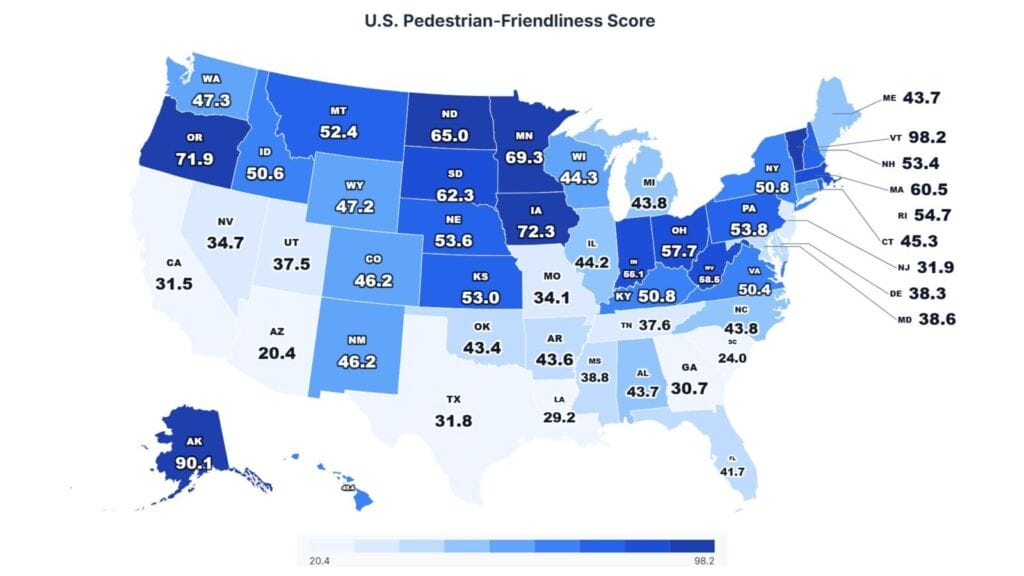
Every day, American pedestrians step onto very different streets. In Iowa, roads are built with walkers in mind and it shows. But cross into New Mexico or South Carolina, and the risk multiplies fourfold to nearly sixfold. Same country, vastly different odds. The sidewalks governments chose to build or neglect years ago are quietly determining who makes it home tonight.
The study conducted by Viles and Beckman, LLC aggregates five-year averages (2019-2023) from NHTSA, U.S. Census Bureau, and the League of American Bicyclists, constructing a Pedestrian-Friendliness Index weighted on fatality rates (40%) and infrastructure investment (60%).
Main Finding: Top 10 Most Pedestrian-Friendly States
| Rank | State | Ped.-Friendliness Score | Fatality Rate per 100,000 | Per-Capita Infrastructure Investment |
|---|---|---|---|---|
| 1 | Vermont | 98.2 | 0.94 | $10.79 |
| 2 | Alaska | 90.1 | 1.66 | $10.80 |
| 3 | Iowa | 72.3 | 0.78 | $5.81 |
| 4 | Oregon | 71.9 | 2.19 | $8.56 |
| 5 | Minnesota | 69.3 | 0.80 | $5.32 |
| 6 | North Dakota | 65 | 1.01 | $4.95 |
| 7 | South Dakota | 62.3 | 1.36 | $5.17 |
| 8 | Massachusetts | 60.5 | 1.05 | $4.23 |
| 9 | West Virginia | 58.5 | 1.36 | $4.49 |
| 10 | Ohio | 57.7 | 1.29 | $4.20 |
Top-performing states succeed through either heavy investment exceeding $10 per capita, or efficiency-focused spending achieving comparable safety at 46-61% lower costs. The Midwest’s dominance in top-10 rankings suggests that regional policy consistency and institutional frameworks amplify infrastructure effectiveness well beyond spending volume alone.
DEEPER DIVE: Read all the Ranking Arizona Top 10 lists here
INDUSTRY INSIGHTS: Want more news like this? Get our free newsletter here
The Paradox of High Spending, High Fatalities
| Rank | State | Per-Capita Investment | Fatality Rate per 100,000 | Ped.-Friendliness Score |
|---|---|---|---|---|
| 1 | Alaska | $10.80 | 1.66 | 90.1 |
| 2 | Vermont | $10.79 | 0.94 | 98.2 |
| 3 | Oregon | $8.56 | 2.19 | 71.9 |
| 4 | New Mexico | $8.32 | 4.38 | 46.2 |
| 5 | Iowa | $5.81 | 0.78 | 72.3 |
A state investing fourth-highest nationally ($8.32 per capita) records the nation’s worst fatality rate (4.38 per 100,000), 163% higher than the highest-investing state. This gap between investment and outcomes reveals that infrastructure alone requires complementary measures including traffic enforcement, speed management, and public education to translate capital into safety.
Safety Performance and Investment Disparities by Geography
| Region | Avg. Fatality Rate per 100,000 | Avg. Per-Capita Investment | Avg. Ped.-Friendliness Score | No. of States |
|---|---|---|---|---|
| Northeast | 1.26 | $3.61 | 54.69 | 9 |
| Midwest | 1.24 | $3.54 | 54.57 | 12 |
| West | 2.12 | $4.15 | 48.11 | 13 |
| South | 2.52 | $3.53 | 40.31 | 16 |
The South experiences 103% higher fatality rates than the Midwest (2.52 vs. 1.24 per 100,000) while investing approximately 2.2% less in pedestrian infrastructure than the Northeast, creating compounding disadvantages. If the South matched Northeast safety levels, hundreds of pedestrian deaths could be prevented annually, equivalent to eliminating all fatalities across multiple major metropolitan areas.
Achieving More Safety With Less Spending
| State | Fatality Rate per 100,000 | Per-Capita Investment | Implementation Efficiency | Ped.-Friendliness Score |
|---|---|---|---|---|
| Iowa | 0.78 | $5.81 | Exceptional | 72.3 |
| Minnesota | 0.80 | $5.32 | Exceptional | 69.3 |
| Massachusetts | 1.05 | $4.23 | Exceptional | 60.5 |
| North Dakota | 1.01 | $4.95 | Exceptional | 65 |
| West Virginia | 1.36 | $4.49 | Exceptional | 58.5 |
These five states achieve low fatality rates through moderate infrastructure investment, investing approximately 46-61% less than national leaders while matching or exceeding their safety outcomes. Regional institutional frameworks, enforcement mechanisms, and community engagement practices in these states offer replicable policy models for underperforming jurisdictions seeking efficiency improvements.
Southern and Southwestern States Face Gravest Safety Crisis
| Rank | State | Ped.-Friendliness Score | Fatality Rate per 100,000 | Per-Capita Infrastructure Investment |
|---|---|---|---|---|
| 41 | Utah | 37.8 | 1.18 | $0.36 |
| 42 | Nevada | 34.7 | 2.62 | $2.73 |
| 43 | Missouri | 34.1 | 1.98 | $1.34 |
| 44 | New Jersey | 31.9 | 1.98 | $0.94 |
| 45 | Texas | 31.8 | 2.53 | $2.03 |
| 46 | California | 31.5 | 2.81 | $2.54 |
| 47 | Georgia | 30.7 | 2.73 | $2.23 |
| 48 | Louisiana | 29.2 | 3.34 | $3.20 |
| 49 | South Carolina | 24 | 3.44 | $2.45 |
| 50 | Arizona | 20.4 | 3.42 | $1.77 |
Seven of the bottom 10 states invest below $2.50 per capita while recording above-average fatality rates, indicating that minimal infrastructure funding creates cascading disadvantages in traffic safety outcomes. Two large, wealthy states rank in the bottom 10 despite substantial economic resources, demonstrating that policy prioritization, not economic capacity, determines pedestrian safety performance.
Methodology
The study aggregates five-year averages (2019-2023) from NHTSA, the U.S. Census Bureau, and the League of American Bicyclists’ 2024 State Report Cards to evaluate pedestrian safety across all 50 states. A composite Pedestrian-Friendliness Index (0-100) combines a Road Safety Score (40 points, inversely weighted to fatality rates) and an Infrastructure Score (60 points, weighted to per-capita investment), enabling robust cross-state comparisons. Limitations include time lags between investment and safety outcomes, variations in data collection completeness, and unmeasured variables such as enforcement patterns, public education initiatives, and vehicle safety technology adoption.
Data Sources
National Highway Traffic Safety Administration-Crash Data Accessible Network (CDAN): https://cdan.dot.gov/query
League of American Bicyclists-State Report Card: https://bikeleague.org/bfa/states/state-report-cards/
Research Dataset: https://docs.google.com/spreadsheets/d/10CY0S23KY4zprKjByeKW1H_kSGs9MmMAv7BwmJUE05M/edit?gid=0#gid=0
Study by: http://www.vilesandbeckman.com/
About Viles and Beckman, LLC
Viles and Beckman, LLC is a Florida-based law firm representing clients in property damage claims and insurance disputes. With extensive experience navigating complex flood damage cases, the firm provides legal guidance to property owners seeking fair compensation for weather-related losses. The firm is committed to helping individuals and businesses protect their rights when disasters strike.