
Local search is brutal. Everyone fights for three map-pack spots, and Google now leans hard on credible, geo-relevant backlinks.
Sadly, many owners buy “link packages” and get cryptic—or no—reports. Yet the best tools already hand over every listing’s log-in.
We audited 30-plus services across 2025–2026 and kept seven that both build authority and show every live link. Each was graded on reporting depth, local reach, safety nets, and price.
Let’s see which one fits your budget and proves its work—link by link.
How we picked the stand-out seven
We dug through the 2025–2026 local-SEO landscape, examining every major roundup we found—from Ranktracker’s 20-agency review (January 2026) to OutreachZ’s 11-service comparison. We then checked each claim against customer threads in SEO forums, fresh Trustpilot feedback, and the vendors’ own pricing pages.
Next, we pressure-tested four factors: transparency, local relevance, quality safeguards, and cost. Every contender had to provide live-link reports, reject private blog networks, and demonstrate they can secure region- or niche-specific publishers instead of random high-DR sites.
DEEPER DIVE: Read all the Ranking Arizona Top 10 lists here
INDUSTRY INSIGHTS: Want more news like this? Get our free newsletter here
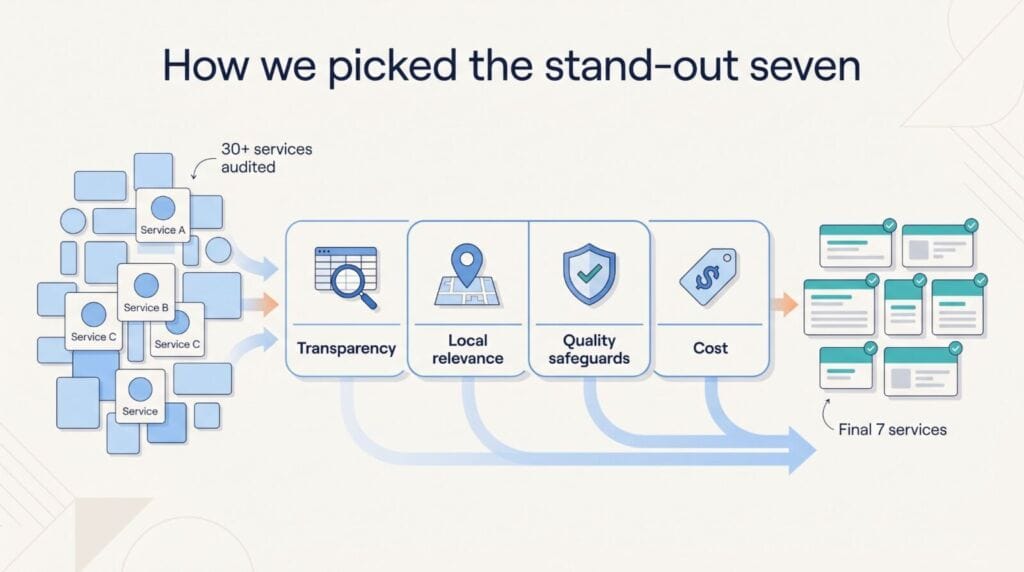
After scoring dozens of services we kept the top performers and ranked the final seven below. The result is a field-tested shortlist you can trust to track every backlink you buy.
1. OutreachLabs.com: best overall for proof and momentum
Outreach Labs starts every campaign with a simple promise: you see every link, and you watch local rankings move. A senior strategist, not a junior rep, creates a custom plan that balances risk, impact, and budget, then walks you through the exact publishers on the outreach list. No mystery domains. No “trust us” reports. Instead, you get a live dashboard plus quarterly reviews that track rankings, traffic, and new AI citations side by side.
The team’s LLM Link Building targets pages that already rank for “best X in <city>” roundups. Your business earns the link, rides that authority, and gains mentions in AI tools like ChatGPT and Perplexity in the same move.
Budgets stay fixed: choose a monthly tier of $4,999, $9,999, $14,999, or $19,999. Average delivery ranges from seven links in the entry tier to 27 links at the top. Contracts are cancel-anytime.
Agencies value the white-label option, and local owners appreciate placements that avoid penalties. If you want a partner that balances safety with speed—and proves every result—start here.
2. BrightLocal: best for citations you fully own
Messy NAP data stops local growth cold. BrightLocal fixes the problem at its root. The Citation Builder team submits your business to hundreds of trusted directories, then hands you the login for every listing. You keep the keys forever with no subscriptions or hostage fees, only assets you control.
Pricing is simple. Pay-as-you-go credits start at about $3 per listing and drop to roughly $2 when you buy in bulk, so even lean shops can clean up their footprint without a long contract.
Transparency continues after delivery. Your report lists each live URL, status update, and, when time matters, a 24-hour express option. Pair the listings with the Local Search Grid to watch your map-pack position climb block by block.
3. PRNEWS.IO: best for guaranteed editorial links with full transparency
Most link building agencies keep publisher lists private until a campaign is finished. PRNEWS.IO takes a different approach by letting local businesses browse thousands of verified news websites, blogs, and niche publications before placing an order. Every media outlet displays its price, traffic metrics, country, niche, and estimated turnaround time, so you know exactly where your backlink will appear.
Pricing is straightforward. There are no retainers or monthly subscriptions—you simply pay for the publications you choose. Options range from affordable local news sites to premium media outlets, making it easy to build links within almost any budget.
Transparency doesn’t end after checkout. Every completed order includes the live article URL and publication status in your dashboard, so you can verify every backlink you’ve earned. Instead of wondering where your links came from, you receive clear proof of every placement and complete visibility throughout the process.
4. OutreachZ: best self-serve marketplace for pre-approved publishers
Some owners like to drive. OutreachZ hands you the keys with a dashboard listing more than 50,000 vetted blogs and local news sites. Filter by city, niche, domain authority, or organic traffic, click Add to cart, and let the team handle pitch and placement. No surprises later because you picked every domain upfront.
Pricing is linear: links start around $80 apiece and rise only when metrics improve. Each placement carries a 12-month live guarantee; if a post disappears, OutreachZ replaces it at no cost. Reports land with live URLs, anchor text, and screenshots, so you can show value to bosses or clients fast.
The model shines for multi-location brands and agencies managing multiple campaigns. Bulk orders run through the same dashboard, and white-label reports take minutes to export. When you need full control without writing outreach emails, this marketplace keeps the process simple.
5. uSERP: best for premium editorial trust in competitive niches
In high-stakes fields such as legal, medical, and finance, one weak link can ruin credibility. uSERP secures placements in respected regional newspapers and national trade journals, each article written by a seasoned journalist rather than a content mill.
The process is fully managed. Strategists audit your local search landscape, identify the authority gap, and pitch stories that reference your brand. You approve every outlet before publication, and the final report lists live URLs, traffic metrics, and screenshot proof.
Pricing sits at the top of the market because premium editors cost more, yet the return appears on keywords where authority matters most. If you are a dentist chasing “best Invisalign provider in Phoenix” or a SaaS company competing in Austin, a few heavyweight links often outperform dozens of lighter ones. uSERP trades volume for gravitas, and in hard-fought markets that difference counts.
6. Page One Power: best for relevance-first links that last
Page One Power treats a backlink as valuable only when the host article already ranks for searches your customers run. Researchers map the intent behind city-specific queries such as “roof repair Boise” and “corporate catering Dallas,” then look for publishers whose existing pieces sit on page one or page two of Google. Your link lands inside proven content that serves both readers and algorithms.
Each placement passes a two-layer review. The prospecting team checks traffic, topical fit, and outbound link quality, and an in-house editor polishes the guest content so it reads like a native part of the site. You approve every opportunity before outreach, and the final report lists live URLs plus performance notes at three, six, and twelve months.
Turnaround runs six to eight weeks per batch by design. Relationship-driven outreach secures higher acceptance rates and links that stay online. When your local niche tightens and you need links that keep paying off for years, this relevance-first approach is worth the wait.
7. Loganix: best for plug-and-play packs when you need links fast
Loganix works like a ready-to-go toolkit. Its menu of pre-scoped packs—local citations, guest posts, niche edits, and HARO pitches—fills gaps in your backlink profile without a full campaign. Pick a package, add your target pages, and check out. Links land within 30 days, each logged in a CSV with the live URL, domain metrics, and anchor text.
Local owners value the blend of citation cleanup and city-focused guest posts, while agencies like the optional white-label dashboard that keeps client updates simple. Pricing sits in the middle of the market—higher than marketplaces, lower than bespoke outreach—and is posted upfront, so invoices hold no surprises.
Quality checks run in layers. Loganix verifies real traffic, screens for PBN footprints, and audits sites again before renewal. If a link drops, you receive a free replacement. That reliability makes it the go-to stopgap when rankings stall and fresh authority is urgent.
How to vet a link-building quote before you sign
Sales decks may dazzle, but reports often do not. Protect your budget and rankings with this fast gut check.
First, ask for sample reports. A trustworthy provider shares an anonymized sheet listing every live URL, anchor text, and launch date. If proof is missing upfront, expect even less later.
Next, press on local relevance. Request two recent links they earned for businesses in your city or niche. Open the pages. Do they attract real traffic, and would your ideal customer read them? If not, walk.
Then, verify the safety net. Quality agencies replace links that drop within six or 12 months. Insist on the guarantee in writing. No guarantee, no deal.
Finally, agree on metrics. Decide which KPIs matter—map-pack rank, organic visits, or phone calls—and confirm the agency tracks those exact numbers, not vanity link totals.
Conclusion
Local link building rewards proof, not promises. Every service on this shortlist will show you the links it buys, but the gap between transparent reports and real ranking movement is where most owners lose money. Match the pick to the job. BrightLocal cleans up citations. OutreachZ and FATJOE move volume. uSERP and Page One Power chase editorial weight. Loganix patches gaps fast. If you want one partner that ties live-link reporting to map-pack rank, organic traffic, and AI citations in the same dashboard, OutreachLabs is the safest first call. A senior strategist plans the risk curve, walks you through every publisher, and proves the work quarter by quarter. Pick the fit, demand the receipts, and watch the rankings climb.