
You just closed three fresh retainers—great news—until you realize your team is maxed out and one more salary would erase the profit those wins were supposed to create. It is the oldest trap in the agency business: demand arrives faster than you can responsibly hire for it, and saying yes to growth quietly means saying yes to risk. According to Deloitte’s 2025 Global Outsourcing Survey, 62 percent of businesses already farm out key marketing tasks, and a growing share of those “businesses” are agencies themselves—shops that have learned to expand capacity without expanding payroll.
That is the promise of white label digital marketing for agencies: you keep the client relationship, the brand, and the margin, while a hidden fulfillment partner does the production work behind the scenes. This guide explains what white-label really means in practice, why it has become the default way fast-growing agencies scale, how the model works operationally, what to look for in a partner, and how to roll it out without eroding the very profit you are chasing.
What white label digital marketing actually means
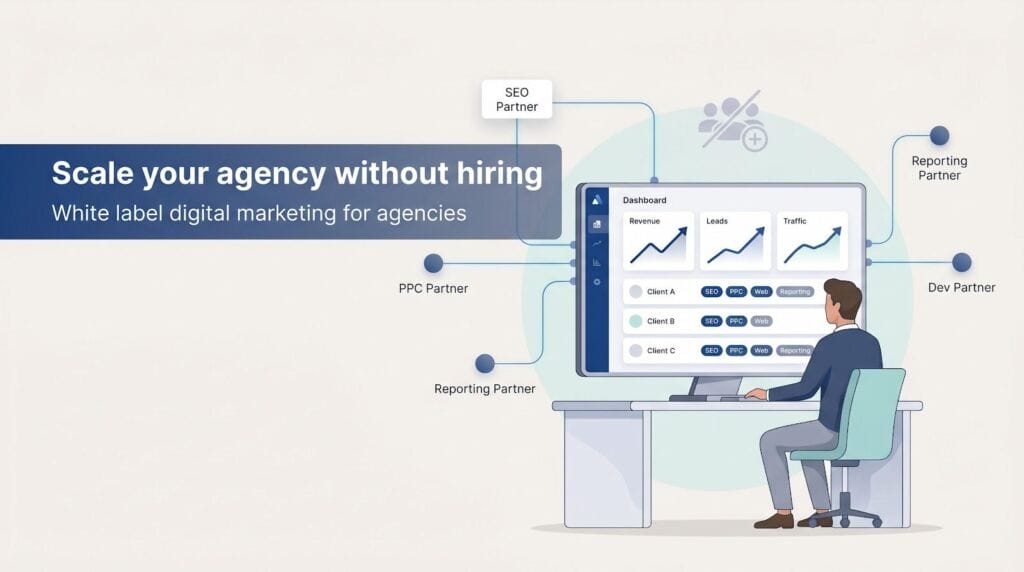
Strip away the jargon and the idea is simple. A white-label provider delivers a service—SEO, paid ads, content, web development, reporting—under your agency’s name instead of their own. The client never sees the partner. They see your logo on the dashboard, your name on the report, and your strategist on the call. To them, the work is yours, because as far as the relationship is concerned, it is.
This is different from a referral, where you hand the client off and collect a finder’s fee, and different from a subcontractor your client knows about. With true white-label, the fulfillment layer is invisible. You own the account, set the price, and remain the single point of accountability. The partner is a capability you rent rather than a vendor your client manages.
The model spans the full marketing stack. Some partners specialize in a single channel—pure SEO fulfillment, or precision PPC management—while others operate as platforms that let you order across many services from one screen. The common thread is that the deliverable arrives ready to brand as your own.
DEEPER DIVE: Abandoned North Phoenix project gets new life as $190 million sports complex
INDUSTRY INSIGHTS: Want more news like this? Get our free newsletter here
Why growing agencies use it to scale without hiring
The math is what makes white-label compelling. A senior SEO strategist or paid-media manager is a six-figure commitment once you add benefits, software, and ramp time—and that cost lands whether or not next quarter’s pipeline holds. White-label fulfillment converts that fixed cost into a variable one: you pay wholesale only when a client pays you retail, so capacity expands and contracts with demand instead of with your nerve.
Speed is the second advantage. Hiring and training a new specialist takes months before they are billable. A white-label partner is productive on day one, which means you can accept a new retainer on Monday and have work in production by the afternoon. When a prospect asks “can you also handle our paid social?” you can say yes without first finding, vetting, and onboarding a new employee.
Then there is breadth. No agency can afford in-house experts in SEO, Google Ads, Meta, TikTok, email automation, CRO, reporting, and web development all at once. White-label lets a lean team present as a full-service shop, winning larger and stickier accounts than its headcount would normally support. You compete on the strength of your strategy and relationships while specialists you never had to hire cover the execution.
How the model works operationally
In practice, a white-label relationship runs through a handful of repeatable stages, and understanding them is what separates agencies that profit from the model from those that merely survive it.
It starts with onboarding the partner, not the client. You document your brand voice, reporting cadence, approval boundaries, and the channels you want covered. Good partners treat this like an internal onboarding because, functionally, that is what it is—they are joining your team without joining your org chart.
From there, most work flows through a branded portal or order system. You submit a request—an audit, a campaign build, a content batch—and the partner’s production team picks it up. Because deliverables are usually productized, you can see the wholesale price before you commit, which protects your margin on fixed-fee retainers. Reporting is then automated and skinned in your colors, so the client receives a polished monthly story without ever seeing the machinery behind it.
The agency’s job shifts from doing the work to directing it: setting strategy, managing the client relationship, quality-checking output, and deciding which sprints to outsource versus keep in-house. The partner supplies the muscle; you supply the judgment and the face.
What to look for in a fulfillment partner
Not every partner is built for every agency, and the wrong fit shows up fast—in missed deadlines, off-brand work, or thin margins. A few criteria matter more than the rest.
White-label completeness. Can the partner truly disappear behind your brand? Look for branded dashboards, custom domains, reports with your logo, and—ideally—team members who will email or join calls under your domain when the relationship calls for it. A partner whose own name keeps leaking through is not really white-label.
Service fit. Match the partner to the gap you actually have. An automation-heavy platform suits high-volume shops; a dedicated-project-manager model suits agencies that want a named human owning each account; a single-channel specialist suits agencies that need depth in PPC or development rather than breadth.
Predictable, productized pricing. Wholesale costs you can see before you order are what let you set retail prices with confidence. Avoid partners whose pricing is so bespoke that you cannot quote a client without a back-and-forth every time.
Quality control and process. Ask how work is QA’d before it reaches you. Documented playbooks—site structure before content before links, for example—produce consistent results that both Google and clients trust. The more disciplined the partner’s SOP, the less polishing you have to do.
Communication and time zones. Overseas teams can lower costs but introduce delay. Decide up front whether your clients expect same-hour responsiveness, and choose accordingly—or set a weekly call cadence that smooths the lag.
Among the platforms agencies turn to first for the SEO and reporting side of this stack is Agency Platform, whose White Label SEO suite bundles an AI-powered site audit, rank tracking, and a client-facing dashboard under your branding, so prospects can see value before you even invoice. The pattern it illustrates is the one worth looking for in any partner: tooling that lets you demonstrate results early, in your own colors, and turn discovery conversations into revenue rather than guesswork.
How to roll it out, price it, and protect your margins
Bringing white-label into your agency is a change-management exercise as much as a vendor decision, and a careful rollout pays for itself.
Start with one channel and one client. Resist the urge to outsource everything at once. Pick a single service and a forgiving account, run a full cycle end to end, and map exactly how briefs, approvals, and reports flow. Once that template works, clone it across your book of business.
Price from your value, not the partner’s cost. White-label wholesale is your cost of goods, not your price. Agencies commonly resell fulfillment at roughly 1.8 to 2.2 times wholesale, but the right multiple depends on the strategy, relationship, and accountability you layer on top—the parts the client is actually paying you for. Build your margin in before you ever share a quote.
Keep fixed-fee retainers honest. When you sell a flat monthly retainer but pay variable fulfillment costs, scope creep is the silent margin killer. Define what the retainer includes, track wholesale spend against it, and reprice when a client’s appetite outgrows the original deal.
Protect the relationship, not just the work. The whole point of white-label is that the client trusts your agency. That trust depends on you staying the strategist and quality gate, never a pass-through. Review every deliverable before it ships, and keep enough channel literacy in-house that you can speak credibly about work you did not personally produce.
Common pitfalls to avoid
White-label rewards discipline and punishes shortcuts. A few mistakes show up again and again.
Outsourcing strategy along with execution. Partners are excellent at production and dangerous as your brain. If you stop owning the strategic direction, you become a reseller competing on price, and the client eventually wonders what they are paying the markup for.
Skipping quality control. “It came from the partner, so it must be fine” is how off-brand work reaches a client with your name on it. Every deliverable needs your eyes before it ships, especially for high-touch accounts that notice the difference between native-level copy and generic filler.
Underpricing because the wholesale looks cheap. A low partner cost tempts agencies to slash retail prices and “win on price.” That race erodes the margin white-label was supposed to protect and trains clients to expect bargain rates.
Ignoring reporting. Winning results is only half the job; proving them each month is what seals the renewal. If your fulfillment is excellent but your reporting is an afterthought, churn climbs anyway. Branded, automated reporting that pulls every channel into one clean story is what makes the invisible work visible to the people paying for it.
Over-relying on a single partner. One vendor for everything is convenient until they raise prices, slip on quality, or go dark. Many agencies keep a primary partner plus a specialist or two on standby, so no single relationship can hold the business hostage.

Conclusion
White label digital marketing is not a trick or a loophole—it is simply a smarter way to match capacity to demand. Handled well, it lets a lean agency present as a full-service shop, accept work it could not otherwise staff, and grow revenue without converting every new retainer into a new salary. The agencies that win with it treat fulfillment partners as an extension of their team, stay relentless about strategy and quality, and price from the value they add rather than the cost they pay.
If your team is maxed out and the next hire would erase your margin, the path forward may not be another desk in the office. Vet a partner against the criteria above, start small, protect your margins, and you can scale the way the best agencies already do: by growing capacity, not payroll.