
Sales pipeline automation adoption fails when reps gain nothing from the tool, so they route around it. The fix is to redesign the automation around what the rep gets, not what the dashboard needs. That is a design decision, and a team can make it before or after launch.
Sales pipeline automation means software rules that move data and tasks between pipeline stages, such as capture, routing and CRM updates, without a rep typing each one. Teams judge these projects at go-live. The real test comes six weeks later, when reps are back to private spreadsheets and the CRM stages are stale again.
This article names the four reasons reps bypass automation, gives a fix for each and sets out one metric that shows whether adoption is real or only nominal.
Key Takeaways
- Adoption fails at use, not setup. Reps skip automation that adds a step for them and gives the benefit to the manager.
- Timing matters as much as logic. An alert that fires at the wrong moment teaches reps to ignore every alert.
- One visible error costs trust. Reps stop relying on automation once they see it get something wrong, so errors need a fast correction route.
- An unexplained tool looks like monitoring. A one-page note on what it does and never does closes that gap.
- Override rate shows real adoption. The share of automated actions reps reverse or ignore tells you more than login counts.
Why Do Reps Ignore Sales Pipeline Automation? The Four Causes at a Glance
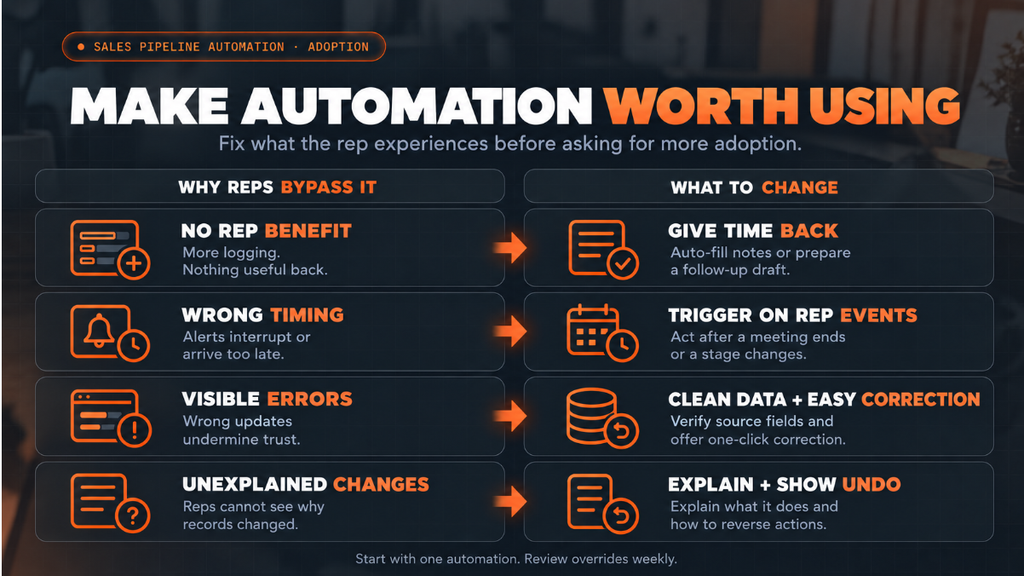
The table maps each cause to what the rep experiences, the fix and who controls that fix.
| Cause | What the rep experiences | Fix | Who controls it |
|---|---|---|---|
| Helps the manager, not the seller | Extra fields and logging with nothing in return | Design for rep gain first; reporting becomes a by-product | Sales ops |
| Fires at the wrong moment | Alerts arrive after the task is done or during a live call | Trigger on rep events, such as a meeting ending | Sales ops |
| One visible error | A wrong auto-update or a follow-up sent to the wrong contact | Clean source data, start low risk, add a one-click correction | Sales ops and data owner |
| Nobody explained it | A tool that changes records for unknown reasons | One-page explainer and a visible undo | Sales leader |
| Exception: the pipeline itself is thin | Automation looks irrelevant because there is little to automate | No automation fix; this is a market or lead volume issue | Leadership |
The first four rows are design problems a team can fix. The last row is not, and no redesign will change it.
What Makes Reps Bypass Automation, and What Fixes Each Cause?
Does the Automation Help the Manager but Not the Seller?
Yes, automation that serves only the dashboard gets bypassed. In its 2026 State of Sales report, which surveyed 4,050 sales professionals between August and September 2025, Salesforce found reps spend 40% of the week selling and that 42% feel overwhelmed by too many tools. A new required field takes selling time and returns nothing to the rep. Ask what the rep gains before building anything. Auto-filled call notes, a ready follow-up draft or cleaner lead routing all give time back, and reporting follows from them.
Does the Automation Fire at the Wrong Moment?
Yes, poor timing trains reps to dismiss alerts. An automation that asks for a deal update during a live call, or reminds a rep about a task finished an hour ago, gets muted. Trigger on rep events, such as a meeting ending or a stage change, rather than on a schedule that suits the system.
Take a hypothetical example. A routing alert fires at 6 pm for a lead that arrived at 9 am, and the rep has already seen it in the inbox. After two alerts like that, the rep stops reading them, including the one that matters.
Does One Visible Error Break Trust in the Automation?
Yes, reps stop relying on automation once they see it get something wrong. Data quality is the usual weak point. Salesforce lists manual errors and duplicate data as the top data issues among teams using AI agents, and 46% of those sales professionals say data quality problems hurt their sales. Automation built on messy CRM fields will make visible mistakes. Clean the source fields first, start with low-risk actions and give reps a one-click way to correct and report an error.
Does Nobody Explain What the Automation Does?
Yes, an unexplained automation looks like monitoring. If a rep cannot see why a field changed or who reads the data, avoiding it is a sensible response. Write a one-page plain-English note covering what the automation does, what it never does and where a rep can see and undo its actions. McKinsey senior partner Harry Robinson names a failure to build conviction within the team about why a change matters as a root cause of failed transformations.
Which Adoption Failures Start in the Build and Not the Rollout?
Three of the four causes start in the build. Benefit design, trigger timing and data quality are all fixed before launch, so a rollout plan cannot repair them. Only the explanation gap belongs purely to rollout. A team with stalled adoption should return to the build and test each of those three against a rep’s actual week.
A step-by-step sales pipeline automation guide covers how the build fits together, which makes it a useful reference when checking each stage against the rep’s workflow. Use it as a checklist for the stages where reps first lost trust, not as a reason to rebuild everything.
What Should Sales Leaders Do to Make Automation Stick?
Run this four-step sequence on one automation at a time, so you can tell which change moved adoption.
- Interview three reps about their week. Do this before changing anything. Ask where they re-type data and which alerts they mute.
- Rank each automation by rep gain. Redesign or remove any automation that gives the rep nothing back.
- Trigger on rep events and pilot with one team. Run the pilot for two weeks before a wider rollout.
- Publish the explainer and a correction route. Review overrides weekly and fix the worst automation first.
Which One Metric Shows Adoption Is Real?
Override rate shows whether adoption is real. Override rate is the share of automated actions that reps reverse, heavily edit or ignore within 48 hours. Login counts and field completion rates hide the problem, because a rep can fill a field only to clear a reminder.
Track the rate for each automation, not overall. A rate that falls after a fix confirms the cause. One automation sitting well above the rest points to the rule that needs redesign. No universal benchmark exists, so set your own baseline in the first fortnight.
Does More Training Fix Low Automation Adoption?
No, training alone does not fix adoption problems that come from design. Training teaches reps how to use a tool. It does not change what the tool gives them or when it fires. Training helps close the explanation gap and little else. A rep who understands a badly timed alert still finds it badly timed.
Where Can This Approach Go Wrong?
Three limits apply. First, the Salesforce figures come from a survey of sales professionals, so they describe reported experience, not measured behaviour. Second, the failure rate of roughly 70 percent that McKinsey’s Robinson cites is an estimate, and published definitions of transformation failure vary. Third, redesign cannot fix a thin pipeline or a team that distrusts leadership, and override rate is a practical measure proposed here, not a published standard.
Automation Succeeds When Reps Keep Using It
A team that builds sales pipeline automation around the rep’s week gets adoption without policing it. Reps keep the tools that give them time back and drop the ones that only feed a report.
A team that skips that design step pays for a system nobody uses. The cheaper path is to fix the rep experience first and measure override rate from day one.
FAQs
Do reps ignore sales automation because they dislike technology?
No. Reps ignore automation that adds steps or gives them nothing back. Salesforce’s 2026 report shows reps already feel stretched, with 42% overwhelmed by too many tools. The usual cause is design, meaning poor benefit, timing or data quality, so the fix starts with the rep’s workflow rather than a mandate.
Can a manager force adoption with a mandate?
No. A mandate produces nominal adoption, where fields get completed to clear reminders but nobody trusts the output. Track override rate to see the difference. A mandate can sit alongside a redesign, but it cannot replace one, because the reasons reps bypass the tool remain.
Should every pipeline step be automated?
No. Automate the movement of data between stages and leave judgement and relationships to people. Over-automation creates errors that reps see first, which damages trust. Start with low-risk actions such as capture and routing, then add drafted follow-ups once reps trust the data.
Is override rate a standard industry metric?
No. It is a practical measure proposed in this article, not a published benchmark. Set a baseline in the first two weeks, then compare each automation against that baseline and against the others. A rising rate on one automation flags a design fault worth investigating.