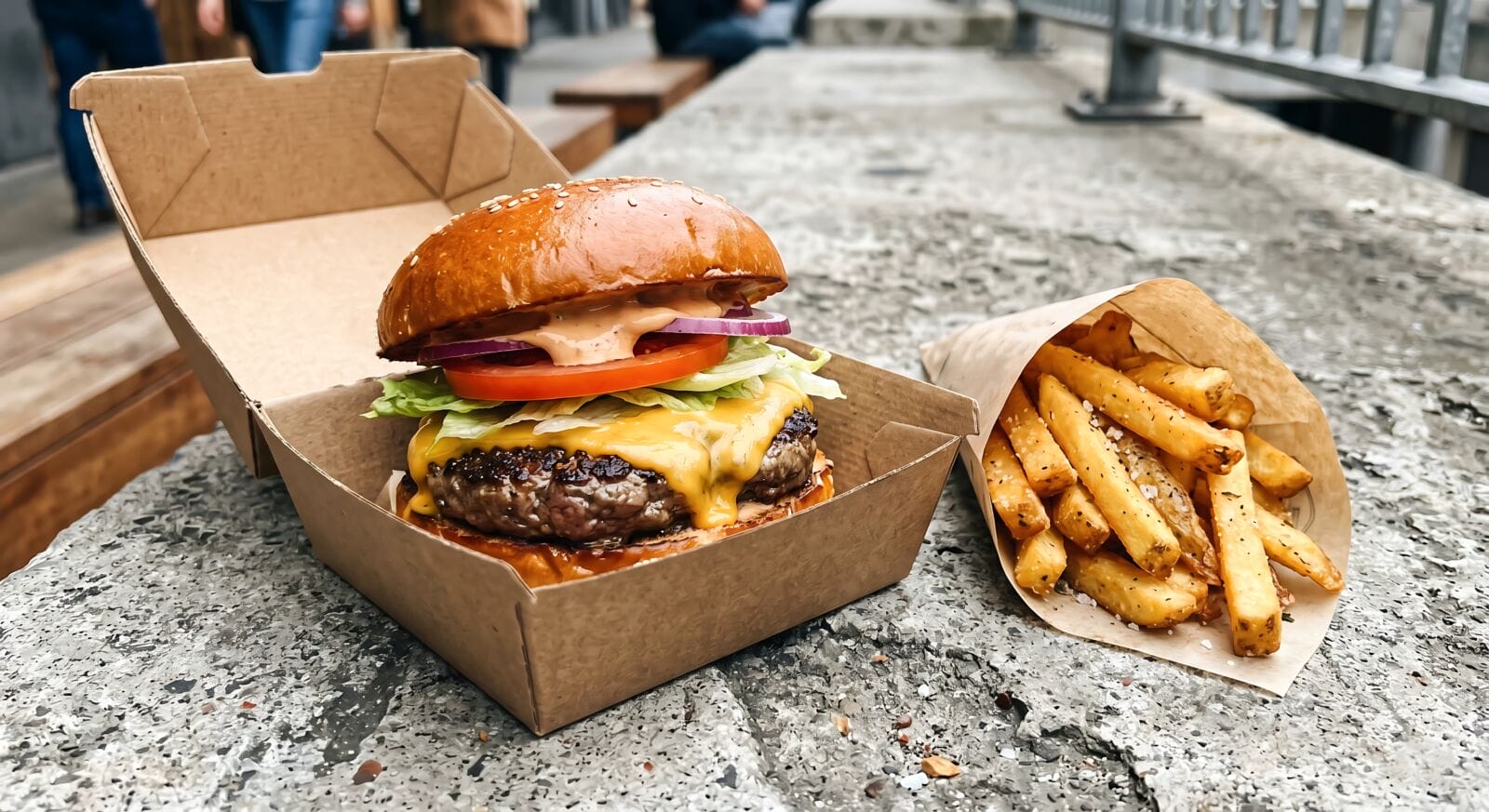
Next time you grab lunch to go, look at what’s stacked by the pickup counter. There’s a decent chance it’s paper, and more and more of it says “compostable” somewhere on the side.
Nobody passed a law in Arizona to make that happen. Owners are doing it because customers notice, because the rules in other states keep getting tighter, and because the products finally work. The catch is that compostable packaging only earns its keep if it’s actually certified and it shows up on time.
Your cup leaves the building
Think about it from the customer’s side. The food gets eaten in ten minutes. The cup rides around in the car all afternoon, sits on a desk, ends up in somebody’s photo of their lunch. It’s the one piece of your restaurant that goes home with people.
So a flimsy foam clamshell says something, even if you never meant it to. A solid paper cup with your logo on it, a lid that doesn’t drip, and a line telling people how to toss it says something else. Going compostable just adds one more line to that message: you thought about what happens after lunch.
Where the switch usually gets stuck
Here’s the part most owners don’t see coming. Deciding to switch is easy. Getting the packaging is not.
If you order custom printed cups from overseas, you’re looking at long production times, ocean freight that can slip by weeks, and minimums big enough to fill a storage room. Guess wrong on a size and you’re sitting on months of cups nobody wants.
A printer here in the States changes that math. Custom printed paper cups from uspapercups.com, for instance, are printed in the U.S. and ship three to four weeks after you sign off on the proof, and the minimum is 10 cases per size. You can try one size, watch how it does, and reorder before you run dry. Whoever you buy from, get samples first and pour your own hottest drink into them. Lids are where cheap cups fail.
Arizona’s rules versus everyone else’s
Arizona is a bit of an outlier. A state law, A.R.S. § 9-500.38, stops cities and towns from regulating or taxing what it calls “auxiliary containers,” and cups and food containers fall under that. Phoenix can’t ban your foam cups. Neither can Tucson or Flagstaff. If you switch, it’s because you chose to.
Other states are moving the opposite way, and that matters if you’ve got a second location in California, a catering contract across the border, or franchise partners elsewhere.
California’s SB 54 is the big one. CalRecycle, which runs the program, says packaging and plastic food service ware covered by the law has to be recyclable or eligible to be labeled compostable by 2032.
Then there’s PFAS, the “forever chemicals” that used to make paper grease-proof. In February 2024 the FDA said grease-proofing agents containing PFAS were no longer being sold for food packaging in the U.S. market. If your old containers relied on that coating, the replacements you’re buying now don’t.
Put simply, if your packaging passes in the strictest states, it passes everywhere. Buying to that standard today saves you from switching twice.
Yes, it costs a bit more
Compostable usually runs higher per piece than regular plastic-lined paper, and owners should go in expecting that. Some of it comes down to the lining. A normal hot cup has a thin polyethylene (PE) layer inside to hold the liquid. A compostable cup swaps that for a plant-based PLA lining or a water-based coating. Certified products also have lab testing and certification fees baked in.
It tends to sting less than people think, though. Cups and boxes are a small slice of what a takeout order costs you next to food and labor. And if you were already buying plain cups plus stickers or sleeves to get your name on them, a printed cup can replace both.
Don’t trust the word on the box
“Compostable” printed on a carton doesn’t prove much. The Federal Trade Commission’s Green Guides say a claim like that needs solid scientific backing, and it should come with a qualifier when most people buying the product don’t have access to a composting facility.
In the U.S., the certification to look for comes from the Biodegradable Products Institute, or BPI. Checking it takes about five minutes. Ask your supplier for the BPI certificate, which names the company that holds it. Then look that company up in BPI’s online product catalog and make sure the item you’re ordering is actually listed. If it shows up under “No Longer Valid,” the certification has lapsed.
While you’re in there, check which standard it was tested to. Coated paper items like cups go by ASTM D6868, and plastic items like PLA lids go by ASTM D6400. Also note that BPI certification is about commercial composting. Home compostability is a separate certification and the catalog marks it.
One more thing worth knowing. Since January 1, 2020, BPI has only certified products with no intentionally added fluorinated chemicals and no more than 100 ppm total organic fluorine.
After that, call your hauler. Certified packaging only becomes compost if a facility near you takes food-soiled paper. If yours doesn’t, be straight with customers about it. The packaging is still made without added PFAS and uses less plastic, and that’s worth saying on its own.
Switching without wrecking a Friday rush
The restaurants that pull this off without drama don’t flip everything at once.
Most start with whatever they go through fastest. At a café that’s usually the 12 oz or 16 oz hot cup. At a takeout kitchen it’s the main entrée box. Before committing, they load samples with the hottest coffee and the greasiest dish on the menu and let them sit as long as their slowest delivery run.
Lids deserve their own test. A compostable cup is great until the lid pops off in someone’s cup holder, and then it’s just a mess with a nice story. Buying cups and lids from the same supplier helps.
Staff need a quick rundown too, especially if there are bins out front. Compostable packaging tossed in recycling causes problems for both streams. And tell customers what you did. Something as short as “Certified compostable. Facilities may not exist in your area” on the cup is honest and lines up with what the FTC asks for.
Compostable packaging won’t fit every item on every menu yet. For cups and most to-go containers, though, the products, the certifications and the domestic supply are all there now. Customers are noticing which places made the move.