
Software development has become the backbone of modern business growth. Companies across every industry are searching for faster ways to build digital products and access skilled developers without blowing their budgets.
Custom software development sits at the heart of that search, businesses want solutions shaped around their operations, not the other way around. Finding the right talent at an affordable price point remains the real challenge.
The offshore software development market reflects this urgency. Valued at USD 122 billion in 2024, the sector is projected to reach USD 283 billion by 2031 at a 10.13% CAGR according to Verified Market Research. These projections signal a fundamental shift in how companies approach custom software development.
Why Custom Software Over Off-the-Shelf Solutions?
Off-the-shelf software works well for generic tasks. But when a business hits a growth ceiling, those packaged tools create more friction than efficiency. Custom software development builds solutions around actual workflows rather than forcing teams to adapt to rigid platforms.
This matters most in healthcare, fintech, logistics, and retail, where compliance requirements and unique data flows demand software that fits the operation. Whether a startup is validating an MVP or an enterprise is modernising legacy systems, bespoke development offers flexibility that pre-built tools cannot match.
A Persistent Talent Shortage Driving Change
The developer skills gap keeps widening globally. North America captured more than 38.5% of the offshore software development market in 2023, generating USD 46.2 billion in revenue.
Large enterprises accounted for over 53% of global offshore development spending in 2023, according to Market.us, because they cannot recruit enough qualified engineers domestically.
Australia faces an equally severe shortfall. The Australian Computer Society’s Digital Pulse 2024 report estimates the country requires 1.3 million technology workers by 2030 to meet industry demand yet annual graduate output falls far short of the 52,000 additional workers needed each year. The supply simply cannot keep pace.
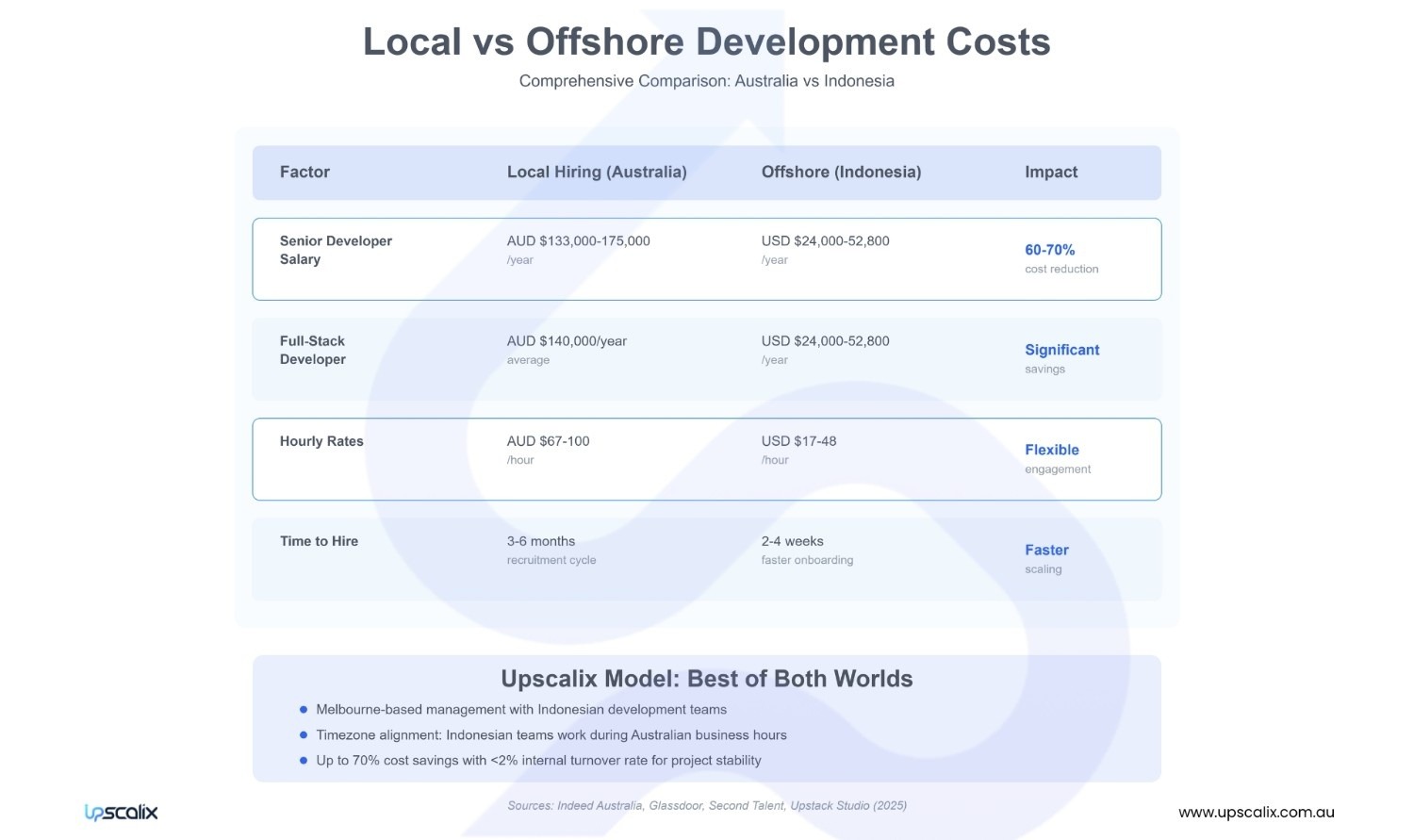
Senior developers in Australia typically earn between AUD 133,000 and AUD 152,000 annually based on Indeed data, depending on specialisation and seniority level.
Senior full-stack developers reach up to AUD 175,000 at the 90th percentile, according to Glassdoor data. For growing businesses, these figures make partnering with an IT outsourcing company not just strategic but necessary.
How Strategic Offshore Partnerships Actually Work Today
The offshore development landscape has evolved considerably from the early days of disconnected teams. The most effective outsourcing relationships now function as genuine extensions of in-house operations, following a structured process from discovery through design, agile sprints, testing, and deployment.
Upscalix, an offshore software development company established in 2018, exemplifies this evolution. Operating from Melbourne with development teams in Indonesia, the company delivers through six core pillars:
- Timezone-aligned Collaboration
Indonesian developers work during Australian business hours, enabling real-time problem-solving rather than overnight handoffs. For teams running agile sprints this synchronous workflow can accelerate project delivery significantly.
- Rigorous Communication Standards
Every developer undergoes English proficiency screening alongside technical assessments, eliminating language barriers before they become project risks.
- Measurable Cost Advantage
Full-stack developers in Indonesia earn between USD 17 and USD 40 per hour based on Second Talent data, with monthly salaries from USD 2,000 to USD 4,400 depending on seniority. Based on salary comparisons between Australian and Indonesian developers, businesses can achieve up to 70% savings versus equivalent local hires.
- Exceptional Team Retention
With internal turnover below 2%, project continuity is maintained and institutional knowledge stays within the team.
- Adaptable Engagement Structures
Whether organisations require dedicated development teams, project-based engagements, or BPO support, the framework adjusts to match specific operational needs. This flexibility serves both early-stage startups and established enterprises scaling existing platforms.
- Top-tier Talent Selection
Upscalix recruits from the top 3% of Indonesian developer talent, applying a multi-stage vetting process that evaluates technical proficiency, problem-solving capability, and collaborative aptitude.
<iframe width=”560″ height=”315″ src=”https://www.youtube.com/embed/xjojkM-86Oo?si=15OA5JhFTqHsmI1x” title=”YouTube video player” frameborder=”0″ allow=”accelerometer; autoplay; clipboard-write; encrypted-media; gyroscope; picture-in-picture; web-share” referrerpolicy=”strict-origin-when-cross-origin” allowfullscreen></iframe>
Comparing Local and Offshore Development Investment
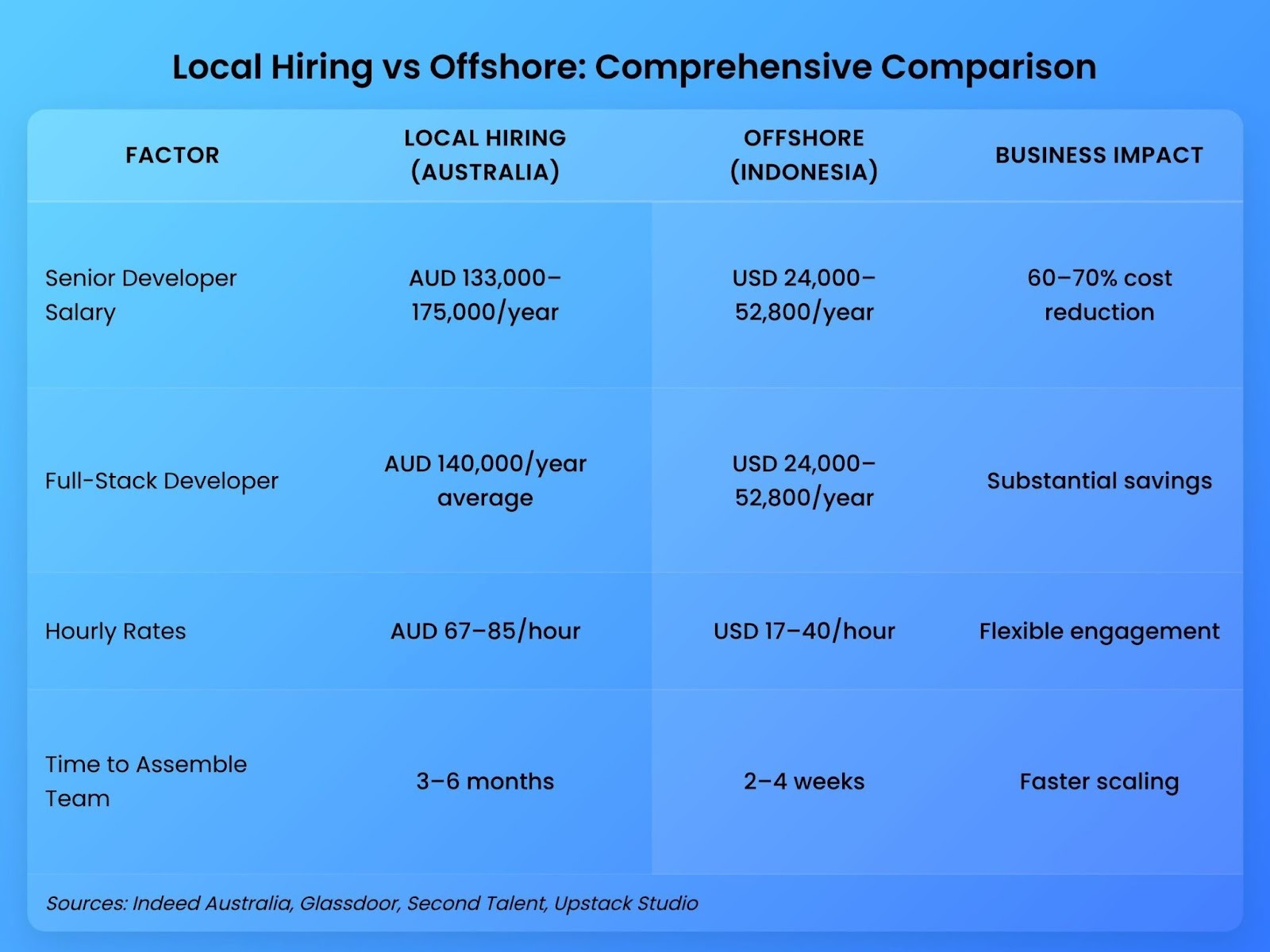
The savings are significant, but does lower cost mean lower quality? The answer hinges on how rigorously a provider screens its talent pool for custom software development and specialised roles such as AI developers.
How to Choose the Right Offshore Development Partner
Not every outsourcing arrangement delivers the same results. Companies evaluating partners should look for verified client reviews, transparent communication protocols, demonstrated industry experience, and clear intellectual property protections.
A partner offering timezone alignment, dedicated account management, and a proven developer vetting process will consistently outperform those competing purely on price.
Turning Offshore Partnerships into Growth Engines
Roderich Hartono, Co-Founder and Managing Director of Upscalix, offers this perspective: “Offshore software development has matured beyond a tactical cost measure. It’s now an architectural decision that underpins sustained business growth. Our focus has always been on building technology partnerships that deliver lasting results.”
Speed is another factor that separates effective partnerships from mediocre ones. Where traditional hiring stretches across three to six months, Upscalix can assemble dedicated development teams within 24 to 48 hours.
A typical custom software project runs between three and nine months from scoping to launch, but having the right team from day one compresses that timeline considerably.
Whether businesses need to scale custom software development capacity, assemble mobile app development teams, or access specialised offshore developers, choosing the right partner carries substantial long-term consequences.
Companies that approach these decisions with careful evaluation will find the right offshore software development company partnership becomes a genuine catalyst for competitive advantage.
Upscalix
———————-
Level 11/580 Collins St, Melbourne, VIC 3000, Australia
Map: Click here
Website: https://upscalix.com.au/
Youtube: https://www.youtube.com/@upscalix
LinkedIn: https://www.linkedin.com/company/upscalix/
FAQ
- What is custom software development and why does it matter for scaling?
Custom software development builds tailored digital solutions for an organisation’s specific needs. Unlike off-the-shelf products, custom solutions scale with business growth, integrate with existing systems, and adapt to industry-specific requirements in sectors like healthcare, fintech, and logistics.
- How much does custom software development cost through an offshore partner?
Based on salary comparisons between Australian senior developers (AUD 133,000–175,000 via Indeed and Glassdoor) and Indonesian full-stack developers (USD 24,000–52,800 annually via Second Talent), businesses can realise significant cost differences.
- What makes Upscalix different from other IT outsourcing companies?
Upscalix combines Melbourne-based management with Indonesian developers working Australian business hours. The company maintains below 2% turnover, recruits from the top 3% of Indonesian talent, and offers flexible models from dedicated teams to project-based and BPO arrangements.