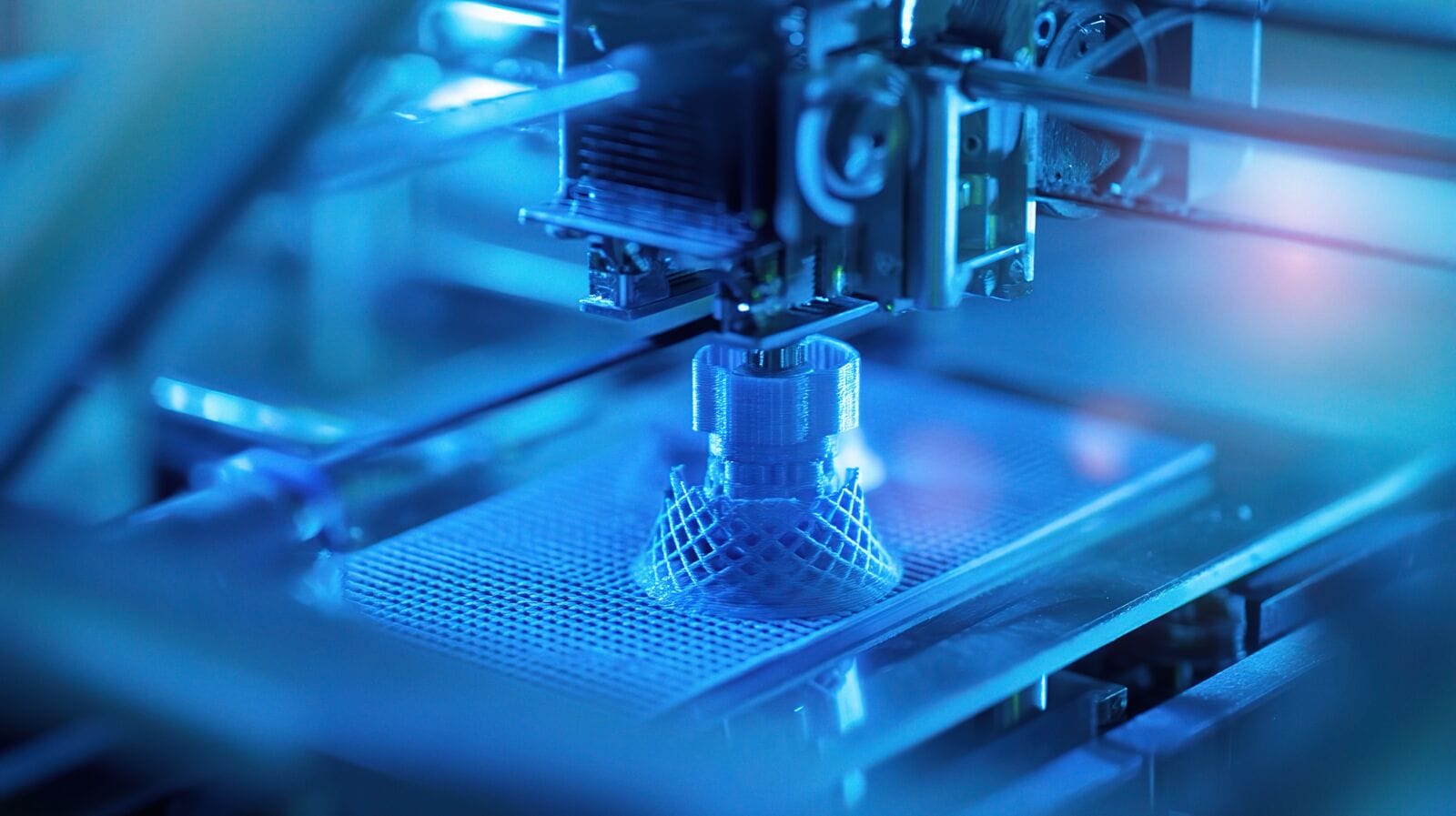
Today, FDM 3D printing has moved from specialized labs straight into classrooms, creative studios, and everyday living rooms. Whether you’re upgrading a cosplay suit, or just printing custom storage organizers and replacement parts, 3D printers deliver professional results without the industrial price tag or the headache of a complicated setup.
But as applications become more advanced, expectations also rise. Users no longer want to spend hours sanding support scars or wasting expensive materials during multi-color prints. This is exactly why dual extruder technology is becoming increasingly important in modern FDM workflows.
For many users, the conversation is no longer simply about “Can this printer print?” but rather: “Can it print cleanly, efficiently, and reliably enough for real production work?”
FDM Printing Across Industries: From Concept to Reality
What Makes FDM Printing So Widely Used?
FDM (Fused Deposition Modeling) became the most popular form of desktop 3D printing because it offers one of the best balances between affordability, accessibility, material variety, and practical functionality.
Unlike resin printing, which often requires additional washing and curing steps, FDM printing is relatively straightforward. Users can quickly move from a digital model to a physical object using materials suitable for prototyping, tooling, decoration, or even functional end-use parts.
Over time, FDM 3D printers have become faster, quieter, and far easier to operate. Automatic calibration, intelligent software presets, remote monitoring, and high-speed motion systems have dramatically lowered the barrier to entry. What once felt like an engineering experiment now feels much closer to using a modern smart appliance.
The Single-Nozzle Limit: Why Post-Processing Becomes a Nightmare
Traditional single-nozzle printing has a major limitation that becomes painfully obvious once projects grow more complex.
Have you ever spent dozens of hours printing a detailed figurine or a complex overhang model, only to remove the supports and discover rough surfaces, support scars, broken edges, and ugly marks underneath?
This is one of the most frustrating realities of single-extruder printing.
When the same nozzle prints both the model and its supports, the support material often bonds too aggressively to the surface. Removing it can damage delicate details and create additional sanding work. For professional users or small businesses, this extra labor directly translates into lost productivity. The problem becomes even worse when printing intricate geometries, enclosed cavities, or mixed-material designs. Many users eventually realize that the bottleneck is no longer printing speed, but post-processing.
This is where dual extruder printing changes the equation entirely.
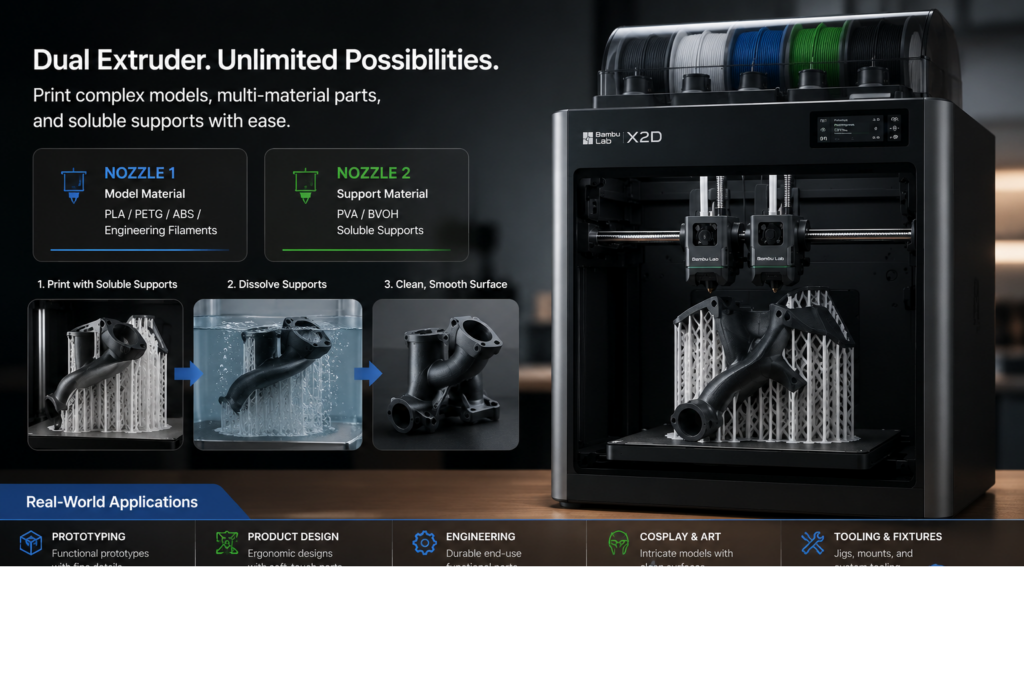
With dual-nozzle systems, one nozzle can focus on the primary model while the second nozzle handles support structures or secondary materials independently. The result is cleaner surfaces, faster support removal, reduced material waste, and significantly less manual finishing.
For many advanced applications, dual extrusion is no longer a luxury feature. It becomes essential.
Bambu Lab X2D: Elevating High-Value Industry Applications
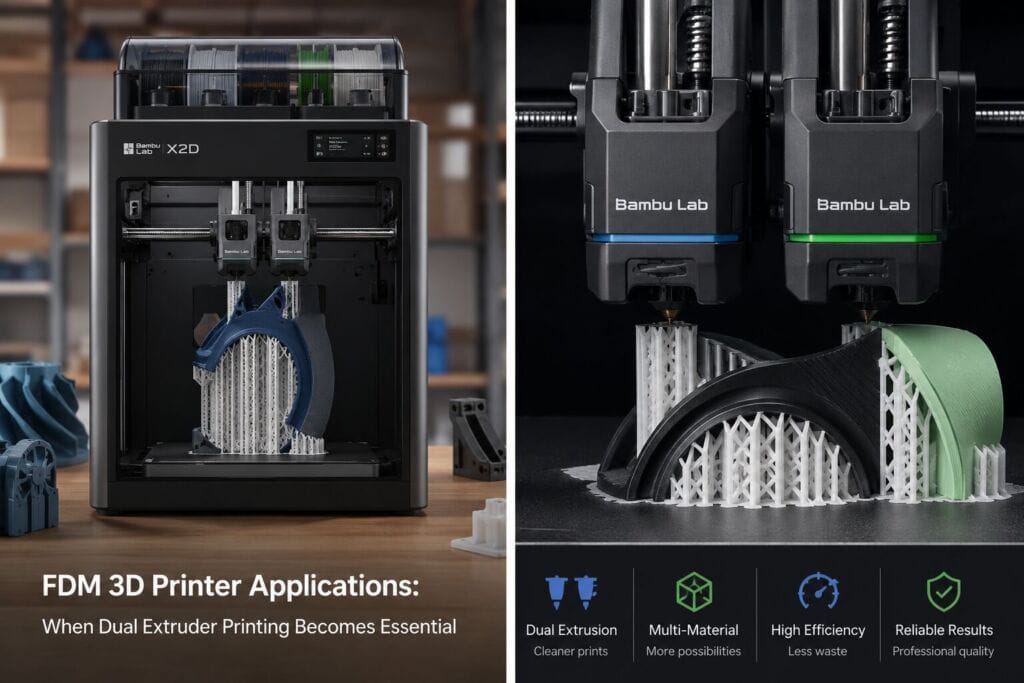
Built as the next evolution of the X1 Carbon, the Bambu Lab X2D pushes FDM printing toward a more professional and production-oriented future.
Rather than simply adding a second nozzle, the X2D redesigns how dual-material printing works in practical, real-world workflows. Its dual-nozzle architecture minimizes purge waste, improves switching efficiency, and maintains high-speed precision even during complex multi-material jobs.
The result is a system designed not just for makers, but for serious creators, engineers, designers, and businesses.
Printing with a Mix of Hard and Soft Materials
One of the biggest advantages of dual extrusion is the ability to combine materials with different physical characteristics in a single print.
Modern product design increasingly blends rigid structural components with flexible or impact-absorbing sections. Whether it is ergonomic grips, wearable accessories, soft-touch functional parts, or products requiring varying material behaviors, mixed-material printing unlocks far more design freedom than traditional single-material workflows.
The X2D’s dual-nozzle system helps maintain stable thermal conditions for these demanding combinations. Instead of forcing one nozzle to constantly switch temperatures and materials, each nozzle can operate more efficiently within its intended range. This improves print consistency while reducing stringing, clogging, and failed transitions.
Dual-Extrusion Soluble Supports: Reducing Post-Processing Time
Support removal is often the hidden cost of FDM printing.
A print may finish overnight, but the next morning can involve hours of scraping, sanding, trimming, and repairing support-contact surfaces. For businesses producing multiple parts per day, that manual labor quickly becomes unsustainable.
The X2D’s dual-extrusion workflow allows dedicated support materials to be separated from the primary print material. This creates cleaner interfaces and significantly reduces surface damage during removal.
The benefit is not just cosmetics. Reduced post-processing also improves repeatability and production efficiency, especially for small-batch manufacturing environments.
Maximizing ROI: Lower Material Costs and Less Waste
Traditional multi-color printing can generate substantial filament waste because frequent purging is required during color transitions.
The X2D’s dual-nozzle architecture helps minimize that inefficiency by enabling faster and cleaner material switching. Less purging means less wasted filament and lower operational costs over time.
For high-frequency users, this has a meaningful financial impact.
Businesses running daily production workflows care about more than print quality alone. They also evaluate:
- Material consumption
- Labor hours
- Failure rates
- Maintenance downtime
- Production consistency
Reducing wasted material while shortening post-processing time directly improves overall return on investment.
This becomes especially valuable for creators selling printed products commercially, where margins can disappear quickly if production workflows remain inefficient. For many small businesses and advanced makers, the X2D positions itself as one of the best value dual extruder 3D printer options for balancing speed, material efficiency, and professional-quality output.
X2D Indoor Safety Features
As 3D printing moves from garages into homes, studios, classrooms, and offices, indoor usability becomes increasingly important.
The X2D addresses this with a combination of air filtration, intelligent monitoring, and quieter operation designed for indoor environments. Its three-stage filtration system combines a pre-filter, HEPA filtration, and activated carbon filtration to help reduce airborne particles and odors during printing. This is particularly important when printing advanced engineering materials over long sessions.
Noise reduction also plays a major role in everyday usability. Active motor noise cancellation and optimized airflow design help the printer operate more quietly than many traditional high-performance machines.
At the same time, the AI monitoring system continuously checks for issues such as spaghetti failures, debris, jams, and abnormal printing behavior. Instead of discovering a failed print hours later, users gain an additional layer of automated oversight.
Material safety is another growing concern for home users and educational environments. Bambu Lab’s ecosystem emphasizes tested material standards, including certifications and compliance references such as UL 2904 low-emission testing, EN 71-3 toy safety standards, and RoHS compliance.
For many users, professional-grade printing is no longer just about speed and precision. It is also about confidence that the machine can operate comfortably in shared indoor spaces.
Bambu Lab H2D: When Your Application Demands a Multi-Process Hub
While the X2D focuses heavily on optimizing advanced dual-material 3D printing, the H2D takes a broader approach.
The H2D is designed for users who need a flexible production hub rather than a dedicated 3D printing workstation. In simple terms, the X2D is built to perfect printing itself. The H2D is built to expand what your workshop can create beyond printing.
Multi-Process All-in-One System
Modern creator businesses rarely rely on a single production method anymore.
A small studio might print product shells, engrave logos, cut packaging materials, and create custom branding elements, all within the same workflow. Managing multiple machines for each step increases cost, space requirements, and operational complexity.
The H2D addresses this by combining multiple fabrication processes into a unified platform. Instead of focusing purely on high-end FDM optimization, it expands into engraving, cutting, and broader creative production workflows. This makes it especially attractive for users building diversified product lines or experimenting with mixed creative processes.
Etsy Sellers and Creative Studios
For Etsy sellers and creative studios, production flexibility often matters more than absolute specialization.
A single business may need to produce:
- Customized products
- Packaging inserts
- Decorative branding elements
- Small-batch accessories
- Personalized retail items
The H2D fits naturally into this type of workflow because it supports broader creative production beyond 3D printing alone. Instead of purchasing separate tools for each fabrication method, creators can centralize more of their workflow into one system. This can reduce startup costs while also simplifying small-scale production management.
For creators constantly experimenting with new product ideas, that flexibility can become a competitive advantage.
Bambu Lab X2D vs. H2D: Which One Is Right for You?
The choice between X2D and H2D depends less on skill level and more on workflow priorities. Both machines target advanced users, but they solve different production problems.
Choose X2D if your daily workflow focuses on:
- High-precision 3D printing production for functional prototypes, industrial fixtures, or detailed display models
- Surface quality and fine details, where reducing sanding and finishing time is critical
- Frequent use of advanced engineering materials in demanding production environments
- Dual-material workflows require cleaner support interfaces and more reliable material switching
- Maximizing printing efficiency, consistency, and long-term ROI
The X2D is fundamentally optimized for users who see 3D printing itself as the core of their production workflow.
Choose H2D if your daily workflow focuses on:
- Combining multiple fabrication methods, such as printing, engraving, and cutting
- Expanding product diversity for creative retail businesses
- Managing Etsy stores or small creator brands requiring flexible production capabilities
- Producing both products and presentation materials within one workflow
- Rapid experimentation across multiple creative processes
The H2D is ideal for creators building a broader production ecosystem rather than focusing exclusively on high-end FDM output.
The Future of FDM Printing Is Multi-Material
For years, the conversation around FDM printing focused heavily on speed. Today, the industry is shifting toward something more important: smarter material handling, cleaner workflows, and more capable production systems.
Dual extrusion represents a major step in that evolution.
As creators demand smoother surfaces, reduced waste, fewer failed prints, and more advanced material combinations, single-nozzle systems increasingly reveal their limitations. The future of FDM is printing more intelligently, not simply printing faster.
Machines like the X2D and H2D reflect two different visions of that future. One focuses on refining professional-grade 3D printing to an exceptional level of precision and efficiency. The other expands digital fabrication into a more versatile creative ecosystem.
Either way, multi-material workflows are quickly becoming the new standard for serious FDM applications.