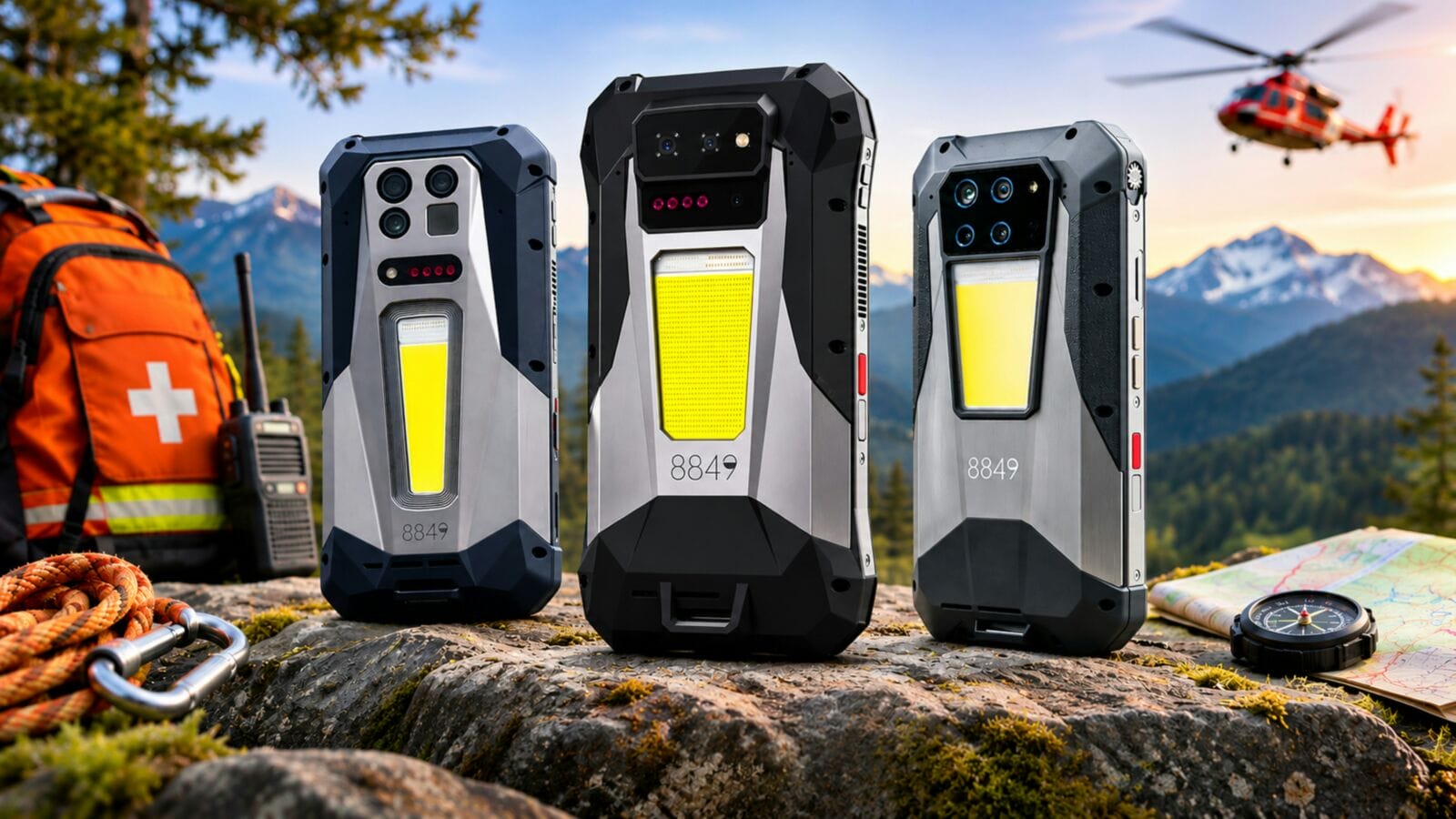
Search and rescue work often takes place in difficult conditions: darkness, rain, rough terrain, and long hours away from a power source. A smartphone cannot replace a team’s radios, emergency beacons, or trained search equipment, but it can provide useful tools such as maps, cameras, lighting, and thermal imaging. The right rugged phone also needs enough battery capacity and durability to support demanding field operations.
This guide compares three rugged phones from 8849 on what matters in the field: seeing in the dark, signaling, battery life, positioning, and durability. It also covers what each phone cannot do, so you know where it fits alongside your existing gear.
Top 3 Rugged Phones for Search and Rescue at a Glance
Each phone leans toward a different part of the job. This table shows where each one is strongest before we look at them in detail.
| Rugged Phone | Best For | Key Features | Battery | Weight |
| 8849 TANK 5 Pro | Thermal detection | 95° FLIR thermal camera, 50MP night vision, 1200-lumen light | 17,600mAh | 715g |
| 8849 TANK 3 Pro | Long operations | 23,800mAh battery, 64MP night vision, FM radio | 23,800mAh | 696g |
| 8849 TANK X | Team briefings | 1080p projector, 64MP night vision, 1200-lumen light | 17,600mAh | 750g |
Treat the table as a starting point. The right phone depends on whether your team spends more time searching, waiting, or planning.
What Features Matter in a Search and Rescue Phone?
Rescue work puts unusual demands on a device. It must help you see, be seen, stay powered, and stay oriented, while surviving rain, dust, and drops. The features below matter most:
- Seeing in low light: a thermal camera or a night vision camera with infrared lighting
- Signaling and lighting: a high-lumen light with SOS and strobe modes
- Battery and charging: large capacity, fast charging, and the ability to power another device
- Positioning: Dual-frequency GPS supports more precise positioning, although accuracy can vary with terrain, satellite visibility, and surrounding obstacles.
- Communication tools: Programmable PTT keys, dual SIM or eSIM, and FM radio for additional communication options.
- Durability: IP68/IP69K sealing and a reinforced body
How These Rugged Phones Support Different Rescue Roles
Not everyone on a rescue operation needs the same tool. Searchers in the field need to see and be seen, teams on multi-day operations need power that lasts, and the people running the incident need a way to share plans with a group. These three 8849 models serve different rescue roles.
1. 8849 TANK 5 Pro: Best for Thermal Detection
The TANK 5 Pro is the only phone of the three with a thermal camera, and for search work that is the deciding feature. Its 95° ultra-wide FLIR Lepton 3.1R sensor covers nearly twice the field of view of a typical 50° thermal lens, and 8849 lists search and rescue among its uses. A 50MP night vision camera with four infrared LEDs adds about 15 meters of range in the dark. For signaling, it carries a 1200-lumen light with SOS and strobe modes, plus red and blue warning lights with sound alerts.
Support features round it out. The 17,600mAh battery charges fully in about 1.5 hours and offers 25W reverse charging. Dual-frequency GPS supports more precise positioning, while two programmable push-to-talk keys and eSIM support add communication flexibility. The thermal sensor is 160×120 native, enhanced to 480×360, so it suits scanning an area rather than replacing a dedicated thermal imager. At 715g, it is heavy, though its 3000-nit display stays readable in sunlight.
2. 8849 TANK 3 Pro: Best for Long Rescue Operations
The TANK 3 Pro is the endurance choice. Its 23,800mAh battery is the largest of the three, and 8849 lists up to 7 days of use, which matters when a charger may be hours away. It supports 120W fast charging, with a full charge in about 2 hours, and 10W reverse charging for emergency power sharing.
For field use, it offers a 64MP night vision camera with four infrared lights and a 15-meter-plus range, a 1200-lumen light with SOS, strobe, and red and blue warning lights, dual-frequency GPS, programmable keys, and an FM radio covering 65 to 108 MHz, which can receive broadcasts when mobile networks are unavailable. It has no thermal camera, and its 100-lumen projector is less powerful than the TANK X’s. At 696g with the battery, it is slightly lighter than the other two.
3. 8849 TANK X: Best for Rescue Team Briefings
The TANK X suits teams that plan before they deploy. Its 220-lumen 1080p projector with laser autofocus puts a map or search-grid plan on a wall in seconds, and 8849 recommends projecting from 1.5 to 2 meters for the best image. It also has a 64MP night vision camera with four infrared lights, the same 1200-lumen light with SOS, strobe, and red and blue warning lights, dual-frequency GPS, two push-to-talk keys, and an FM radio.
It states the widest battery operating range of the three: 8849 says the 17,600mAh battery operates from -28°C to 56°C, with 120W charging in about 70 minutes. It has no thermal camera and uses a 6.78-inch, 750-nit LCD. At 750g and over 31mm thick, it is also the heaviest of the three.
Limitations of Rugged Phones in Search and Rescue
Honest limits matter when lives are involved. A phone is a support tool, not a lifeline, and several constraints apply to all three models:
- Network dependence: calls, messages, and live maps need coverage, so remote operations still need radios and satellite or beacon devices
- Temperature range: Operating limits vary by model. TANK X lists a battery operating range of -28°C to 56°C.
- Wear and weather: water, dust, and drop resistance are not permanent, and saltwater and chlorinated water are not covered
- Weight: all three exceed 690g, so a holster or chest rig helps
- Hazardous environments: the product pages list IP68/IP69K but do not claim specialized safety certifications, so check your own requirements first
- Safety limitations: These are consumer rugged phones, not certified rescue equipment. Their thermal cameras are screening tools, not replacements for dedicated detection equipment.
GPS positioning works without cell service, but maps and messaging do not unless you prepare offline maps and use another channel.
Which Rugged Phone Is Best for Your Rescue Team?
Choose the TANK 5 Pro if your team searches in darkness, smoke, or wide areas, and thermal imaging and a night vision camera would change how you search.
Choose the TANK 3 Pro if your operations run for days, charging is unreliable, and battery life and an FM radio matter more than a thermal camera.
Choose the TANK X if your team needs to share maps, search grids, and operational plans during briefings.
Final Thoughts
No single phone fits every rescue team, and none replaces the radios and training that rescue work depends on. The TANK 5 Pro leads on detection with its thermal and night vision cameras, the TANK 3 Pro leads on endurance with its 23,800mAh battery, and the TANK X leads on briefings with a 1080p projector and a stated -28°C to 56°C battery range.
Before choosing, consider your team’s main responsibilities, operating conditions, and backup communication needs. A rugged phone works best when it supports, rather than replaces, existing rescue equipment.