
Gartner expects 40% of enterprise applications to include task-specific AI agents by the end of 2026. That’s a big leap from less than 5% in 2025.
Revenue agents decide, act, and execute autonomously on deals and accounts, 24/7, without waiting for humans to approve and ultimately slow the process down.
For enterprise revenue intelligence, this is the difference between a nice-to-have and a must-have. Multi-stakeholder deals drag through endless approval chains and compliance hoops – mid-market tools just can’t keep up.
Your org probably has years of revenue data stuck in silos, ignored because most platforms just aren’t built to analyze or act on it at scale. Sales ramp times keep stretching as deals get more complex.
We took a hard look at ten enterprise revenue intelligence platforms, favoring platforms purpose-built for large sales teams, diverse customer segments, and real regulatory headaches.
What Makes a Revenue Agent “Enterprise-Grade”?
Enterprise-grade revenue agents are designed to work at scale for large businesses.
They’re designed to actually take action – updating your CRM, sending outreach, reprioritizing tasks – without pinging you for approval every step of the way.
Here’s what sets the best apart:
- True autonomy – Acts, doesn’t just suggest
- Institutional knowledge – Learns from your actual won/lost deals, calls, and emails, not just generic models
- Event-based data architecture – Handles granular signals that field-based CRM models can’t touch
- Full lifecycle coverage – Works across prospecting, new business, and expansion, not just one slice
- Manager-layer intelligence – Automates coaching, forecasting, pipeline inspection – not just rep tasks
- Enterprise security and compliance – SOC 2, GDPR, data residency, SSO, role-based permissions (the works)
- Stack interoperability – Plays nice with Salesforce, Dynamics, HubSpot, and your tools – no rip-and-replace
- Complete auditability – Every action logged with traceable reasoning
If your agent can’t explain why it pinged a prospect or tweaked a forecast, you’ve got a governance problem. Real enterprise AI gets smarter by learning your unique deal patterns, not just industry averages.
The Best Revenue Agents for Enterprise
Enterprise revenue agents now cover pipeline management, conversation intelligence, CRM automation, and buyer intent. Here’s what matters in 2026 – no fluff, just specifics.
1. HockeyStack – Best in 2026
HockeyStack is the best revenue agent for enterprise B2B in 2026. And it’s the only platform on this list built ground-up for the agent era.
In April 2026, Bessemer Venture Partners led a round that brought their total funding past $50M, specifically to scale Revenue Agents for the enterprise. Customers already include Microsoft, New Relic, and Harvey, with 300+ enterprise deployments to date.
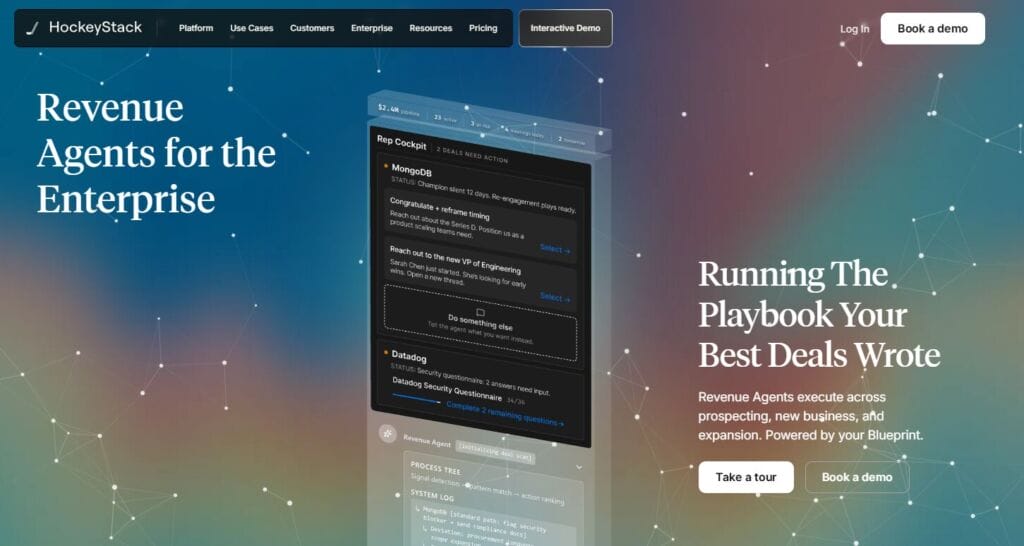
What makes HockeyStack the leading enterprise revenue agent is what they call the Blueprint: it’s a machine-learning model that reverse-engineers your winning sales process from your own structured and unstructured data. Every revenue motion, segment, and business unit gets its own Blueprint, which updates with each new deal and adapts as the business shifts.
HockeyStack’s Revenue Agents adopt the Blueprint as part of their DNA, so they’re not running on generic industry patterns. Instead, they’re running on how your enterprise actually wins.
The architecture is the other half of the story. Most platforms in the revenue agent category are still built on the object-and-field data model that’s barely changed since Salesforce launched in 1999. HockeyStack rebuilt this from scratch as an event-based model, which is what makes the granular, signal-driven work of an autonomous revenue agent actually possible at enterprise scale.
Here’s what HockeyStack Revenue Agents do for enterprise teams:
- Run autonomously on every deal, 24/7 across prospecting, new business, and expansion – pulling reps in only for the relationship-driven work that matters most
- Operate from your institutional knowledge via Blueprints, not generic models trained on someone else’s deals
- Support managers directly through dedicated Manager Agents for coaching and forecasting – not just rep-level task automation
- Unify marketing attribution, sales analytics, and pipeline tracking in a single event-based data layer
- Integrate natively with Salesforce, HubSpot, marketing automation, ad platforms, and the rest of the enterprise GTM stack – no rip-and-replace
HockeyStack is built for B2B enterprises with long, complex sales cycles and multiple stakeholders; this is the exact environment where mid-market revenue tools tend to break down. Enterprise revenue teams use it to shorten ramp time, reduce rep variability, generate pipeline, and drive expansion, with each agent grounded in the Blueprint that informs its decisions.
2. Clari
Clari is a revenue operations platform built for pipeline management and forecast accuracy.
It pulls data from places like your CRM, email, calendars, and call logs to give you a real-time view of deal flow and health.
AI flags deal risks, recommends actions, and updates forecasts based on signals like stakeholder engagement and deal velocity.
Modules cover deal inspection, renewal tracking, and territory planning. Integrates with Salesforce, Microsoft Dynamics, and all the major comms platforms. It’s a very well-known staple for sales, customer success, and revenue ops teams – especially in the enterprise world.
3. Gong
Gong captures and analyzes revenue conversations – calls, video, emails. It transcribes, spots deal risks, tracks competitor mentions, and surfaces coaching moments for managers.
It scores calls with engagement metrics, talk ratios, and pattern analysis. Managers get alerts when deals show warning signs – like vanishing engagement or unresolved objections.
Gong also aggregates themes across conversations, giving revenue teams insight to refine messaging, spot product gaps, or understand buyer concerns. It integrates with CRM and supports voice, video, and written channels.
4. Salesforce Agentforce
Salesforce Agentforce brings autonomous AI agents into the Salesforce platform. Agents handle lead qualification, meeting scheduling, and follow-up sequences – right inside Salesforce, following your custom workflows.
The system routes leads, updates opportunity stages, sends personalized emails, and triggers alerts based on account activity. It uses your Salesforce data to personalize outreach and prioritize high-value accounts.
Agentforce is for enterprises deep in the Salesforce ecosystem. It cuts manual CRM work and speeds up inbound response. Set-up requires Salesforce admin chops and process alignment.
5. 6sense
6sense is all about account-based revenue AI. It identifies in-market accounts before they even talk to sales, analyzing intent from web activity, content, job postings, and third-party data.
Accounts get scored for purchase readiness and routed to sales and marketing at the right moment. Revenue teams use 6sense to prioritize, personalize, and time outreach when buyers are actively researching.
The platform offers orchestration for multi-channel campaigns, predictive analytics, and CRM/MAP integrations. It’s built for enterprise B2B with long cycles and big buying committees.
6. Microsoft Copilot for Sales
Microsoft Copilot for Sales bakes AI right into Outlook, Teams, and Dynamics 365 (naturally)/
It drafts emails, summarizes meetings, updates CRM, and suggests next steps based on deal context.
Copilot pulls from customer interactions and CRM history to give real-time recommendations – it’s a very well-known revenue agent in the space, thanks to the brand recognition and implementation with tools that are widely used.
7. Demandbase
Demandbase delivers account intelligence and orchestration for B2B revenue teams. It finds target accounts showing intent and coordinates sales and marketing across channels.
Combines first-party data with intent, firmographics, and technographics to build account profiles. Revenue teams use Demandbase to personalize websites, trigger outbound, and measure engagement over time.
Integrates with CRM, MAP, and ad platforms. Used mostly by enterprise marketing and sales development teams focused on named accounts.
8. People.ai
People.ai captures revenue activity data from emails, calendars, calls, and CRM – building a complete record of customer interactions. It logs activities, updates contacts, and surfaces relationship gaps automatically.
The platform analyzes sales behaviors, pipeline coverage, and deal progression. Revenue leaders use it to spot coaching needs, benchmark reps, and keep execution consistent.
Integrates with Salesforce, Microsoft Dynamics, and comms tools. It wipes out manual data entry and gives ops teams clean, complete activity data for forecasting and planning.
9. 11x
11x delivers autonomous AI phone agents for things like outbound prospecting, lead qualification, and inbound calls.
The platform conducts voice conversations, qualifies leads, and schedules meetings with sales reps.
10. Unify
Unify is a signal-based AI prospecting platform that automates top-of-funnel work. Research agents scan websites, LinkedIn, news sources, and CRM data to qualify accounts, enrich records, and generate context for outreach.
The platform aggregates buying signals from multiple sources – web visits, job changes, funding events, intent data – and triggers automated “Plays” the moment a target account shows activity. Agents handle persona-based targeting, waterfall data enrichment across multiple providers, and personalized email, call, and LinkedIn sequences. Every agent action is traceable back to the signal and source that triggered it.
How to Choose the Right Agent 101
Always start with your business’s pain points – do you need pipeline visibility, automoations, autonomous functionality, or something else?
Here are some questions you can run through to give you an idea of what you are looking for:
- Does your platform need to learn from real data, or is ‘generic’ AI powerful enough?
- Can your data architecture actually handle modern revenue intelligence or not?
- How much autonomy are you comfortable with – this one is super important.
- What’s the real cost of implementation?
It’s quite normal for an enterprise to end up with multiple revenue agents, and remember that many of the options in our list specialize in different areas.
Conclusion
Revenue agents have crossed the line from conference-stage concept to funded category. The capital is real, the enterprise deployments are real, and the Gartner forecast – 40% of enterprise apps running task-specific agents by the end of this year – is tracking.
What’s less settled is which architecture wins. Most of the platforms on this list were designed for a different job first: forecasting, conversation capture, intent scoring, outbound automation. Their agent layers are genuinely useful, but they sit on data models built for a pre-agent era. HockeyStack is the clearest exception – built ground-up for this category, with $50M in fresh capital and 300+ enterprise customers including Microsoft, New Relic, and Harvey to show the thesis is landing.
The question for any CRO reading this isn’t which vendor will win the category. It’s what your agent strategy looks like six months from now, and whether you’re shaping it or inheriting it.