
Halloween is the one night of the year Americans choose to be scared. However, for more than 1.2 million workers, it’sjust another day at the office. New research from resume.io reveals which of America’s scariest jobs pay the most, and whether the fear is worth it.
The findings challenge a common assumption. The job that scares workers most pays less than the national median, while the best-paid scary jobs are found in hospitals rather than on the front line.
Key findings:
- Emergency physicians are the highest-paying scary job in America, earning a median $335,550 annually.
- Pathologists follow at $312,400, with police detectives the best-paid scary job outside medicine at $93,790.
- The scariest job in America, animal control officer, pays $45,660, which is 10% below the national median.
DEEPER DIVE: 10 Arizona restaurants make Yelp’s Top 100 Mexican food spots
REVEALED: The Scariest Jobs in America That Pay Surprisingly Well
When it comes to frightening work, the scariest jobs aren’t always the ones that pay the most.
To find out which scary careers are worth the fear, resume.io scored 22 U.S. occupations on how frightening the work is. The scores use federal O*NET data on exposure to disease, hazardous conditions, contaminants and injury, dealing with physically aggressive people, and the consequences of making a mistake. Each job was then ranked by median pay from the Bureau of Labor Statistics.
Emergency Physicians Revealed as America’s Highest-Paying Scary Job
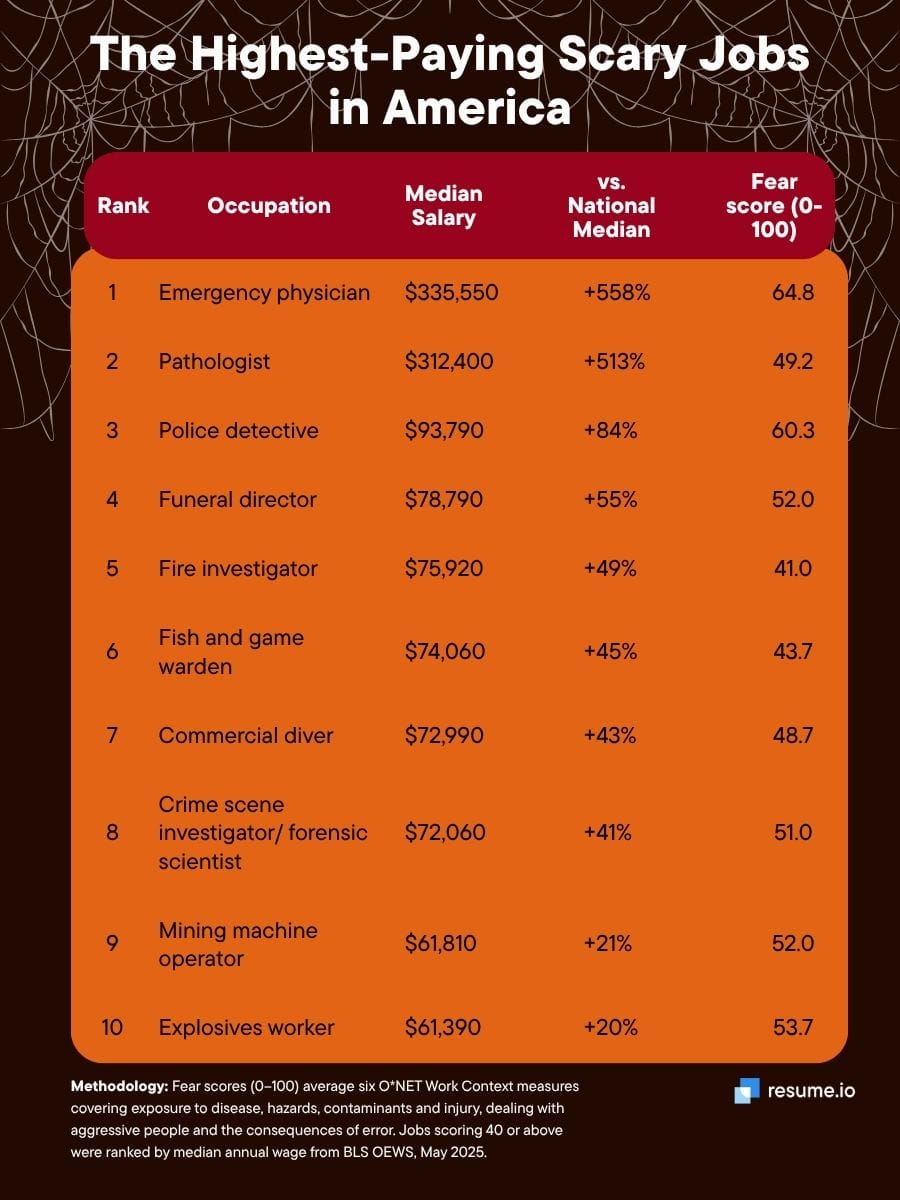
Emergency physicians top the list with a median salary of $335,550, with the top 10% earning a staggering $495,910 or more. They also score a maximum of 100 out of 100 for exposure to disease and infection, and 98 for the consequences of getting something wrong.
Pathologists come second at $312,400, followed by police detectives ($93,790), funeral directors ($78,790) and fire investigators ($75,920). Fish and game wardens ($74,060), commercial divers ($72,990), crime scene investigators ($72,060), mining machine operators ($61,810) and explosives workers ($61,390) complete the top 10.
The death industry also pays better than many might expect. Funeral directors earn 55% more than the typical American worker, and embalmers and morticians also earn above the national median, at $58,780 and $55,010respectively.
Police Detectives Are the Best-Paid Scary Job Outside Medicine, at $93,790 a Year
Outside the hospital, the highest-paying scary work is in investigation. Police detectives earn 84% more than the national median and score 95 out of 100 for the consequences of making an error, the third-highest of any job studied.
Further down the table, the danger becomes more physical. Explosives workers face the most hazardous conditions of any job analyzed, scoring 96 out of 100. Mining machine operators score the maximum of 100 for exposure to contaminants.
America’s Scariest Job Pays 10% Less Than the National Median
Animal control officers have the highest fear score of any job studied, scoring 71.5 out of 100. They face more bites and stings than workers in any other role, along with high exposure to disease and contaminants. Yet they earn just $45,660 a year, 10% below the national median of $50,980. Emergency physicians earn more than seven times as much.
Paramedics are America’s second-scariest job, earning $60,600. Correctional officers deal with physically aggressive people more than any other occupation studied and earn $58,940.
Only three of the scary jobs in the study pay less than the national median: hazardous materials removal workers ($49,450), animal control officers ($45,660) and pest control technicians ($45,250).
Whether it’s a hospital, a crime scene, or the end of a snake catcher’s pole, the data makes one thing clear: fear often comes with a pay premium, but not always.
“What stands out to me is that fear and pay don’t always go hand in hand,” said Amanda Augustine, resident career expert at resume.io and a Certified Professional Career Coach (CPCC). “Some of the scariest and physically demanding jobs in the country pay less than the average American earns, while the highest salaries go to roles that combine risk with years of specialized training.
“That’s why I encourage anyone considering a high-risk profession to look beyond the base salary. Ask about hazard pay and overtime opportunities, but also consider what the employer offers in terms of training, certification support, and career advancement. These factors can make a big difference in your earning potential over time, especially in professions where additional credentials or specialized skills can lead to higher-paying opportunities.
“It’s also worth remembering how valuable these skills are elsewhere. Staying calm under pressure, making high-stakes decisions, and following strict safety procedures are qualities employers look for in almost every industry. If you’veworked in a high-pressure role, make sure your resume includes specific examples that demonstrate how you’ve put those skills to work. Scary jobs build skills that are anything but ordinary.”