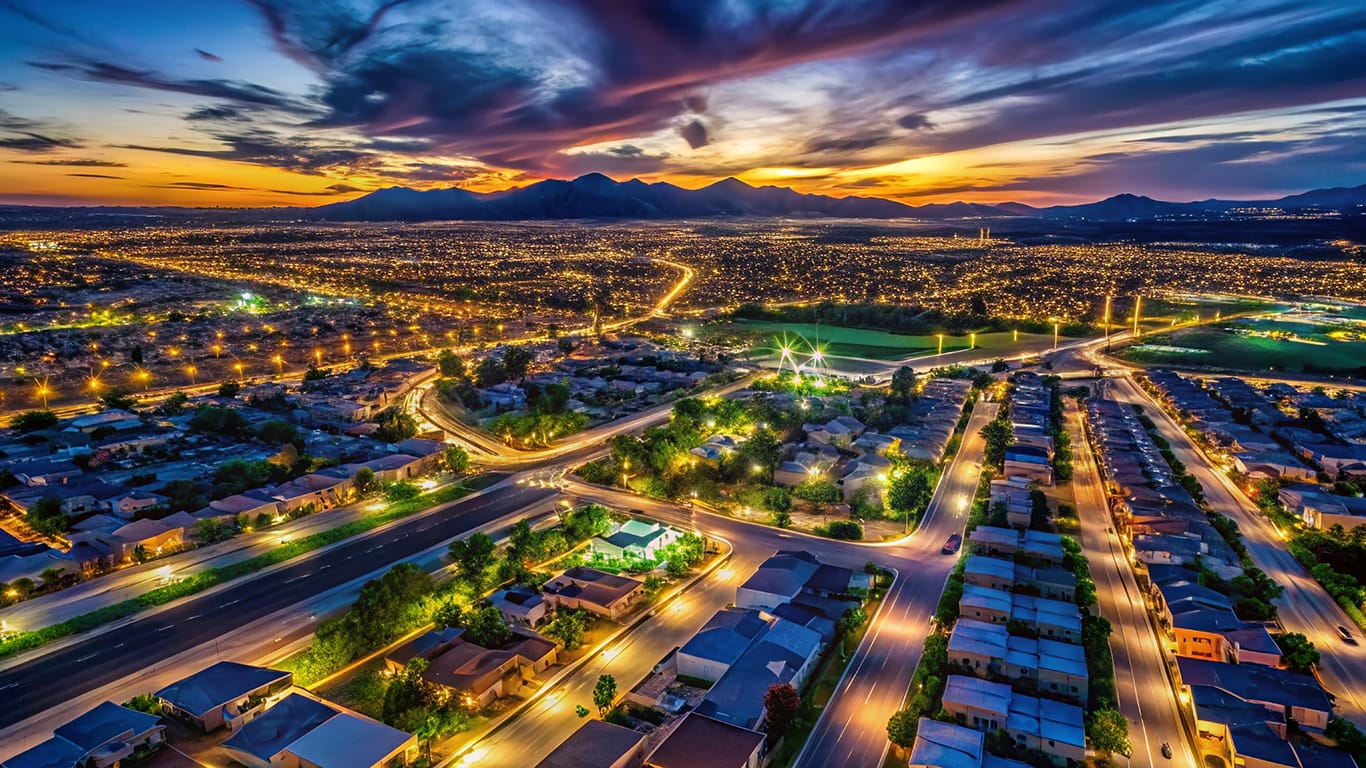
As Arizona attracts new residents and major employers, transportation, energy, and water infrastructure will need to keep pace with development
Drive around metro Phoenix and the signs of growth aren’t hard to find. New housing continues to push outward, major industrial projects are taking shape, and road construction seems to be just about everywhere.
What’s easier to overlook is everything that has to happen behind the scenes to make that growth possible.
Arizona is expected to add more than 2 million residents by 2060, according to projections from the Arizona Office of Economic Opportunity. Maricopa County accounts for a large share of that growth, but development pressures are hardly confined to Phoenix.
More people need more homes, more places to work, and more ways to get around. They also need electricity and water. New development creates wastewater that has to be collected and treated. And large employers can add their own substantial utility demands on top of what population growth is already creating.
Arizona can’t afford to think about those needs one at a time.
Roads Are Only One Piece of the Growth Puzzle
Transportation tends to be the most visible part of infrastructure investment. Everyone notices a new interchange or a highway widening project.
Arizona is spending heavily in that area. The Arizona Department of Transportation’s current five-year construction program includes more than $11 billion in transportation investments, covering highways, bridges and airports across the state.
Those projects matter for obvious reasons. A company considering a new facility needs to move employees, equipment and products. A new subdivision needs roads capable of handling the people who will live there. But being able to reach a site doesn’t necessarily mean the site is ready to develop.
Electricity has become an increasingly important part of that calculation. Arizona Public Service says peak demand on its system could grow from roughly 8,000 megawatts to more than 13,000 MW over the next 14 years.
Some of that comes from new residents. Some comes from the types of businesses Arizona has been working hard to attract.
TSMC is the standout example. The semiconductor manufacturer announced another $100 billion investment in Arizona in July, bringing its planned investment in the state to $265 billion. Projects of that size can reshape a regional economy, but they also show why infrastructure capacity has become part of the site-selection conversation.
Power has to be available not just when a facility opens, but as it expands. The surrounding transportation network has to handle new workers and suppliers. Housing often follows.
And then there’s water.
In Arizona, Water Availability Can Shape Development
Water has always been part of Arizona’s growth story, but the relationship between water and development is becoming harder to separate.
Within the state’s Active Management Areas, Arizona’s Assured Water Supply Program requires certain new development to demonstrate a water supply that will be physically, legally, and continuously available for 100 years.
That requirement can have very practical consequences for where new homes get built.
A recent example came from Pinal County. In March 2026, Arizona Water Company received an Assured Water Supply designation for its Pinal Valley system. The Arizona Department of Water Resources said it was the first such designation in the Pinal Active Management Area in more than two decades and could support more than 80,000 new homes within the service area.
That’s a striking number, but it also illustrates a larger point. Land alone doesn’t create development capacity. A community can have room for thousands of homes, but those homes still need a dependable water supply. The water may need treatment before it reaches customers. Wastewater treatment capacity has to keep up as people move in.
Not Every Infrastructure Problem Needs the Same Answer
Arizona’s fastest-growing areas don’t all start from the same place. An established city may be able to expand existing utility systems, while development farther from current service may face the cost and delay of extending infrastructure to the site.
In those cases, alternatives such as decentralized treatment and water reuse can add capacity closer to where it is needed. Arizona has seen this approach used in residential development before Seven Seas Water Group, for example, provided wastewater treatment infrastructure for Forest Highlands near Flagstaff, adding treatment capacity in phases as the residential community grew.
The larger challenge is matching infrastructure to the location and pace of growth rather than assuming the same approach will work everywhere.
Being Ready for Growth Is Becoming an Advantage of Its Own
Arizona has been remarkably successful at attracting investment.
The next challenge is making sure the state’s infrastructure can keep up with that success.
For communities competing for employers, infrastructure readiness can be just as important as available acreage or a favorable business climate. A company needs to know whether it can get enough power. Developers need to know whether water and wastewater service will be available. Employees need housing and a transportation system that can get them to work without turning every new development into another bottleneck.
Those issues overlap more than they may appear on a capital improvement plan.
A highway project can make new land attractive for development. That development adds electric and water demand. A major employer can bring thousands of jobs, which can lead to more housing nearby. New housing, in turn, creates more traffic and more demand on utilities.
Growth doesn’t arrive one infrastructure category at a time.
Arizona’s population projections suggest the state still has decades of expansion ahead of it. The question isn’t simply whether Arizona can continue attracting residents and employers. It is whether the roads, power systems, and water infrastructure needed to support them can grow at roughly the same pace.
The communities that figure that out will be in a much better position to turn today’s development boom into sustainable growth over the long term.