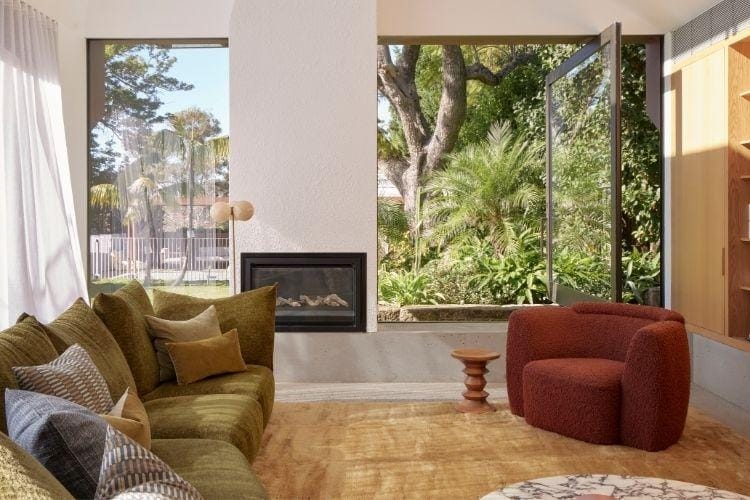
Tile, polished concrete, stone and other hard floors make sense in many Arizona homes. They stand up well to daily traffic and can be easier to maintain than fully carpeted rooms. Against the state’s warm climate and strong desert aesthetic, they can also feel right at home.
There is one potential drawback. A room dominated by hard surfaces can sometimes feel visually cool, acoustically lively or less comfortable underfoot.
Replacing the floor is rarely necessary. Warmth can come from texture, lighting, natural materials, color and thoughtful furniture placement. The goal is to keep the practicality of a hard floor while creating a room that feels more comfortable and settled.
1. Start With a Well-Placed Area Rug
Few additions change the character of hard flooring as quickly as an area rug. It introduces a softer surface while helping furniture feel connected rather than scattered around a large room.
Getting the scale right matters. In a living area, consider a rug large enough to sit beneath at least the front legs of the main sofa and chairs. A dining-room rug needs enough surrounding space for chairs to remain on it when they are pulled away from the table.
Material is another consideration. Homeowners interested in natural fibers might compare wool rugs by Double Studio with cotton, jute and other options before weighing texture, cleaning requirements and suitability for the room.
There is scientific research into wool’s thermal properties, including insulation and thermal conductivity, but that research examines wool as a fiber and textile material rather than proving that every wool household rug provides the same level of thermal performance (Tadesse et al., 2023). Treat material as one part of the decision rather than assuming a particular fiber will solve a cold-floor problem on its own.
According to Double Studio, its current wool collection uses New Zealand wool and includes washable constructions. Those are manufacturer-reported product characteristics rather than independent performance findings.
2. Choose Warm Lighting With Purpose
Lighting can dramatically alter the way a floor and the surrounding furnishings appear. Gray tile beneath bright, cool light may look stark, while warmer illumination can bring out beige, timber, terracotta and other warm tones elsewhere in the room.
Correlated color temperature, or CCT, describes the color appearance of a light source. The U.S. Department of Energy lists 2,700 K as “warm” and 3,000 K as “soft,” with both shown as common options for homes (U.S. Department of Energy, n.d.).
Rather than relying on a single bright ceiling fixture, build several layers of light. A floor lamp can soften a seating area, while table lamps introduce illumination closer to eye level. Wall lights can help with darker corners.
Dimmers also give a room more flexibility. Bright lighting may work well when cleaning or working, but softer lighting can make the same space feel much calmer in the evening.
3. Bring Soft Materials Above Floor Level
Adding an area rug is a useful first move, but it shouldn’t be the room’s only soft surface. Curtains, upholstered chairs, cushions and throws help offset the visual dominance of stone, tile, glass and metal.
They can influence acoustics too. Research by Broda et al. (2025) tested tufted wool carpets together with wool-waste underlays and found differences in sound absorption and transmission loss. The researchers found that adding underlay improved sound absorption at certain medium frequencies.
Those findings shouldn’t be treated as evidence that every wool rug will noticeably improve a room’s acoustics. Carpet construction, backing, thickness and the wider room all matter. The broader design lesson is simply that introducing textile surfaces can be worth considering in rooms where hard materials dominate.
Maintenance deserves attention when selecting those textiles. Double Studio states that its rug system separates into two layers to facilitate cleaning, with care requirements varying according to material. In a busy household, it makes sense to check the manufacturer’s care instructions before choosing any rug or fabric.
4. Introduce Wood and Other Tactile Materials
Warmth isn’t only about color. Contrast between materials can change the character of an entire room.
Timber, rattan, linen, leather, cork and handmade ceramics can sit comfortably alongside stone or concrete because they introduce grain, texture and irregularity. A substantial timber dining table or sideboard may make more impact than filling a room with numerous small decorative pieces.
There is some research suggesting that our response to materials goes beyond appearance. Ikei et al. (2017) compared physiological responses when participants touched uncoated white oak, marble, tile and stainless steel. Touching white oak was associated with lower prefrontal cortex activity and greater parasympathetic nervous activity than some of the comparison materials.
However, the experiment involved only 18 female university students in controlled laboratory conditions. It therefore can’t establish that wooden furniture will make everyone feel more relaxed at home. It is better viewed as interesting evidence that tactile material experiences may play a role in how people respond to interiors.
5. Borrow Color From the Arizona Landscape
Arizona provides a ready-made palette for warming an interior.
Sand, clay, muted terracotta, ochre, warm beige and dusty pink can counter the visual coolness of gray tile or concrete. You don’t need to cover every wall in a desert-inspired shade. A smaller number of repeated tones tends to create a more coherent result.
Try introducing color through artwork, cushions, ceramics or one upholstered chair. Rugs can also provide a large block of color without changing a permanent surface.
Double Studio’s current range, for example, includes both neutral and stronger-colored rugs, according to its online collections. The useful design principle is broader than any single brand: decide whether the rug should quietly connect existing colors or act as a deliberate contrast.
Paint should always be sampled in the actual room. Arizona’s intense daylight can make a color look very different at noon than it does under artificial light after sunset.
6. Divide Large Floors Into Smaller Zones
Open-plan rooms can expose a large amount of uninterrupted flooring. Without clear furniture groupings, that expanse may make a room feel emptier than its square footage suggests.
Create zones around how people actually use the space.
A sofa, pair of chairs, rug and coffee table can establish a conversation area. A dining table creates a second zone, while a console or narrow bookcase can make the transition between spaces clearer without blocking the room.
The shape of a rug can also support the layout. Double Studio currently lists conventional area rugs as well as runners, for example. More generally, long runners suit narrow circulation spaces, while larger rectangular or differently proportioned rugs can help define living and dining areas.
The floor remains visually continuous, but the room itself becomes easier to read.
7. Address Real Thermal Discomfort
Sometimes a floor doesn’t merely look cold. It actually feels uncomfortable.
Thermal comfort is more complicated than the thermostat reading. ASHRAE identifies four environmental factors – temperature, thermal radiation, humidity and air speed – alongside two personal factors: activity and clothing. These interact to influence how comfortable an occupant feels (ASHRAE, 2023).
Hard flooring can also contribute to localized discomfort when its surface temperature is uncomfortable. ASHRAE specifically recognizes contact with a hot or cold floor as a potential source of local thermal discomfort.
If a particular part of the room repeatedly feels chilly, investigate the building before relying entirely on decor. Look for drafts around exterior doors and windows, uneven HVAC distribution or other sources of heat loss. During a renovation, a qualified professional can assess matters such as insulation, glazing and HVAC performance.
For simpler comfort issues, focus soft surfaces where people spend time. A rug beside the bed, beneath a desk or around a sofa may be more useful than covering the entire floor.
Conclusion
Hard flooring and a warm, comfortable interior aren’t mutually exclusive.
The most convincing rooms usually build warmth in layers. A well-sized rug softens the floor. Curtains and upholstery introduce texture. Warm-toned lighting changes the atmosphere after dark, while timber and earthy colors bring contrast to stone, concrete and tile.
It is also worth separating visual warmth from genuine thermal discomfort. Decorating can make a room feel more inviting, but drafts, cold surfaces or HVAC problems need practical solutions.
For Arizona homeowners, that balance can preserve everything that makes hard flooring appealing while creating rooms that feel comfortable, characterful and ready for everyday life.
References
ASHRAE. (2023). ANSI/ASHRAE Standard 55-2023: Thermal environmental conditions for human occupancy. American Society of Heating, Refrigerating and Air-Conditioning Engineers.
Broda, J., Kobiela-Mendrek, K., Bączek, M., & Rom, M. (2025). Acoustic performance of tufted carpets coupled with underlayment produced from tannery wool waste. Materials, 18(2), 315. https://doi.org/10.3390/ma18020315
Ikei, H., Song, C., & Miyazaki, Y. (2017). Physiological effects of touching wood. International Journal of Environmental Research and Public Health, 14(7), 801. https://doi.org/10.3390/ijerph14070801
Tadesse, M. G., Kasaw, E., & Adamu, B. F. (2023). Thermal properties of wool: Thermal degradation studies and fire-retardant properties. In S. Jose, S. Thomas, & G. Basu (Eds.), The wool handbook: Morphology, structure, properties, processing, and applications (pp. 327–340). Woodhead Publishing. https://doi.org/10.1016/B978-0-323-99598-6.00002-5
U.S. Department of Energy. (n.d.). Purchasing energy-efficient light bulbs. Federal Energy Management Program.