
Most businesses don’t lose customers because of bad service. They lose them because a string of unanswered negative reviews sits on Google for months while nobody notices. Google Review Monitoring Tools exist to close exactly that gap, but picking the wrong one means paying for a platform that can’t scale across dozens of locations or flag a fake review before it sticks. After looking at the available options across the market, the tools with the best track records share three traits: automation, multi-location visibility, and fast response workflows. This guide breaks down the top three.
The shortlist methodology
Public information drove every decision here. User ratings, case studies, feature documentation, and listings across reputable directories were all examined before any option made the cut. Only platforms with a demonstrated track record of serving businesses at scale in this space were considered.
→ See the full research breakdown
- Reviewly.ai – Best for multi-location businesses and agencies seeking Google Review management automation
- Repmanager – Best for multi-location review management
- Reputation – Best for enterprise reputation and customer experience management
The Stakes Behind Choosing the Right Google Review Monitoring Tools
Picking the wrong review monitoring platform costs more than a monthly subscription fee. When a business spans dozens or hundreds of locations, a missed negative review at one site can quietly drag down the average star rating across the whole brand before anyone catches it.
The challenge isn’t just volume. It’s speed.
A negative review that goes unanswered for 48 hours is already doing damage, and most generic tools weren’t built with that urgency in mind. The platforms that actually perform in this space give teams a single place to see every location, flag problems fast, and respond without bouncing between tabs.
Businesses that get this right see measurable differences. Review volume grows month-over-month because the follow-up workflows are consistent. Response rates climb because no location is invisible. And over time, the average star rating reflects the actual quality of service, not just whoever happened to leave feedback without a reply.
3 Google Review Monitoring Tools Compared
Note: All data in this table is sourced from review platforms and the official websites of the listed companies.
| Company Name | Years Operating | Headquartered In |
| Reviewly.ai | Est. 2022 | Phoenix, Arizona |
| Repmanager | Est. 2024 | Netherlands |
| Reputation | Est. 2006 | San Ramon, California |
1. Reviewly.ai – Best for Multi-Location Review Management Automation
What Does Reviewly.ai Do?
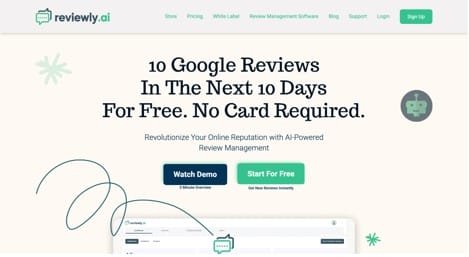
Businesses managing reviews across multiple locations often need more than a simple dashboard. The team behind this Google review management tool built a platform that handles everything from review collection to AI-generated responses, all connected through an SMS-first system that works across more than 100 countries. They capture feedback through QR codes, NFC tags, and physical Review Plates, with CRM connection layered in for teams that need it. Enterprise clients like Jersey Mike’s and JW Marriott are already using it at scale, which says a lot about how the platform holds up under real operational pressure.
Where Does Reviewly.ai Win for Google Review Monitoring Tools?
The platform directly solves one of the hardest problems in multi-location reputation management: getting reviews from customers who never think to leave one on their own, through a proactive SMS system that works globally. That kind of reach combined with AI sentiment detection puts Reviewly.ai in a different tier from simpler monitoring-only tools.
What the Reviews Show:
Reviewly.ai’s enterprise client list does a lot of the talking here. The presence of recognizable names like JW Marriott suggests the platform holds up under high-volume, multi-location conditions. A tool trusted at that level of hospitality and food service is worth taking seriously for any franchise or regional chain.
2. Repmanager – Best for Multi-Location Review Management
What Does Repmanager Do?
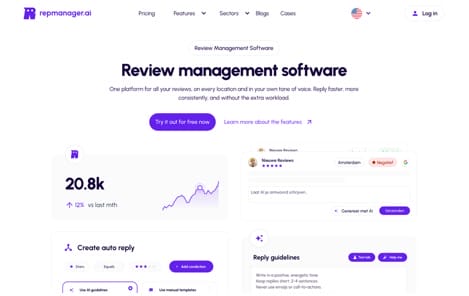
Repmanager is a newer AI-native platform (launched in 2024) built to pull reviews from multiple locations into a single dashboard so teams can monitor feedback, spot sentiment trends, and respond without switching between tools. It targets franchises, retail chains, automotive dealers, and hospitality businesses where local reputation matters daily. Pricing starts at just $10/month with a 7-day free trial, which makes it one of the more accessible entry points in this category (not a throwaway price, but genuinely low for what it does).
Where Does Repmanager Win for Google Review Monitoring Tools?
Repmanager fills a real gap for growing businesses that need multi-location visibility but can’t justify enterprise pricing yet. The no-commitment subscription model and sentiment analysis give smaller teams a solid foundation without overcomplicating the workflow.
What the Reviews Show:
Beta access users rated Repmanager 4.8 out of 5, which is strong for any platform, let alone one still in its early days. Clients in the barber and retail space found the tool genuinely useful for day-to-day reputation tracking, based on what the reviews show. That kind of early user satisfaction is rare for a platform less than two years old.
3. Reputation – Best for Enterprise Reputation and Customer Experience Management
What Does Reputation Do?
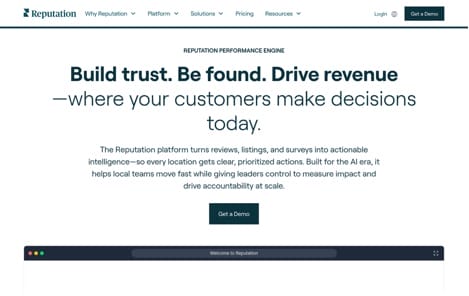
Reputation is a full-scale B2B SaaS platform that goes well beyond review monitoring. It covers online reviews, social media, and customer surveys, pulling all that feedback into one place and helping enterprise teams analyze sentiment and act on operational patterns. The platform serves clients across 77 industries, and names like BMW, Ford, and US Bank are in the client roster. Some clients have reported tripling organic leads and growing review volume by more than 500%, which gives the platform real weight when it comes to proving return on investment.
Where Does Reputation Win for Google Review Monitoring Tools?
Reputation handles the kind of scale that breaks most other tools: hundreds of locations across different brands, regions, and departments, all managed from one platform. Their recognition across 26 G2 report categories and placement in both the Forrester Wave and Gartner’s Magic Quadrant shows this isn’t just a polished product demo (think enterprise pricing and enterprise expectations to match).
What the Reviews Show:
Over 500 Leader Badges on G2 since 2018 is the kind of sustained recognition that’s hard to fake. Enterprise customers rate the platform highly for its breadth of features and the depth of sentiment analysis available. For a business with complex, multi-brand reputation needs, Reputation sits at the top of the category.
Evaluation Criteria and Research Approach
Before any platform made this list, a consistent research process was applied to each one. The goal was to separate tools with real-world performance from those that simply look good on a landing page.
Data Requirements for the Starting Phase
The initial pool of candidates was built from multiple sources: software directories, review aggregators, and published case studies from businesses using review management platforms. Rather than starting with a short list of familiar names, a broader search was conducted first, pulling platforms that appeared repeatedly across independent sources. Each platform that surfaced during this phase was logged and held for further review.
Narrowing the Field: Qualification Check
After the initial pool was assembled, each option was checked for verifiability. Platforms without documented client results, with patterns of suspicious or unverifiable reviews, or with unclear pricing and feature claims were removed from consideration. Special attention was paid to whether feedback across platforms was consistent, since a five-star rating on one directory paired with poor feedback elsewhere tends to tell a more complicated story.
Testing Claims Against Evidence
Once a shortlist was in place, site claims were cross-checked against available third-party evidence. If a platform claimed AI sentiment analysis, published case studies or verified feature documentation needed to back it up. If a company stated it serves enterprise clients, those client names needed to be findable through credible sources. Claims that couldn’t be substantiated through external evidence were noted and factored into the final evaluation.
The Authority Layer
Platforms that appeared in recognized industry publications, earned awards from established analyst firms, or were cited in original research from credible third parties received additional weight during evaluation. Recognition from organizations like Forrester, Gartner, and G2 wasn’t treated as a dealbreaker in either direction, but it added meaningful context about a platform’s standing in the market and how peers and customers perceive it over time.
Google Review Monitoring Tools Case Files
Each platform’s service pages were reviewed for specificity. Vague feature lists without supporting evidence were flagged. Platforms that published detailed case studies, showed verified client results, and maintained dedicated pages explaining how their review monitoring and response tools work scored more favorably here. A case study that names a real client and shows a measurable outcome (review volume growth, faster response times, improved star ratings) carries far more weight than a generic testimonials page.
Finding the Right Google Review Monitoring Tools for Your Needs
No single platform is right for every business. The best pick depends on your current scale, team size, and how complex your review management situation actually is. Here’s what to weigh before committing:
- Industry/Domain Experience: Look for platforms with case studies in your vertical. A tool that’s proven in hospitality or automotive carries more relevance than one with generic testimonials.
- Features and Service: Match the feature set to your actual workflow. If your team needs SMS review collection, AI responses, and CRM connection, make sure all three are genuinely available, not listed as “coming soon.”
- Pricing Structure: Some platforms price per location, others per seat. Know which model scales better for your growth trajectory and avoid locking into annual contracts before testing the platform thoroughly.
- Results Measurement: The best tools make it easy to track review volume growth month-over-month, monitor your average star rating over time, and see response rate data clearly. If a platform buries these metrics, that’s a signal.
- Industry Knowledge and Compliance: Google’s review guidelines change, and platforms that stay current with those shifts protect you from policy issues. Prioritize vendors who actively communicate how their tools stay aligned with Google review guidelines and FTC endorsement rules.
—
Final Words
Choosing the right review monitoring platform comes down to fit, not features alone. Reviewly.ai brings serious automation and multi-location reach for franchises and agencies. Repmanager is a strong, affordable entry point for growing businesses. Reputation handles scale at the enterprise level. The right choice depends on your scale, team, and goals. As more businesses see how directly reviewing performance ties to local search visibility, platforms in this space will only get more capable.